In Memoriam: Robert S. Mueller III
Former FBI director “did everything we asked him to do”
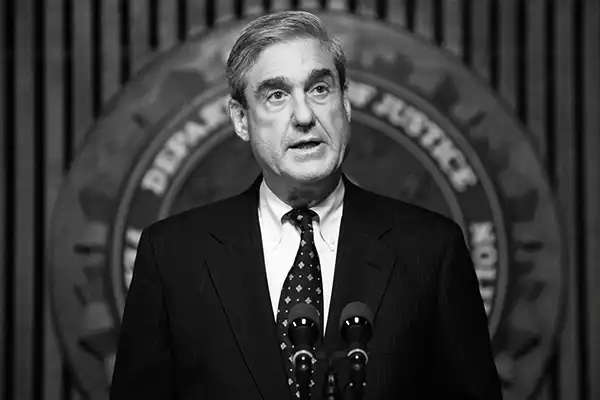
On Dec. 11, 1968, Marine 2nd Lt. Robert Mueller (Law class of ’73), the scion of a wealthy family who volunteered to serve in Vietnam, was leading a rifle platoon in Quang Tri province when it was ambushed by an enemy armed with rocket-propelled grenades, machine guns and mortars.
Under heavy fire, Mueller led a team on a mission to recover a platoon member who had been mortally wounded. Four months later, Mueller was shot through the thigh while leading his platoon to rescue U.S. soldiers under another heavy attack.
Mueller, the former FBI director and special counsel who died March 20 at age 81, returned home with a Bronze Star for valor and a Purple Heart, among other honors. He enrolled at UVA Law in the fall of 1970 with a worldview shaped by his service, he said in 2013.
“I do consider myself fortunate to have survived that tour in Vietnam,” he said, upon receiving the Thomas Jefferson Foundation Medal in law. “There were many who did not, and perhaps because of that I’ve always felt compelled to try to give back a little.”
Mueller spent most of his career in public service, as a federal prosecutor, head of the Criminal Division of the Department of Justice, director of the FBI for 12 years, and, most recently, special counsel in charge of the investigation into Russian interference in the 2016 presidential election.
Mueller took over the FBI a week before the terrorist attacks of Sept. 11, 2001, and was widely credited with revamping and modernizing the agency to focus on counterterrorism.
“National security—that is, preventing terrorist attacks—became our top priority,” he said in his 2013 speech at UVA.
In 2017 the Department of Justice named Mueller special counsel to lead the investigation into Russian meddling in the 2016 election. The probe was politically charged, with President Donald Trump repeatedly calling it a “witch hunt.”
The probe resulted in 34 people being indicted or entering guilty pleas and culminated in the 448-page “Mueller Report.” Regarding Trump, Muller wrote that “while this report does not conclude that the President committed a crime, it also does not exonerate him.”
The sense of duty that characterized Mueller’s life and career extended to his relationship with UVA, said classmate and former Law School Dean John Jeffries (Law class of ’73).
“He did everything we asked him to do,” Jeffries said. “Every time we asked him to show up and participate, he did.”
Mueller gave the commencement address at the Law School graduation in 2003. Rain forced the ceremony into Memorial Gym, where the acoustics were less than ideal, Jeffries recalled. Afterward, Mueller shook the hand of every graduate as they left the stage.
“Director Mueller’s graciousness and warm interactions with the graduates made what could have been a dreary event an uplifting one,” then-Law School Dean Paul Mahoney said in 2013.
Mueller in 2013 talked of the warm reception he received at UVA, at a time when some other law schools were not as welcoming to Vietnam vets, he said.
“The university was looking for a range of experiences, understanding that a true legal education is an amalgam of the law and of values with the goal of preparing its students for service—service to the country, service to Virginia and service to others,” he said.
Mueller met and became friends with classmates who had opposed the war, he said. He also connected with fellow veterans, such as Cameron Smith (Law class of ’73), who also served in the Marines.
Smith said he followed Mueller’s career and was not surprised that he was known for his integrity and service.
“The character that he had, the sense of duty and honesty, was very much apparent during our years in law school,” Smith said.
Mueller, who had retired to Charlottesville in recent years, is survived by his wife, Ann; two daughters; and five grandchildren.
—Ed Miller