UVA’s own ‘red scare’
When a professor became an accuser
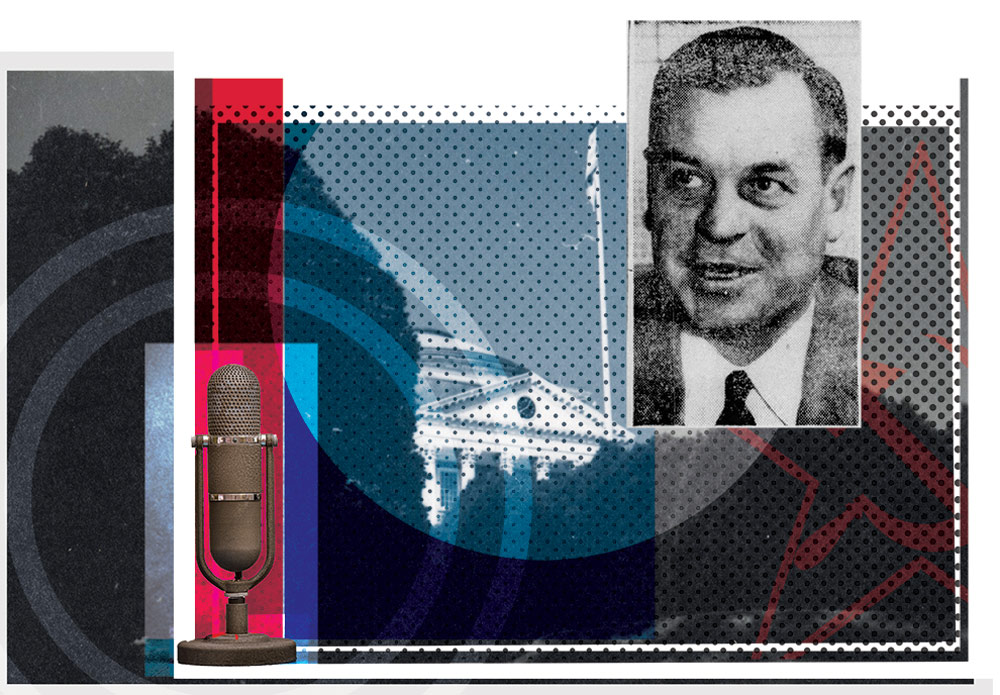
During the era of McCarthyism, when allegations of being a communist or a sympathizer could ruin careers and reputations, UVA had its own accuser, an assistant professor in the Woodrow Wilson School of Foreign Affairs named Homer G. Richey (Col 1929, Grad 1930).
In 1951, Richey publicly alleged that several of his colleagues at the school exhibited “shades of redness.” The resulting controversy lasted several months and set off a vigorous debate on academic freedom and the use of terms such as “red” and “pink” as attacks against faculty members.
Richey leveled his accusations in the pages of the Cavalier Daily and then took them to Gov. John S. Battle (Law 1913), UVA president Colgate Darden (Col 1922) and the Board of Visitors—as well as the local airwaves, as a fiery radio host on Charlottesville’s WCHV. His correspondence on the topic fills a box at Special Collections.
“There are not many around now who will recall the events of those days, but at the time they created something of a stir,” Richey wrote when he donated his papers in 1988.
Similar scenes played out on campuses across the nation in the early 1950s, when Wisconsin Sen. Joseph McCarthy launched a series of hearings into alleged communist infiltration in the U.S. government. The Foundation for Individual Rights and Expression estimates that about 100 college professors were fired for “real or imagined” communist sympathies from 1947 to 1957, while the American Association of University Professors says the figure is at least 100.
At UVA, however, that script was flipped. Three years before McCarthy got his comeuppance, Darden fired Richey. The Board of Visitors had found that Richey’s charges were baseless.
“The manner in which you have attempted to rouse the passions of people already troubled and apprehensive over communism against your colleagues, the School, over to our part, and the University under whose control it functions, is unworthy of one holding your position,” Darden wrote him.
Unlike elsewhere, the episode was “the Red Scare that failed,” says Jonathan Michaels, an adjunct professor of history at the University of Connecticut who wrote a chapter about Richey and UVA in The Liberal Dilemma: The Pragmatic Tradition in the Age of McCarthyism.
Richey’s controversy began in April 1951, when the Cavalier Daily reprinted an editorial from the Richmond Times-Dispatch that asserted that some universities, which it didn’t name, had become “notorious as hotbeds of Marxism.”
Alongside that editorial, the student paper ran a response from Allen Moger, a professor of history at Washington and Lee University. Moger warned of the tendency to use labels such as “red” and “pink” recklessly.
In a “conscious decision to invite a little controversy,” Michaels wrote in his book, the Cavalier Daily encouraged readers to comment.
Richey didn’t need to be asked twice. A well-known local conservative firebrand, he’d taught at the Wilson School since its founding in 1946 and hosted a weekly radio show.
“The writer herewith ASSERTS and REAFFIRMS what he has said on many occasions and to many people … that the complexion of the School is DEFINITELY PINK if not a DARK HUED RED.”
He took issue with Moger’s assertion that there were no communist sympathizers in Virginia schools, saying he knew of three in his own department whose opinions and actions showed a degree of “redness” through such things as advocating for appeasement of Russia, U.S. recognition of communist China and public ownership of private property.
Responses to his letter poured in, many using pen names. One writer, “Cerebrus,” wrote that Richey’s attack on the school was more personal than political and that by taking his charges to the airwaves, Richey had stepped outside the realm of academia and forfeited “the protective mantle that properly belongs to those who teach.”
“He is a legitimate target for attack,” Cerebrus wrote.
In fact, Richey did have an ax to grind: He was passed over for promotion in 1950 by John Gange, the former diplomat who headed the Wilson School.
In a letter to Darden with the subject line “Promotions in WW School of Foreign Affairs,” Gange recommended that two assistant professors be promoted to associate professor but that Richey not be. Gange said Richey was a “controversial figure toward whom there were strong reactions, both favorable and unfavorable,” with the latter outweighing the former. Gange wrote that he’d tried to keep an open mind but that Richey lacked the credentials to be appointed an associate professor.
“He has not published research that I can discover, although he has written letters and verse to local newspapers on aspects of domestic U.S. politics, and a few book reviews,” Gange wrote in the letter, contained in Richey’s papers. “He has submitted articles to various journals but none have been accepted.”
Richey’s background was in Germanic languages and philosophy. He received a doctorate in philosophy from a German university in 1935 and taught German at UVA before World War II. He was in the U.S. Army when Hardy Dillard (Law 1927), a law professor who was acting as head of the Wilson School—and who knew Richey when they’d worked together at the School of Military Government in Charlottesville during the war—appointed him an assistant professor in 1946.
Gange came along in 1949, looking to make permanent appointments at the growing school. After he’d made his promotion decisions, he told Richey that his political views had nothing to do with him being passed over. Richey agreed to stay on as an assistant professor for another two years.
He wasn’t happy about the arrangement, though. Richey’s radio broadcasts became “quite aggressive in tone,” Michaels wrote, with attacks on President Harry Truman and Secretary of State Dean Acheson, to the point that Gange requested that Richey make it clear he was speaking for himself and not the Wilson School.
Richey complied with that request in a broadcast in February 1951, according to his papers.
“Anyone who has ever heard the Woodrow Wilson School talk and been able to stay awake that long should be under no delusions whatsoever about my views bearing any similarity to his—beg pardon, I mean ‘its,’” he said on air. “I would be mortified if any should think I were guilty of peddling that pink’s party line.”
Richey had already sent a letter to Gov. Battle saying he’d been denied promotion for his political views. After Gange complained to Richey about the tone of his radio disclaimer, Richey fired off a letter to Darden.
“The writer herewith ASSERTS and REAFFIRMS what he has said on many occasions and to many people, both privately and publicly, that the complexion of the School is DEFINITELY PINK if not a DARK HUED RED.”
A committee was raised to look into Richey’s allegations. Headed by Dean of the University Ivey Lewis, it held seven hearings. It found no evidence that the school was “pink” and backed Gange’s decision not to promote Richey.
Unsatisfied, Richey petitioned the Board of Visitors, asking for a full professorship and that Gange be fired. The board held hearings over a five-month period, taking testimony from Gange, Richey and two other professors at the school.
Gange told the BOV that he was as aware as Richey of the “communist danger.” He added, “I also believe that nothing can so cripple this country and benefit the communists as the creation of a state of hysterical fear.”
In the end, the BOV found no evidence justifying Richey’s charges. Three days later, Darden fired him.
“It is my own belief that you have accused our colleagues wrongly and that you have done them a grave injustice,” he wrote.
The Cavalier Daily, which Richey had threatened to sue if it didn’t reveal the identity of “Cerebrus,” a demand the paper refused, couldn’t help but gloat. In an editorial, the paper bade farewell to “Hopalong Homer,” “the local apostle of McCarthyism.”
“We feel he is a disgrace to Virginia, to the men and women of this institution, and to all standards of tolerance or fair play,” it added.
After his firing, Richey responded by saying he wouldn’t retract “one iota” of his charges. And he hadn’t changed his mind by the time he donated his papers to UVA 37 years later.
“I am only sorry that I did not have more ammunition to use against this crowd of Parlor pinks, crypto-liberals and out and out reds,” he wrote.
Richey ran for Congress unsuccessfully in 1952 and died in 1997, a tireless letter writer until the end. An editorial in The Daily Progress noted his passing.
“Mr. Richey’s voice of brash dissent has now been silenced,” it said. “Charlottesville will be the poorer without his colorful, audacious commentary.”