UVA had its own boy in the boat
“Unusual,” “crusty” rower brought home gold 60 years ago
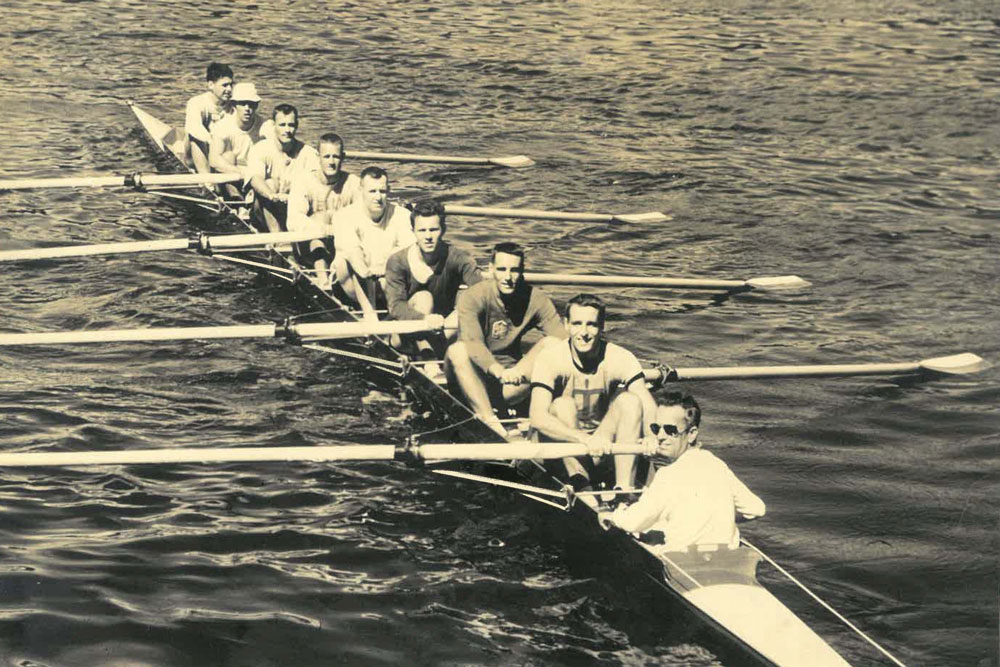
Three decades after the fuzzy-cheeked University of Washington rowers depicted in the movie The Boys in the Boat won Olympic gold in 1936, an underdog crew of a different sort showed up at the Tokyo Olympics in 1964.
Sports Illustrated called the eight-man crew from the Vesper Boat Club in Philadelphia a “crusty bunch of adults.” The New York Times termed them “an unusual crew.” The Philadelphia Inquirer, in a piece marking the team’s 50th anniversary, went with “motley” and “ragtag.”
In the middle of this unlikely bunch, the number four position on the eight-man boat, sat 29-year-old Army Lt. Tom Amlong (Educ class of ’61). When the Vesper crew crossed the finish line one-and-a-half lengths ahead of the favored West Germans on Oct. 15, 1964, Amlong, an Army brat whose parents settled in Alexandria, Virginia, became the first UVA grad to win an Olympic gold medal in any sport.
UVA athletes had been competing in the games for 56 years by then, since James Rector (Law 1909) took second in the 100-meter dash in the 1908 London Olympics (Virginia Magazine, Fall 2021). Heading into the 2024 games, UVA athletes had racked up 17 gold medals. (See how UVA’s athletes performed in Paris.)
Amlong, who died in 2009 at age 73, is believed to be the first from UVA to climb atop the medal stand. Though he’s not a familiar name in the University’s athletic lore, it’s doubtful any other Wahoo left a bigger wake of mixed feelings among his Olympic teammates.
The Vesper team was indeed an anomaly. With an average age of 26, its members were older than the collegiate eights that had dominated U.S. rowing for 60 years. Four of the members were military officers. A fifth rower was a 34-year-old sheet metal contractor and father of six. Just three had rowed in college.
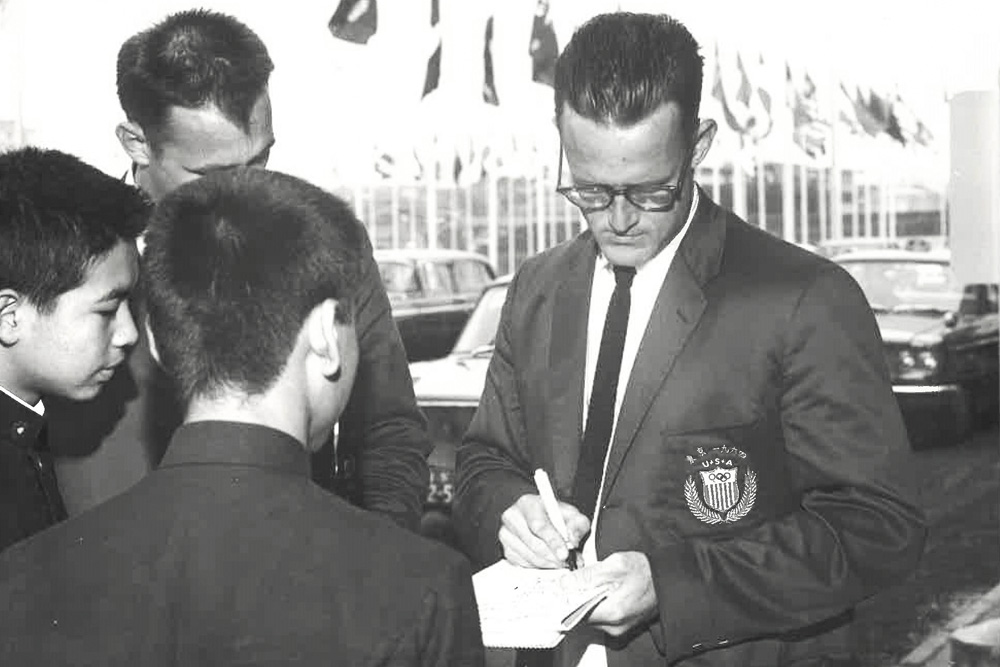
Into the mix came Amlong and his brother Joe, who rowed at the bow of the boat. They were by all accounts master rowers, powerful and technically advanced. They were also abrasive—arrogant, loud and brash roughnecks who seemed to delight in tormenting their teammates, especially three who held Ivy League degrees and whom they judged to be insufficiently rugged.
“Joe and Tom, oarsmen of note, were hardly nice guys and they made little attempt to be nice guys,” teammate William A. “Bill” Stowe, a Cornell graduate, wrote in his book All Together, an account of the 1964 team.
“Antagonistic and contemptuous of everyone, including each other, they were legendary for their lack of tact,” teammate Emory Clark wrote in his book Olympic Odyssey.
In a vote of the other six team members, Tom, older by 18 months, was chosen as the “more obnoxious” of the brothers, Stowe wrote. He avoided both “like the plague.”
And yet Clark also said he found them hard not to like. And far better to have as teammates than as competitors. “Sometimes Tom, in particular, made an effort to be nasty—it being his theory that you would row harder if you were angry and upset. “But the most important attribute of the Amlongs was they were terrific oarsmen and very, very fast in a straight pair.”
Tom Amlong’s path to UVA was anything but straight. Born in Fort Knox, Kentucky, in 1935, he was the third son of Army Col. Ransom Amlong and his wife, Marguerite. One of six children, he grew up in a rough-and-tumble household, says his daughter, Karen Lee.
Ransom Amlong was stationed in the Philippines during World War II. While her husband was deployed, Marguerite took the kids to an Iowa farm to be with family. The boys were on their own quite a bit, Lee says.
“They were tough military kids.”
Tom Amlong learned to row after the war, when his father was stationed in Belgium. He and Joe competed as a pair. They were faster than nearly everyone but didn’t always win, their sibling rivalry sometimes getting the best of them.
Clark wrote that Tom, angry with his brother for some reason, would sometimes stop rowing and turn around and hit Joe, who “quite naturally would falter in his stroke.”
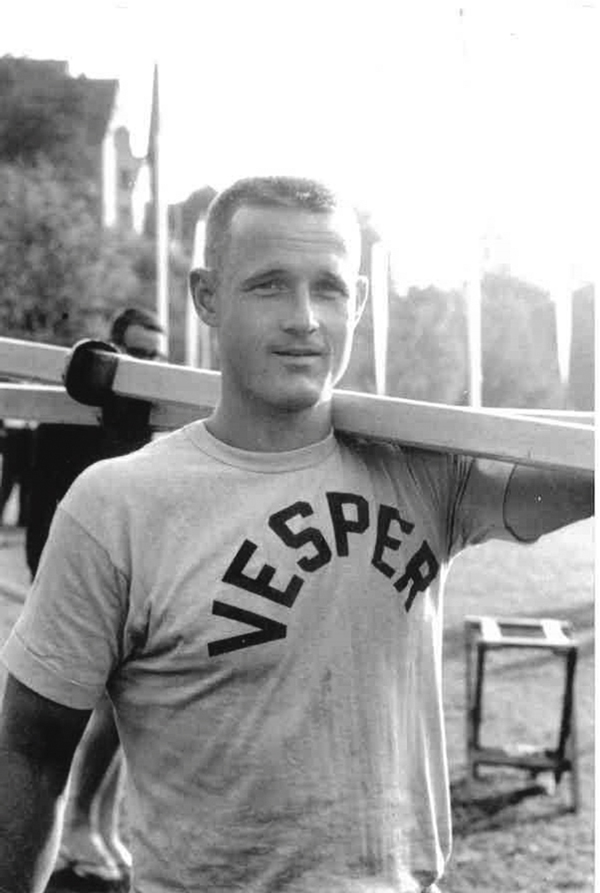
Still, the Amlongs were undeniably talented. In 1954, they enlisted in the Army, joining the 82nd Airborne Division. Accepted into a program that allowed potential Olympic athletes to train, they set their sights on the 1956 games in Melbourne, Australia.
Beaten in the Olympic trials, they split up for the first time. Tom Amlong headed to the University of Maryland for a year and then transferred to UVA. Joe landed at the U.S. Military Academy.
Already 22 by the time he arrived on Grounds, Tom was not a traditional student. He enrolled first in the School of Engineering, then pivoted to the School of Education, with plans of becoming a math teacher. His bio in the 1961 Corks & Curls notes that he was a member of the Newman Club, a Catholic organization; and ROTC.
There’s no mention of rowing. It had been the first intercollegiate sport at UVA, competing with great success from 1877 to 1883 before disbanding. It wouldn’t resume as a formal activity until 1967.
With no team to row for, Amlong worked out on his own, packing on muscle and building stamina. Even though he wasn’t competing, his time at UVA served him well.
“He loved the school,” Lee says. Her father displayed his diploma in his office and told tales of School of Engineering legend “Dean Jean” Holliday, a 43-year administrative assistant who ran the department and was beloved by students.
Amlong taught high school for a year, before answering the call of military life again and re-enlisting in the Army.
Tom and Joe reunited once again on the water, and according to Boathouse Row, a history of rowing in Philadelphia, were recruited to Vesper by Jack Kelly, an accomplished rower who was the brother of Grace Kelly, the Hollywood actor who became Princess of Monaco.
Kelly’s motivation was to return U.S. rowing to its proper place in the Olympic pantheon. After winning eight straight Olympics from 1920 to 1956, the U.S. had finished fifth in 1960.
Kelly assembled a nontraditional team coached by Al Rosenberg, on leave from the city attorney’s office in Philadelphia.
The Amlongs, who at 6-foot-1 each were short for rowers but heavily muscled, brought power to the shell and competitive tension to the locker room.
Was it real or manufactured? Lee says she doesn’t recognize the man portrayed in the books written by Stowe and Clark. She believes her father, who had mellowed considerably by the time she and her two sisters came along, was driven by a desire to win and fabricated a rivalry with the Ivy Leaguers to bring out the best in them.
“They definitely played up that they were tough military kids, and they loved poking fun at these prep school, Ivy League kids,” she says. “They were obsessed, right? They wanted to win. It was no holds barred.”
Stowe, who died in 2016, allowed that the Amlongs were “fierce competitors, as strong of body as they were bull-headed of mind, dedicated to whatever cause they stumbled upon.” He interviewed Tom Amlong for his book and was told by his former antagonizer that he acted the way he did to bring out the best in his teammates. Amlong asked for understanding but offered no apology, Stowe wrote.
“They were obsessed, right? They wanted to win. It was no holds barred.”
Despite the tension—or because of it—the chemistry in the boat proved to be just right. Vesper upset favored Harvard in the U.S. trials before reclaiming U.S. hegemony in the Tokyo games.
Tom Amlong retired from elite-level rowing after the games. He did a tour in Vietnam in 1968. After retiring as a military officer, he moved to Old Lyme, Connecticut, where he coached rowing and remained in top shape by running and competing in rowing events, his daughter says. He died of mantle cell lymphoma, a cancer that the Department of Veterans Affairs determined is likely caused by exposure to Agent Orange, used by the military during the Vietnam War.
Lee says her father didn’t brag about being a gold medalist. He reminisced, though, about the surreal experience of crossing the finish line. The race was the last of the day, and with darkness falling, organizers illuminated the course with vehicle headlights and fireworks. Flares parachuted slowly from the night sky as the Vesper rowers received their medals.
It was like something out of a movie. The U.S. would not win the event again for 40 years.