Tinker, Tale-Teller, Soldier, Seven
Remembering the life of Alexander G. “Sandy” Gilliam Jr.
The black, cloth Seven Society banner on display in the church vestibule looked remarkably good for its age, only a little rumpled, and, oh, the stories it could tell. Those qualities made the tribute all the more fitting for the person being remembered in the sanctuary just beyond, Alexander G. “Sandy” Gilliam Jr. (Col class of ’55), who died June 8 at age 91.

He was a man of many talents and job titles, who always seemed to find himself near the seat of power. He was the Board of Visitors whisperer, the body’s secretary for 18 years. He served as special assistant to a decades-long succession of University of Virginia presidents. In a prior life, he served as an aide to overseas ambassadors, to the U.S. secretary of state and to a Virginia governor.
It was Gilliam who deftly maneuvered Queen Elizabeth II and Prince Philip through their paces when they came for lunch in a newly restored Rotunda in 1976. He arranged for butcher paper to cover the dome’s oculus, lest the midday sunbeam cause Her Majesty to squint. Gilliam had spent weeks with a stopwatch rehearsing every beat of the royal visit and then, after a job well done, clocked 20 minutes in a cold shower with a whiskey and soda.
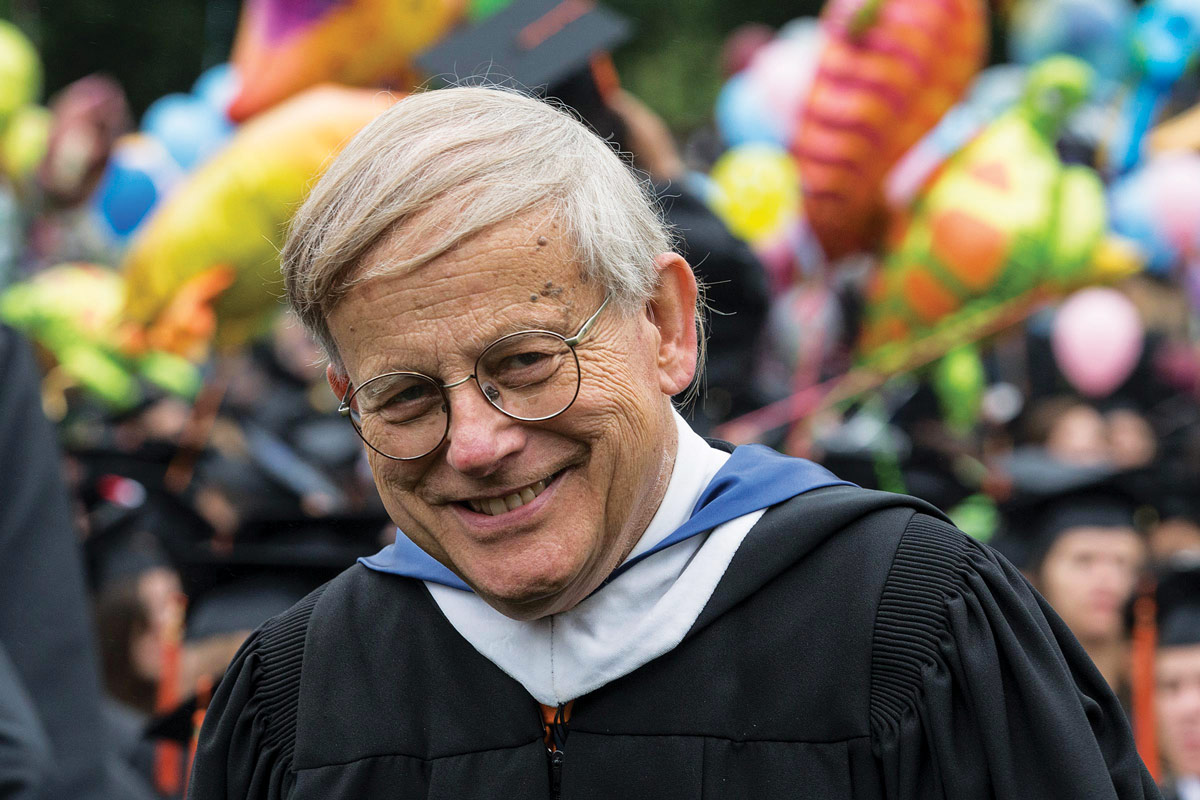
He was the Board of Visitors whisperer, special assistant to several UVA presidents and, in a prior life, member of the Foreign Service.
“He was Mr. Protocol. You always go to Sandy,” says Gordon C. Burris (Educ class of ’67), who worked with Gilliam over the years in his own variety of UVA roles with athletics, the Alumni Association and fundraising. “The whole thing with Sandy was his instinct for the University of Virginia.”
It was in his blood. “Gilliams have been coming here since 1829,” he said of his alumni pedigree in a 2012 oral history that encompassed multiple sessions, a medley of well-told anecdotes and a nearly 200-page transcript. Born in Baltimore and raised in Washington, D.C., Gilliam spent summers during World War II in Charlottesville visiting his maternal grandparents. He remembered as a child running up and down the circular staircases of the two-story Stanford White Rotunda Dome Room, formerly the library stacks.
He embodied the Old U and dressed the part in khakis and Bass Weejuns. Gilliam was often this publication’s first call for a backgrounder on UVA history. It always repaid the investment. With uncanny accuracy and a wry Virginia drawl, he would avoid the highways and take you along the most scenic route to an answer.
Gilliam came to UVA in 1951 hoping to become a renowned physician like his father. After a close brush with organic chemistry, he converted to a history major. He thrived, and he fully immersed himself in UVA life. He became a lifelong loyal Beta Theta Pi fraternity brother, lived on the Lawn, helped edit Corks & Curls and joined the Jefferson Literary and Debating Society. He answered the tap of the T.I.L.K.A. ribbon society and the summons of the Sevens.
Gilliam returned to UVA for graduate work in history after two years as a conscript in the U.S. Army Counter Intelligence Corps. The oral history includes a Cold War story of his reconnoitering East German bad guys from a park outside Frankfurt. With a buttoned-up trench coat concealing the .45 in his shoulder holster, he hid in the bushes, only to be found out by young lovers looking for some cover of their own amid the shrubbery.
Back on Grounds—“the Grounds,” he twice corrected his oral history interlocutor, “always with a definite article”—Gilliam felt the strong pull of the social life he knew too well. “I just could never quite decide whether I was a graduate student or an undergraduate,” he said. “I did all my coursework for my master’s, but I didn’t get the thesis written and I left.”
While teaching history at St. Christopher’s School in Richmond, Gilliam resolved to join the Foreign Service. He served two years in Tel Aviv, where he developed a fascination with the Mideast, and three in Chad, where he developed coping skills for the dysfunction of what he described as “a very unhappy embassy.”
Stateside in the mid-1960s, he synthesized dispatches from the field into twice-daily reports for his boss, Secretary of State Dean Rusk. Gilliam capped his diplomatic career with three beloved years in Beirut.
In 1971, he joined the staff of Gov. A. Linwood Holton, a progressive Republican. Gilliam managed correspondence and other incoming and rose to troubleshooting generalist. He worked alongside fellow Wahoo Staige Davis Blackford (Col class of ’52), the governor’s press secretary, who returned to Charlottesville to become assistant to the UVA president. When Blackford transitioned to his legendary editorship of the Virginia Quarterly Review, he put Gilliam up to succeed him.
Gilliam arrived in 1975 to assist newly installed president Frank L. Hereford Jr. (Col class of ’43, Grad class of ’47). It was for Hereford that Gilliam orchestrated the royal Rotunda visit and with whom he said he had a particularly close relationship.
A go-to source on UVA history, he would avoid the highways and take you along the most scenic route to an answer.
He found less joy during the relatively short presidency of Hereford’s successor, Robert M. O’Neil. Gilliam’s firefighting included jumping in as interim dean of international studies. Later, he got a battlefield promotion to interim vice president for development.
“Geez, for how long?” he asked, recalling the response: “Well, long enough to find a real vice president.”
Amid the tumult and endless impaneling of task forces, Gilliam momentarily entertained an invitation to put in for U.S. ambassador to Chad. In a cover letter accompanying his revisions to the oral history transcript, he wrote, “I am stymied on exactly how to handle the O’Neil years.”
Early in the presidency of John T. Casteen III (Col class of ’65, Grad class of ’66, class of ’70), Gilliam’s portfolio expanded to include secretary to the Board of Visitors. Throughout his board work, he tried to stay at the center of the action, not letting the position devolve to something merely administrative. He had mixed success. “During my time, it was sort of off and on, depending on the rector, depending on the situation,” he said.
There was no equivocation in the standing ovation the board gave its long-serving attaché upon his retirement in 2009. As UVA spokeswoman Carol S. Wood reported at that time, “Asked to say something in response, Gilliam—who is seldom at a loss for words—replied simply: ‘It’s been fun.’”
And it had. “I don’t think he would describe it as work,” John B. Gilliam said of his father’s University career. In his eulogy at St. Paul’s Memorial Church on the Corner in late June, he said Sandy Gilliam practiced what he preached: “Do what you love; love what you do.”
In retirement, the man of many titles took on two more: protocol officer, to oversee the visits of heads of state and other dignitaries, and history officer, to curate and write University history. He stayed busy until his health declined over the last 18 months of his life.
“I tell people that this place just doesn’t seem to be as colorful as it used to be. The faculty is less eccentric than it used to be,” Gilliam said at the end of his recorded memoir. To which, he said, a fraternity brother replied: “Well, I’m delighted to see that you’re trying to carry on the tradition.”
In addition to his son John, survivors include his wife of 51 years Katharine Scott Gilliam (Grad class of ’66), son Alexander G. Gilliam III (Arch class of ’97) and five grandchildren.