Seeing the Chapel in a new light
After a $2.5 million renovation, everything is illuminated
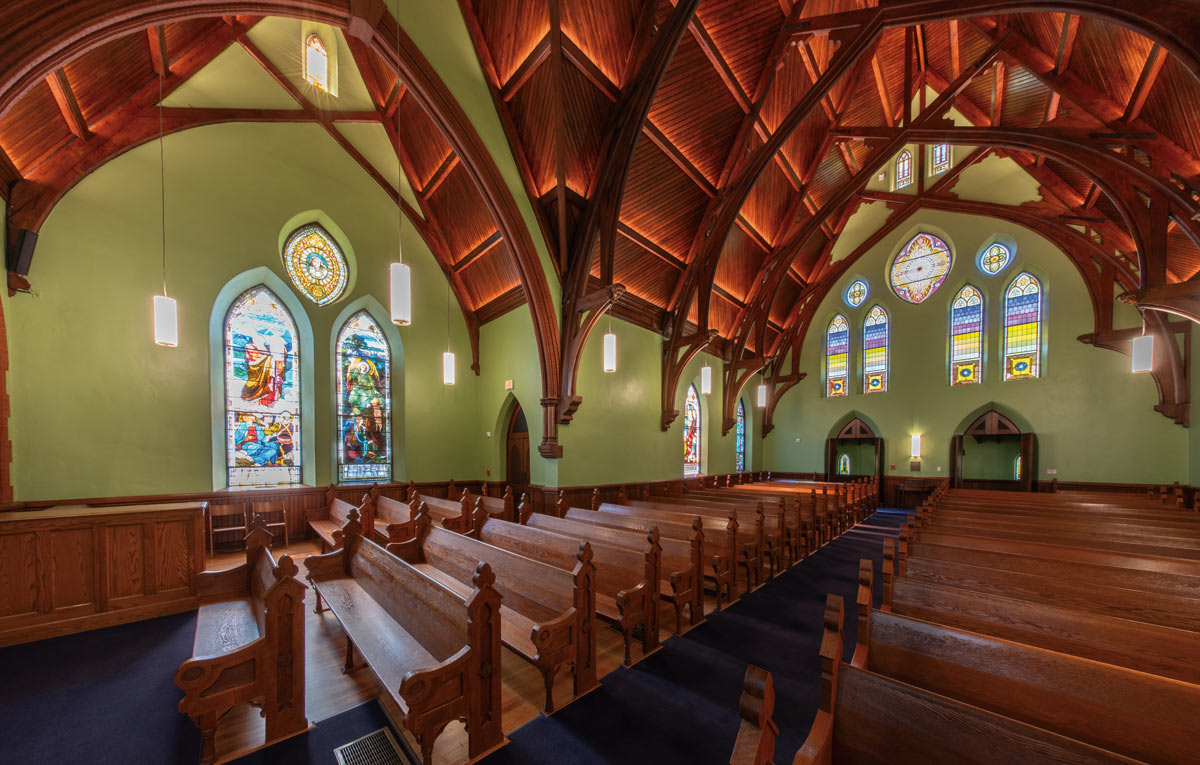
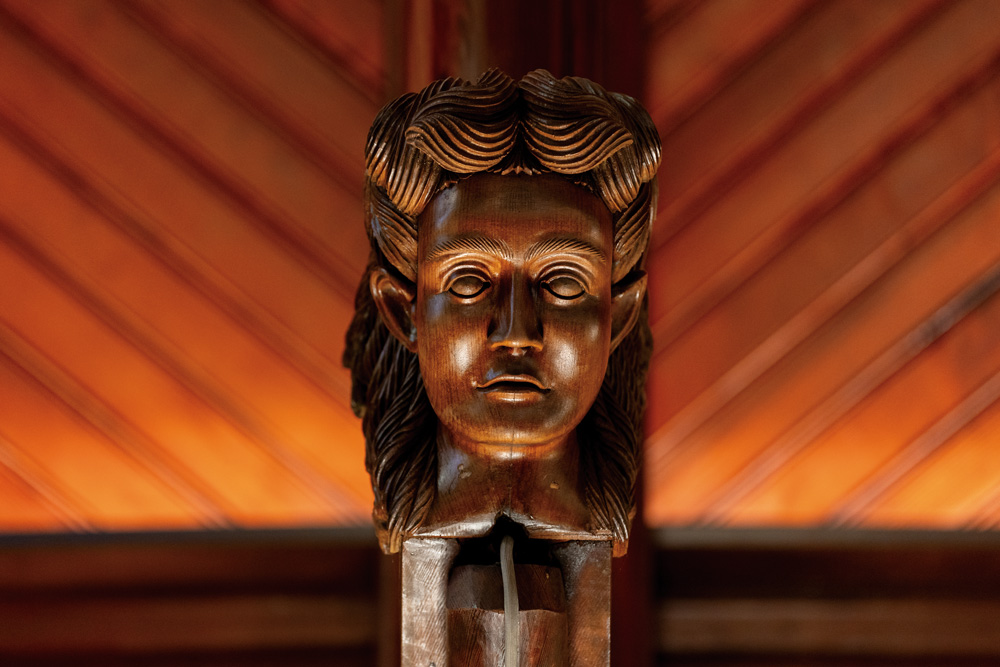
Gaze heavenward inside the renovated University Chapel and you will see the light. It emanates from newly installed LED strips along the support beams and from new fixtures hanging from the carved figureheads on exposed wooden trusses.
Together they reveal the restored beauty of the 134-year-old icon’s vaulted ceiling, a stark contrast to the dark aesthetic that prevailed for decades.
The ceiling was almost black before, says Brian Hogg (Col class of ’83), senior historic preservation planner with the Office of the Architect.
The walls were painted a drab mauve. Darkened wood finishes and poor lighting led to complaints that it was hard to read in the building, Hogg says.
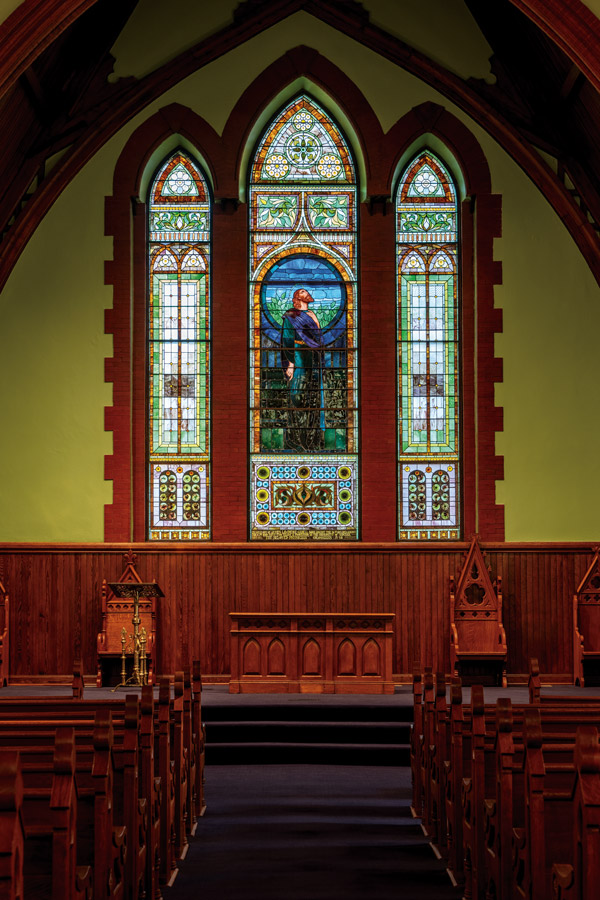
No longer. After a 13-month rehab, the first major makeover of the interior since the 1950s, the Chapel has been lightened and brightened. Craftspeople refinished every piece of wood, liberated the original pine floor from beneath worn cork tile, painted the Chapel’s walls a vibrant green, and upgraded the sound system. In March, with the push of a button, the Chapel’s 127-year-old bell tolled for the first time in 40 years.
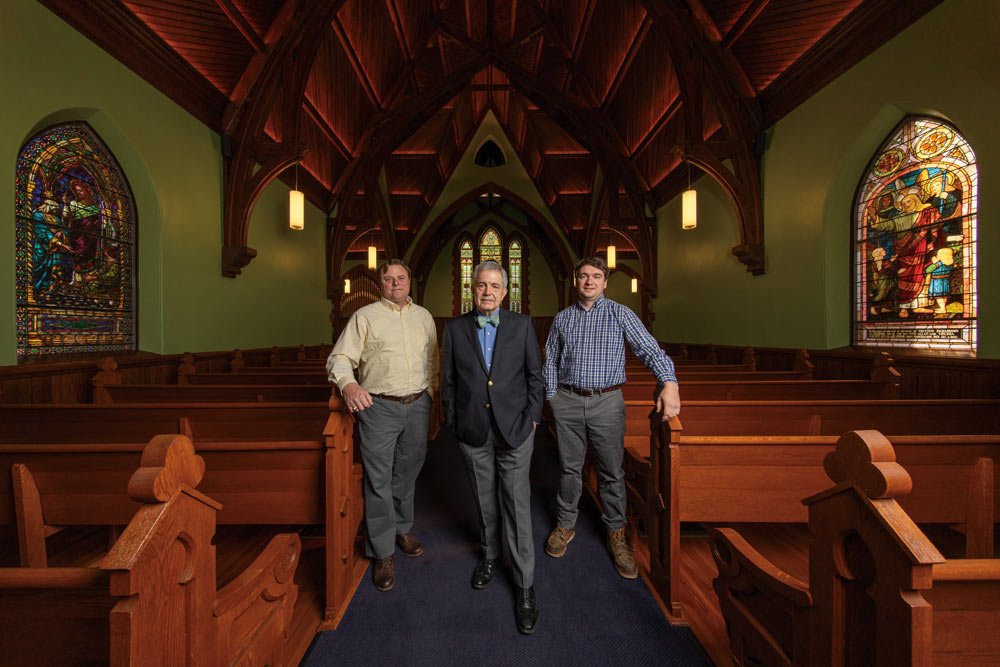
A venue that hosts more than 350 events a year—from weddings and memorial services to concerts, dramatic performances and student-group meetings—came back online during the spring semester. The $2.5 million project was a collaboration between outside conservators and lighting designers and the University of Virginia’s deep cadre of skilled tradespeople: masons, plasterers, carpenters and electricians.
“We’re deservedly very proud of that,” Hogg says, “that so much of the work we’re able to do on historic buildings is done in-house.”
In the case of the Chapel, it’s a rare opportunity to leave a lasting mark, says James Zehmer (Arch class of ’02), a historic preservation manager for UVA’s Facilities Management division. Other than routine maintenance, the building has been left largely untouched for much of its history.
“About every 70 to 75 years we get our hands on the place,” Zehmer says.
Since 1890, the Chapel has stood as something of an outlier, architecturally and philosophically, from the neighboring buildings of Thomas Jefferson’s Academical Village.
Its Gothic Revival style is a deliberate departure from Jefferson’s neoclassicism. The use of natural stone in its construction contrasts with the red brick and white trim found elsewhere. As with nearby Brooks Hall, a Second French Empire conversation piece completed in 1877, it drew criticism for not being “in harmony with the style of the remaining buildings,” historian Philip Alexander Bruce (Col 1879) wrote in History of the University of Virginia: 1819–1919.
“This is in a lot of ways a little English country church,” Hogg says. “That’s kind of what it was evoking in its design.”
Then of course there’s the fact that a chapel was built at all, 71 years after the founding of the University and 64 after the death of Jefferson. Its presence “throws into relief” Jefferson’s wariness of religion’s influence in public education, according to the “Master Plan for Historic Buildings on Campus” a supporting document for the “Historic Preservation Framework Plan” published by the Office of the Architect in 2006.
“In the creation of the Lawn, Jefferson had deliberately eschewed the typical inclusion of a chapel within the college campus, instead electing to place the Rotunda—the library—at the head of the Lawn grouping. The creation of the University Chapel was something of a correction, if not retaliation, of Jefferson.”
At the laying of the cornerstone in 1885, Maximilian Schele De Vere, then in his fifth decade on the UVA faculty, offered his own way of reconciling the placing of a church beside Jefferson’s Roman Pantheon–inspired Rotunda. “Behind us rise in cold though classic beauty the outlines of a pagan temple,” he said, offering similarly faint praise for the “chaste perfection” of the pavilions and for the Lawn’s “long, low colonnades, forever buried in dim twilight or dark shade.”
“What so fit as this to typify the search after truth on Earth?”
The Chapel would inspire a search for something higher, he said.
“Within—the pointed window, the flying buttress, the pointed steeple, all lead the eye upward, and with the eye the heart is also lifted up, aspiring to heaven.”
Despite Jefferson’s nonecclesiastical vision for UVA, religious observances and Sunday school were held in the Rotunda from the earliest days.
By 1835, there was a clamor to build a chapel, both to serve the spiritual needs of students and faculty and to “sway the public’s opinion of the University’s morals,” according to the “University Chapel Historic Structures Report” completed by architecture firm Quinn Evans for the Office of the Architect in 2008.
Neither that effort nor one in 1859 got anywhere. It wasn’t until the 1880s—a period of Christian revival in the country—that the campaign to build a chapel gained momentum, Hogg says.
“Like so many things here, it was a very UVA-specific moment, but it was reflecting larger national trends,” he says.
Baltimore architect Charles Emmett Cassell (Engr 1853), who earned his UVA engineering degree at age 15, designed the Chapel, one of 36 religious buildings he created over the course of a successful and colorful career. Trained as a naval architect, Cassell designed the naval waterworks at Old Point Comfort, Virginia, near his native Portsmouth. When the Civil War broke out, he removed the plans from his office to keep them from falling into Union hands. It was considered treason. Having risen to captain in the Confederate Army, he fled to Chile after the war to avoid execution. He became an admiral in the Chilean Navy before receiving a pardon and setting up shop in Baltimore in 1868. His name is associated with more than 150 architectural designs, over a career that continued until his death in 1916.
Construction of the Chapel began in 1884 after $15,000 had been raised through private donations. The amount soon proved to be insufficient, and the Ladies Chapel Aid Society stepped in to keep the project moving, however slowly. It was finally completed in 1890 at a total cost of $30,000, Bruce wrote.
A fire believed to have originated in the basement coal chute damaged the floor and destroyed 13 pews in 1910. It also might have set the Chapel on a path toward a dark aesthetic.
“All the finishes on the woodwork and the brickwork were purposely darkened,” Zehmer says. “We don’t know exactly when or why, but one hypothesis is that it was to mitigate smoke damage from the fire.”
Decades of candle use also had a darkening effect. The Chapel was rewired and repainted in 1954, and the “well-worn” floor and “ragged carpet” were replaced by cork tile, according to the Cavalier Daily.
The bell tower was renovated, masonry repaired and the roof replaced in subsequent decades, but other than that, the Chapel was “much as it was when first dedicated,” the 2008 report said.
The latest renovation began on the outside. UVA masons repaired water damage, restored the exterior and water-proofed the foundation.
Work inside commenced in December 2022. Conservators from John Canning & Co. of Connecticut cleaned and stripped the wood, and analyzed the original finishes to get an idea of what they looked like new. Though getting a perfect match was not possible, the goal was to create a uniform appearance among several types of wood—pine, oak and chestnut.
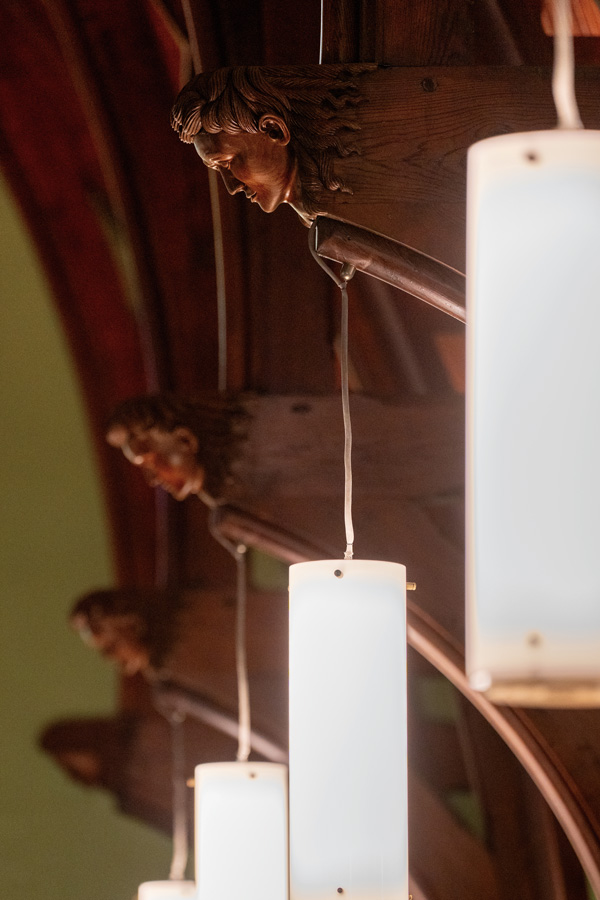
The pews were refinished in UVA’s cabinet shop. Available Light of Raleigh, North Carolina, in concert with Facilities Management’s Design Services group, designed the lighting. UVA’s Construction & Renovation Services installed it. The wiring was routed to be out of sight and the lights positioned to highlight the finishes of the wood, which has a richness and beauty that came as a surprise given what it looked like before, Hogg says.
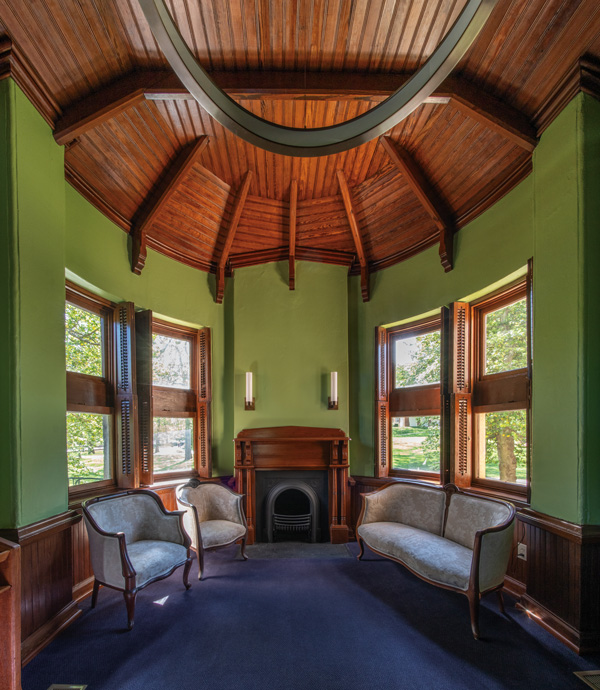
The walls were painted Grenada green, a color based on the original that was popular in the 1880s and 1890s.
The finished product, with its Victorian palette, “would be familiar to anyone who was here in the building’s first 50 years,” Hogg says.
Precisely who was there has been lost to history. The building differs from other churches in that there are “virtually no historic records or photographs,” the 2008 historic structures report says.
“There is no record of weddings, births or deaths.”
That’s because the Chapel had no regular clergy, but rather chaplains from Baptist, Episcopal, Methodist and Presbyterian denominations who rotated each year. Starting in 1904, the YMCA managed the Chapel from its then–recently completed building across the street, Madison Hall, and did so into the 1960s.
There are records for the past 30 years or so, Hogg says. New ones are being made. As of late March, 30 weddings had been scheduled over the coming year, says Katie Dovel, event manager in the Office of Student Affairs.
The renovation added some modern touches. In addition to the upgraded sound system, a newly installed hearing loop will amplify sound for those with hearing aids. And a remote strike can now sound the bell, which had not tolled since 1984, when belfry repairs included removing the pull rope. (A carillon donated by the Seven Society has been chiming since 1957.)
Hogg says the goal was to introduce features that will make the Chapel easier for more people to use, without compromising its character.
“Like all the projects we do, we recognize that the value of the building is in its ability to continue to work for the University.”