School Spirits
Tales of things that have gone bump—or step-thump—on Grounds
Editor’s note: This is a longform story. Click here for an abridged version.
The latched door that opened by itself. The face peering over a shoulder. An unlit flashlight in an unoccupied room lighting up on its own—with security video as proof.
When Alex Davis, director of facility operations in UVA’s Alumni Hall, took the job in 2021, his predecessor David Robey told him about these spooky moments inside the building, once a farmhouse and fraternity house before it became host to the UVA Alumni Association and events. A place with a 200-year history like UVA is bound to have tales to tell—tragedies, untimely deaths, unsettled lore. And many of UVA’s alumni, faculty and staff have their own tales of the unexplained.
When they tell their goosebump-raising stories, they often temper them with comments like “What I’m about to tell you is crazy” or “This is not who I am.” Ghosts or spirits or apparitions, after all, aren’t real. Or are they?
“I want to put that qualifier out there as well,” Davis says. “Because sometimes when I hear myself telling the story, I’m like, ‘This just sounds like nonsense.’” But then the “nonsense” happens again—a light bulb lighting up in his own hand, witnessed by another co-worker too.
‘A great place to murder somebody’
UVA has plenty of ghost stories, passed down across generations by faculty, staff and alumni in writing and by word of mouth.
Some, of course, are nothing more than spooky stories. In 2014, longtime UVA historian Sandy Gilliam (Col class of ’55) wrote an open letter to debunk the “Myth of the Beautiful Ghost of Pavilion VI.” As the story went, the “ghost” was the daughter of a professor who lived in the pavilion. She fell in love with a student, but her parents didn’t approve of him. So the young couple ended the relationship, and the girl died of a broken heart, destined to haunt the pavilion forever.
Gilliam wrote that he first heard about the legend in the mid-’70s as he listened in on a University Guide presentation. He told the Guide Service to stop telling the story, which it did. Years later, Gilliam included the story on a list of “nonsensical statements” about UVA in a presentation to the Guide Service. But somehow the list got into the hands of Guides who didn’t realize what it was and began recounting the tale again, Gilliam wrote. So did commercial tour guides.
“All of this,” Gilliam wrote, “is pure rubbish.”
But other tales aren’t so easily demystified. Shannon Library, formerly Alderman Library, has been a hotbed for them.
In 2015, Will Wyatt (Col class of ’17) was a student working at the library, arriving 15 minutes before it opened on a Sunday. His tasks included walking through the dark Stacks to turn the lights on.
As he went about his business on the top floor, a woman with long, flowing, white hair popped around the corner of the Stacks. “She looks at me and says, ‘This would be a great place to murder somebody,’ and gives me this devilish smile and starts cackling,” Wyatt remembers. “And I’m just like, ‘Uh,’ and I start going faster, flipping the lights on, and she goes back into the darkness of the Stacks.”
The library had been locked overnight, but Wyatt thought maybe the woman had somehow gotten inside. But he found no evidence of her. “The desk was positioned right in front of that door, and we never saw this person leave, so that’s what made me start to think that this might have not been a person,” Wyatt says.
The ghostly woman didn’t scare him away from the library; Wyatt now serves as its public services manager. “Ghosts don’t really freak me out much, but that encounter was a little different,” he says. “When murder starts getting thrown in the mix, your head turns a little more.”
‘I was afraid to breathe’
Montebello, an early 19th-century UVA-owned residence, has served as home to UVA’s engineering school deans for decades. From 2005 to 2015, Sherry Aylor (Educ class of ’76) lived in the house with her husband, then engineering dean Jim Aylor (Engr class of ’68, class of ’71, class of ’77)—and somebody or something that she came to call Isaac.
The first incident took place a few months after moving in. In the middle of the night, Sherry awoke to the sound of footsteps coming up the stairs. “It was step-thump, step-thump,” she remembers.
“I was afraid to breathe.”
She could hear the TV downstairs, where she assumed Jim was having his nightly bowl of ice cream. With each step-thump, she grew more terrified that there was an intruder. She hatched a plan to roll off the edge of the bed onto the floor and make an escape once he came into the room.
Then the sound stopped. She waited before eventually going downstairs to find Jim asleep on the sofa, oblivious to any noise. Sherry started doing some research on the house and found that Isaac Kimber Moran, a Confederate soldier who lost his left leg in the war and later became UVA’s bursar, had lived and died in Montebello.
In fact, when his great-niece stopped by the house to visit, she shared with Sherry that she’d seen something of Moran’s in a pile of trash during a period when the house was in disrepair—his wooden leg. The kind that might make a thumping sound coming up the stairs.
During the decade the Aylors lived in Montebello, Isaac appeared a handful of times. And as Sherry is quick to note, others have experienced weird occurrences there too.
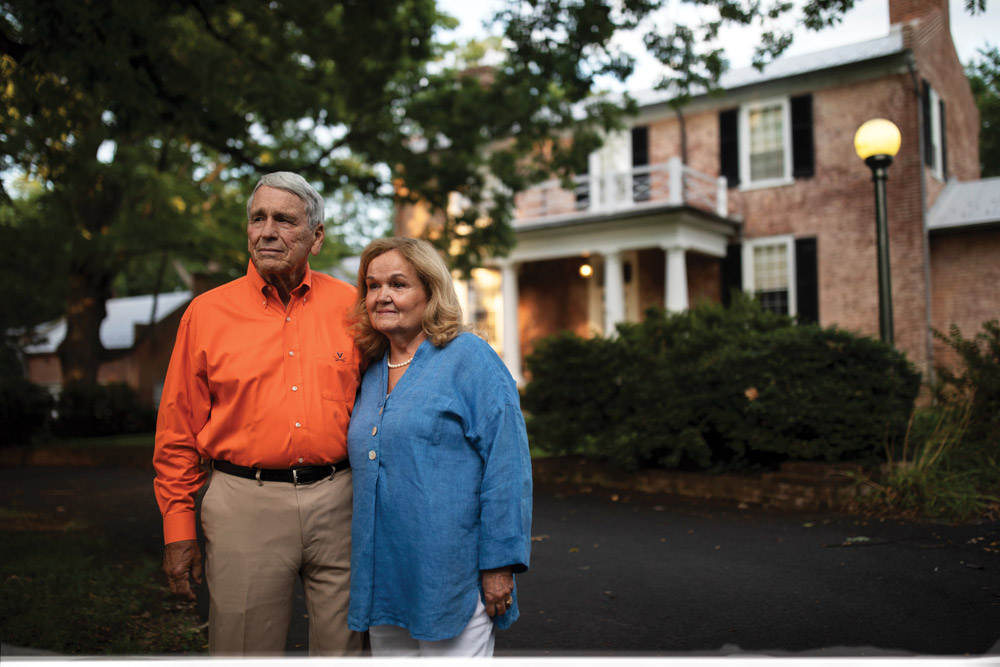
Her sister, alone inside, once bolted out of the house after hearing keys jingling but finding nobody nearby who could be making the sound. During another incident, the Aylors heard a door slam. The next morning, Sherry walked down to the basement, where the heavy laundry room door was shut tight. It had always been left open.
And through a baby monitor, the couple could hear music in an upstairs bedroom—but only when their grandson was napping in the room. “I would hear this very strange music, nothing modern. It was actually a little creepy,” Sherry says. They turned on the monitor when the baby wasn’t in the room but never heard it.
After the initial late-night scare and as she learned more about Moran, Sherry says, she was never fearful. By coincidence, Moran’s time as a soldier may have overlapped, just briefly, with Jim Aylor’s own great-grandfather’s, whose photograph they hung in the house as a novelty. Sherry wonders if that’s why Moran decided to reveal himself to them.
“This sounds so crazy, I’m sorry, but I just felt like it was a place that was special to him, because after he lost his leg, he lived there. He got a new start. He became bursar, he had children,” she says. “I just felt like this was a happy place that he liked to return to, and that was OK with me.”
‘Somebody started laughing’
Old Cabell Hall, home to UVA’s music department, was completely closed late one night, but Joel Jacobus, director of music production, was there. Unlike many of UVA’s buildings, Old Cabell is secured each night because of the expensive instruments stored inside, and police regularly check on it.
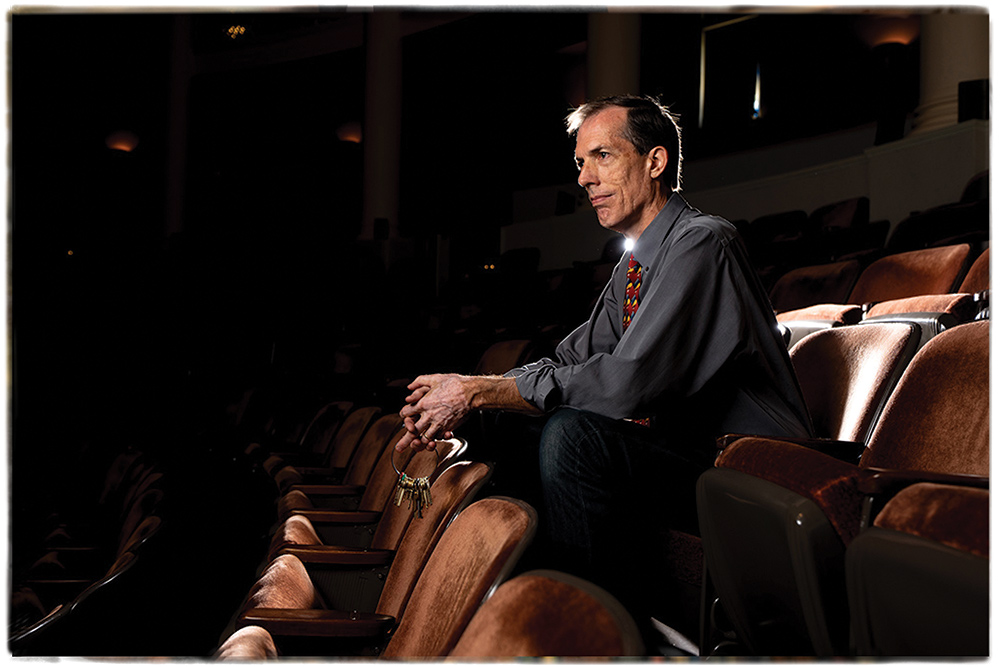
That night, about 15 years ago, Jacobus had locked the building down and completed a security sweep. “I was alone in the building, and I was working in the auditorium, installing some new equipment, when the lights in the auditorium turned off and somebody started laughing,” he says, describing the laughter as “mocking.” “This was at midnight. No doors slammed afterwards, and nobody went running. There were no footsteps. It was just lights turned off, laughter and then nothing.”
Jacobus turned the lights back on—and pretty quickly got out of there for the night. “It was very creepy,” Jacobus says. “It was not, ‘Oh, some student is being annoying.’ It was creepy.”
From the outside, Old Cabell looks like a simple bookend to the Lawn, a traditional-looking two-story, columned structure. The building’s interior, however, is anything but normal.
Opened in 1898, the “odd and unusual place,” as Jacobus describes it, includes three different seventh floors. It has two different second floors, one of which you can’t enter from inside Old Cabell. A staircase goes nowhere, and strange hatches appear to lead down to giant holes in the ground, he says.
“We’re the most confusing building on Grounds, and I think that helps make it spooky,” says Jacobus, who has worked in the building since 2004.
That mocking laughter at midnight might be the spookiest incident during Jacobus’ tenure. But there have been plenty of other odd moments as well.
Jacobus’ cubicle sits with other cubicles on the lobby level on the east end of the building. It’s not uncommon for people to pop in to say hi, Jacobus says. But another visitor seems to be checking in from time to time during regular business hours as well.
“Many of us have experienced a sudden, incredibly strong smell of perfume, as though someone has walked in wearing a lot of perfume,” he says. “And somebody gets up and says, ‘Hello, can I help you?’ And there’s no one there. We don’t know why a perfumed something has just walked through our cubicle area, and that has happened many times.”
There’s also the legend of “Mean Jean,” a cranky housekeeper who didn’t like students messing up her work. As the story goes, she died in her 70s at home in her uniform, waiting for her ride to work.
“There is a fairly strong belief that Jean came into work anyway that day, and students would get pushed from behind and occasionally hit,” Jacobus says. “They would feel like they were being shoved, and they’d turn around and there was nobody there.”
And then there are the unexplained items appearing inside the auditorium. Before and after a concert or talk, house managers walk through each row to ensure that no seats are broken and that no one has left a wallet or cellphone behind. Housekeeping also cleans multiple times a week.
Despite all those efforts, Old Cabell workers find items all the time, but they aren’t only keys or paper tickets left the previous night. They’ve found programs for events five years earlier or items lost years ago. The most impressive, Jacobus says, was a wallet he found.
Everything inside was expired, but he found a name and number, which he called, and asked to speak with its owner. The person who answered was very guarded, asking what the call was all about. Jacobus explained that they’d found his wallet inside Old Cabell Hall. “He said, ‘Well, he died 10 years ago,’” Jacobus recalls.
Whatever it is, Jacobus calls the phenomenon the “interdimensional trash demon.” “Something is leaving gifts for us,” he says.
‘No friends fessed up’
Not long after Sara Allen Harper (Arch class of ’11) moved into her Lawn room—33 West—she had a visitor. “A past resident of 33 West had stopped by early in the fall and warned me that there were stories about 33 West,” she says. “That was in the back of my head all through the year.”
Harper didn’t get specifics about what those stories swirling around about the room involved, but she does remember the tour of University Cemetery that she took with the historian Gilliam and Anda Webb, senior adviser to the executive vice president and provost, later that fall.
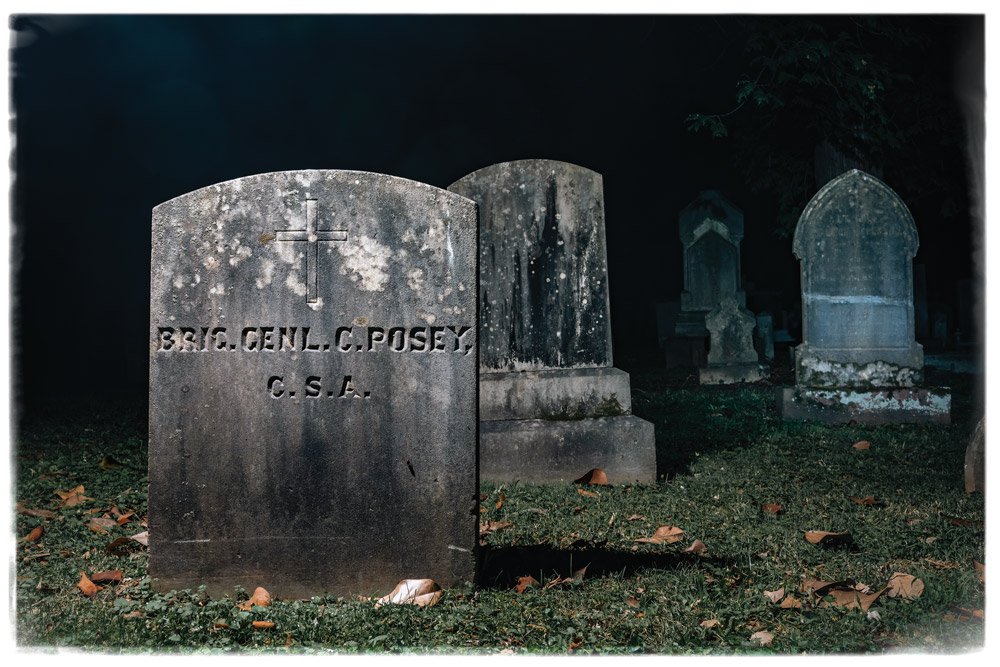
They walked to the grave of Gen. Carnot Posey (Law 1836), and Gilliam shared with Harper the story of his death—inside 33 West on Nov. 13, 1863. It was a tour Gilliam often gave to residents of 33 West, according to Webb.
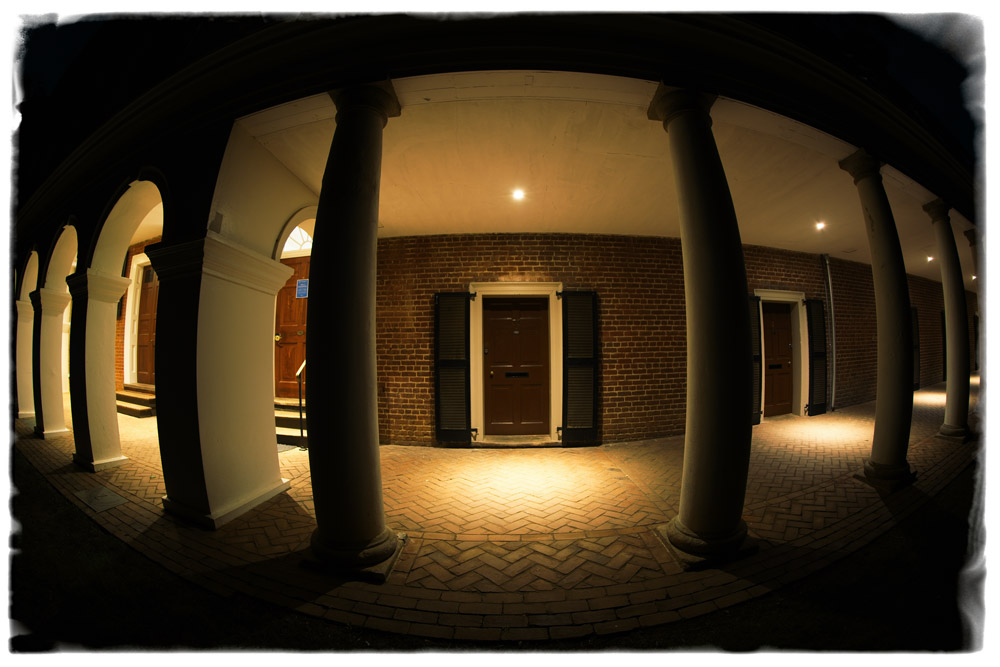
Despite the ominous warning and the story of a death inside her room, Harper chalked up the room’s creaks to the noises of an old building and the sounds of laughter to parties at the Colonnade Club in Pavilion VII next door. Other former 33 West residents also attributed late-night noises or the occasional knock on their door to celebrations in the pavilion.
But in the spring of 2011, Harper found something that gave her pause.
After spending the night at a friend’s apartment, she’d returned to her room before dawn to pack for a conference in Washington, D.C. Nothing seemed out of place until she walked to her desk and noticed some potting soil on the floor.
That’s when she realized that a fern, which had been sitting on her windowsill, had been knocked over. The planter was cracked, but it wasn’t in pieces on the ground. It had been reassembled and set back on the sill.
The door had been locked. And while the window was ajar, nobody could have climbed into the room that way without a ladder because of the significant drop to the ground outside. UVA Police came to investigate, even checking for fingerprints and blood. No clues were found, Harper says.
“There was really no harm, no foul, other than me being a little uneasy about what had gone down,” Harper says. “And no friends fessed up to it either.”
Concerning Ghosts
Scientists and skeptics will tell you there are no ghosts—the laws of physics just won’t allow it. And purported hauntings might be explained by a variety of factors, including carbon dioxide poisoning or the power of suggestion.
Sleep paralysis, which impacts about 1 in 5 people, provides another scientific explanation. As some fall asleep, muscle movement is constrained, but vision and breathing movements remain intact. Research shows that it can trigger experiences that feel like ghostly encounters.
UVA professor Jack Chen covered sleep paralysis as one cause of ghostly sightings in his 2019 class Concerning Ghosts. For his part, Chen considers himself agnostic about their existence. “The funny thing is, I only believe in ghosts when I’m in the basement. In the daylight of my life, I’m not thinking about them,” he says.
What he does know as a professor of Chinese literature is that ideas of ghosts or spirits have filtered through centuries of culture and beliefs, but in different shapes and forms.
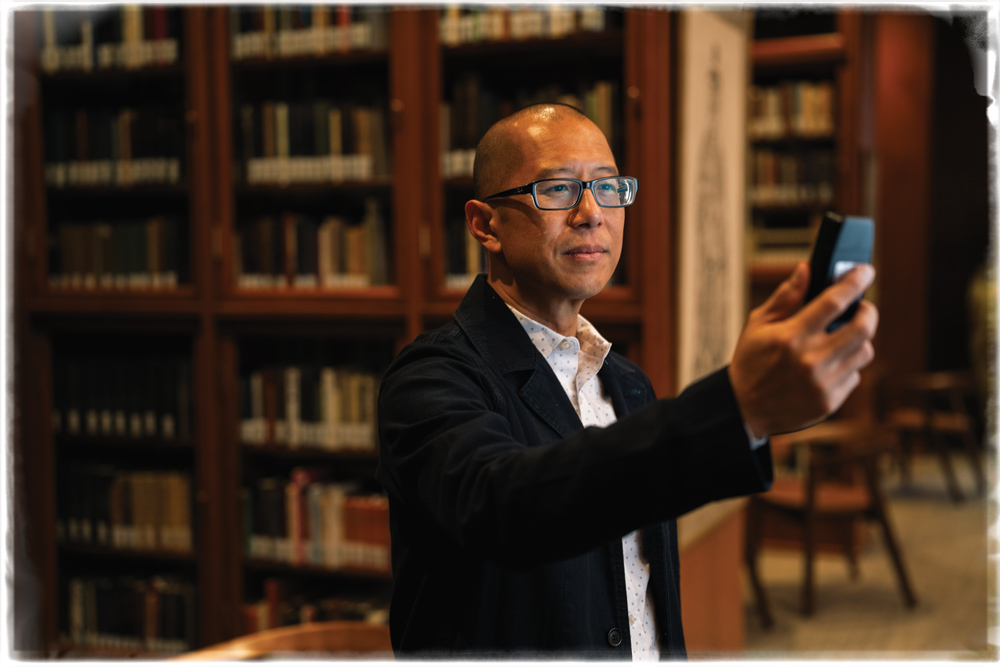
Today, a “ghost” is often considered a disembodied soul or returned dead, perhaps slamming doors or walking up the steps of a spooky basement. In medieval China, the concept of ghost filled another category—a “demonic being,” outside the bounds of the ordinary, Chen says. They often turned up in places like crossroads or inns.
In Victorian times, the idea of “residual haunting” emerged. “The theory is that the ghost is being recorded within the ether of our home or the space around us,” Chen says. “It’s simply a recording—a traumatic recording of intensive emotion that can’t be dissipated.”
New ideas about ghosts and spirits appeared with the introduction of new technologies. The history of the seance, for example, is bound up with the history of the telegraph, telephone and gramophone because they allowed us to pierce the veil of distance, Chen says. With it, people could experience what it’s like to communicate across physical distances—and then started to imagine that we might be able to communicate with a grandparent who has passed on.
Today, technology is providing alleged photos of spirits or proof of their energy.
Electromagnetic field detectors are typically used to track radiation levels from power lines or appliances, for example, to determine whether there might be safety issues.
But they also are commonly used by ghost hunters who believe that spirits emit or influence electromagnetic fields. In the movie Ghostbusters, the characters used a made-up tool called a P.K.E. meter as a stand-in for the EMF meter.
“There’s a whole history of this idea that ghosts are not really a religious framework, but a scientific framework,” Chen says. “The ghost is a kind of energy field. … And why we can detect them with [EMF detectors] is because they are energy fields.”
As part of Chen’s class, students took a trip to then–Alderman Library with an EMF detector.
In some areas of the library, students detected radiation in expected spots, such as near an electrical socket. But then the meter detected a high reading in a place with no immediate reason—in the middle of a stairwell. Students were astonished, Chen says.
But often such findings raise more questions than provide answers. What’s interesting to Chen is that even as we grow more technologically advanced, ghosts remain. “The technologies have changed,” he says. “The ghost itself has not changed in any meaningful way.”
And these encounters break the categories of our knowledge systems, Chen says. “We live in a very nicely settled, ordinary world,” he says. “It is kind of a comfortable place. A lot of the things that we didn’t quite understand, we now understand, or we think we understand. And yet we have these borderline experiences that sort of throw everything that we think is the ordinary right into this state of unknowing.”
‘I saw somebody behind me’
Whatever the reality is, an enduring belief about ghosts is that they seek acknowledgment, Chen says. Whether it’s lighting up an EMF detector or peering over your shoulder, they’re trying to communicate.
Across about 20 years during two separate stints working as Alumni Hall’s facilities manager, Robey has received plenty of those “communications.”
“I don’t know that I necessarily believe in ghosts, per se,” Robey says. “I can just tell you what happened. I know some staff members that worked for me were terrified. … I never felt threatened or felt uneasy. I kind of had a weird relationship. I did talk to it at times and say, ‘Hey, I don’t got time for this.’”
Most of what Robey encountered was around the building’s Virginia Room and Annex, an area that was once its center for functions before the ballroom was added in the 1980s.
In one case, a latched door opened by itself. “You have to literally push down on this latch to open it,” Robey says. He examined the door and found nothing, so he went to the security video to see if anybody had been there. “I saw an apparition come out of this floor, and it hit this one right door, and that’s what caused it to open,” he says. “It was the weirdest thing.”
Other times, he heard doors closing by themselves. But when he checked the videotape, he saw nothing.
Once, after a coworker told him that ghosts could turn on flashlights, he tested it himself. The security video shows him walking into the Virginia Room with a flashlight, turning the flashlight on and off, and placing it on a table unlit. He leaves the room, which is unoccupied. A few minutes later, the flashlight lights up on its own.
Another early morning, Robey went to unlock the Virginia Room and prepare it for a morning event. It was dark, and he put his key in the lock. The key usually turned easily, but this time it got caught.
“I beared down a little bit, and while I was doing that, I picked my head up and looked into the room, but all I could see was a reflection because … I was standing with a dark room inside, and then I saw somebody behind me, real close to me,” he says. “Its head, over my shoulder.”
He was a balding man with a gray beard, about Robey’s height. Robey turned around, but nobody was there.
Davis says he saw the same man years later. Now in charge as facilities director, Davis was talking to a colleague when they saw an older gentleman in a navy shirt and dark pants with a white handkerchief hanging out of his back right pocket. He had a receded hairline with just a little skirt of hair around the back of his head, Davis recalls. With both hands resting on a cubby, the man appeared to be taking a breather.
Davis asked his colleague, Alumni Hall’s receptionist, who saw people come in and out, who the man was. She didn’t know. So Davis walked toward him to see if he needed anything. On his way there, Davis briefly lost sight of the area where the man had been standing. By the time Davis got there, the man was gone.
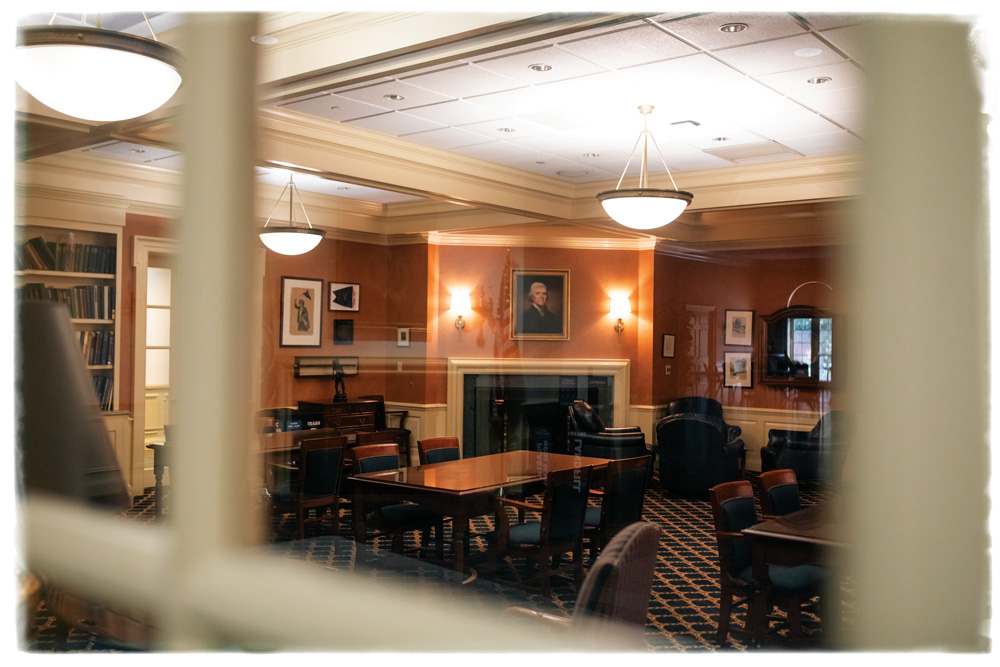
Davis continued down the hallway, searching the only other areas the man could have gone, including the basement hallway and boiler room. Nobody else was in the building.
“That was a full-body apparition,” he says. “And it just completely disappeared. I saw him well enough to think that it was a man standing there.”
He relayed the event to Robey. “I told him that this is the craziest experience I’ve ever had in my entire life,” Davis remembers. “I know that that man was standing there, and he wasn’t there, and I described him, and he says that that was the same man that he saw in the reflection of the door.”
Who was it? What was it? Will we ever know? Who knows?
“Certain things we feel like are settled,” Chen says. “So how do we square our rational modernity of the everyday, ordinary, the sunlight world that we live in with experiences that seem to suggest that we don’t quite understand the world?”