Research’s new unknowns
UVA grapples with uncertainty in federal funding landscape
On Feb. 7, 2025, just a few weeks after Inauguration Day, President Donald Trump’s administration announced an immediate change to research funding from the National Institutes of Health, the federal agency primarily responsible for biomedical and public health research.
Through the grants it issues, the NIH would still fund the direct costs of research at universities, labs and other institutions—but now it would cap reimbursements for so-called “indirect costs” at 15 percent. The announcement called these indirect costs “administrative overhead” and proposed that the cap would help the NIH “ensure that grant funds are, to the maximum extent possible, spent on furthering its mission.”
But what may appear to be a minor technical alteration presents sweeping challenges for research institutions across the nation. Rather than reducing “overhead,” the 15 percent indirect cost cap is estimated to slash research funding by as much as $5 billion nationally, crippling universities’ ability to pay for lab and administrative personnel, shared equipment and even power bills.
UVA is not immune to these challenges. The previous indirect cost reimbursement rate the university negotiated with the NIH was 61.5 percent. A drop down to 15 percent would cost UVA researchers approximately $54 million, based on last year’s numbers, according to Lori McMahon, UVA’s vice president of research.
On March 25, UVA President James E. Ryan (Law class of ’92) sent an email to the university community addressing this “period of significant fiscal uncertainty, with potential deep cuts to federal spending on grants and contracts and other core programs.” He called the circumstances “unsettling” and outlined several measures to reduce spending, including additional hiring reviews for new faculty and staff.
Meanwhile, through the NIH, the Trump administration has delayed the approval of many future biomedical research grants and canceled others already in progress. It has laid off hundreds of employees at the NIH and the National Science Foundation, another government agency that supports scientific research.
As a result of these changes, three NIH grants to UVA have been canceled so far, and one more has received a stop-work order. With the funding environment awash in uncertainty, UVA will admit fewer graduate and postdoctoral students this fall, with the exact number to be determined by individual schools—underscoring the long-term impacts these policy changes will have on the next generation of scientists and researchers.
In late March, almost 2,000 members of the National Academies of Sciences, Engineering, and Medicine signed an open letter warning that “the nation’s scientific enterprise is being decimated” and that “a climate of fear has descended on the research community.”
“Ultimately, it’s going to mean that the U.S. is not going to have the technological leadership that it’s had, because that’s all been based very heavily on basic scientific research,” said Edward Egelman, a professor of biochemistry and molecular genetics at UVA, who signed the open letter. “The U.S. has played a leading role in development of all new technology, and that’s going to change.”
A history of government research partnerships
Federal government dollars have helped fund a slew of medical breakthroughs at UVA over the years. The NIH and the broader Department of Health and Human Services awarded UVA more than $258 million in grants in fiscal year 2024—by far the university’s largest source of research funding, with the next largest federal source being the Defense Department, at $44 million.
But the scope of the NIH’s historic impact extends beyond Charlottesville. NIH-funded research contributed to the development of 99.4 percent of all medicines approved in the U.S. between 2010 and 2019, according to amfAR, the Foundation for AIDS Research.
“There are breakthroughs that happen literally every week in biomedical research in the U.S.,” said William Petri (Grad class of ’80, Med class of ’82), vice chair for research at the Department of Medicine. “It’s one of the things where we lead the world.”
“I think the country is getting a bargain in biomedical research,” said William Knaus, a UVA emeritus professor in public health sciences, who also signed the National Academies’ open letter. “The pipeline for biomedical research at UVA or any other large university-based center is an investment in the future.”
According to the National Science Foundation, the federal government spent about $60 billion on R&D in higher education in 2023, while universities themselves spent $28 billion.
“The federal government can’t do it all by itself, and universities can’t afford it all by themselves,” McMahon said. “You can really see that the magic has happened because of this partnership.”
The successes of the U.S. research community reflect that. One key aspect built up over the decades is the peer review process, the gold standard for scientific evaluation. Peer review plays an important role in “study sections,” which are groups of academics and researchers the NIH gathers to review and score proposals for federal grants.

“NIH makes funding decisions largely based upon those scores,” Egelman said. But the Trump administration has delayed or canceled many of these study sections, essentially blocking new grants from being issued.
“When those study sections are delayed, that means any new grant awards are going to be delayed. That has a horrendous impact on biomedical research,” Egelman said.
In late February, NPR reported that the freeze on study sections had affected 16,000 grant applications and $1.5 billion in NIH funding.
“Those meetings were canceled, sometimes the day before the meeting,” said Mariano Garcia-Blanco, chair of UVA’s Department of Microbiology, Immunology, and Cancer Biology. Since the initial freeze in February, some study sections have been reinstated to review new grant proposals. Yet plenty of other researchers remain in the dark.
“It’s just like being in limbo,” Garcia-Blanco said.
‘Experiments will not be done’
University researchers now face two distinct challenges. The first is the 15 percent cap on indirect costs.
Analysis from The New York Times shows that in fiscal 2024, the NIH spent about $32 billion across 60,000 grants (UVA received over $258 million). “Direct costs” accounted for $23 billion of this total; these are costs such as researchers’ salaries, lab equipment and supplies “directly supporting or benefiting the grant-supported project or activity,” in the NIH’s words.
That leaves $9 billion in indirect costs that would be affected by the 15 percent cap. Also known as facilities and administrative or “F&A” costs, this category includes expenses that are not specific to any single grant—for example, utility costs for a laboratory running multiple experiments, or salaries for laboratory cleaning crews or administrative personnel working with different researchers on different grants.
In its analysis, The New York Times found that a 15 percent cap on these indirect costs would reduce total NIH funding by at least $5 billion using 2024 numbers, with the brunt of the funding gap affecting institutions heavily linked to commercial patenting and drug development, according to a National Bureau of Economic Research working paper.
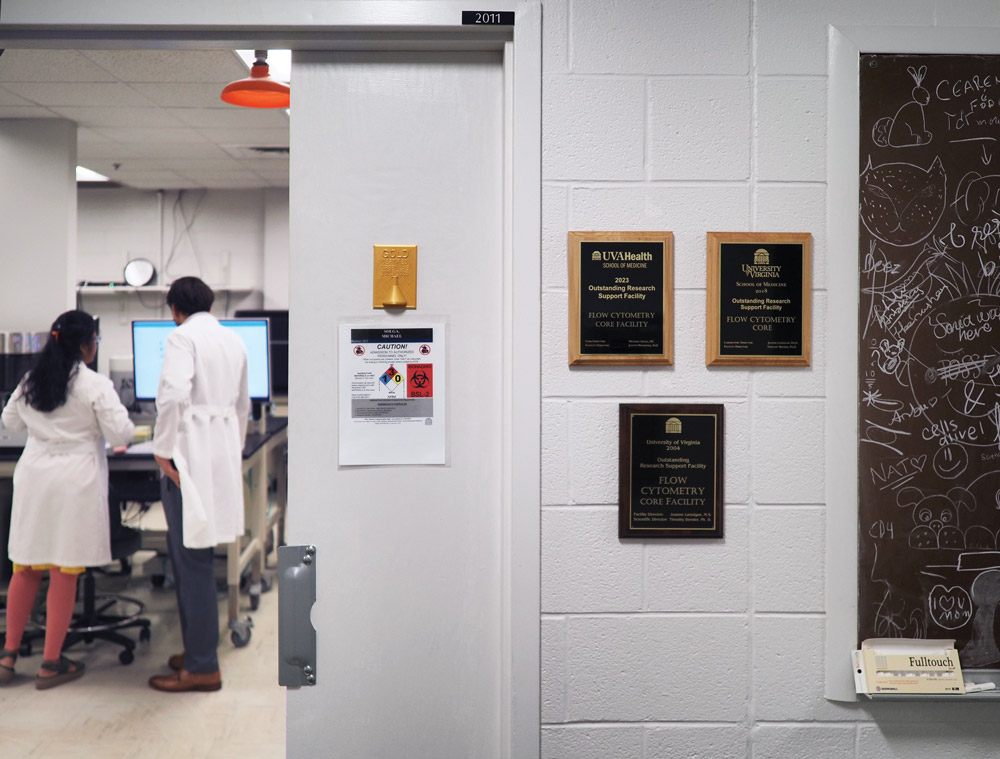
With UVA directly standing to lose roughly $54 million annually, one area where these cuts will be keenly felt is the “research core” system. Research cores are shared facilities that allow researchers to use tools, technologies and personnel not specific to their own lab or work. Research cores frequently house equipment that is too expensive or specialized for any one lab, so researchers pay a fee to access it when needed, which counts as an indirect cost.
“If I think about the papers that we published in really important, competitive journals in the last five years, we would not have published a single one of them if we had not been able to use a research core,” Garcia-Blanco said. “Without those cores, our research would be mediocre at best.”
Previously, the NIH reimbursed UVA researchers for indirect costs totaling up to 61.5 percent of their overall direct costs. Those researchers say a cut down to 15 percent would be devastating.
“Experiments will not be done,” Garcia-Blanco said.
The 15 percent cap is on hold, after state governments and research organizations sued the administration and a federal judge temporarily blocked the cuts.
A more chilling crisis
As that challenge wends through the courts, a deeper “parallel crisis”—in the words of Garcia-Blanco—is rapidly hitting U.S. universities: the delay or cancellation of grants already in progress.
The slowdown in study section scheduling is one form, while other grants are being rescinded without explanation. This April, President Ryan told the Faculty Senate that a total of 14 federal research grants to UVA have been terminated so far this academic year, including the three from the NIH.
“In many cases, it’s just silence,” said Garcia-Blanco, who last year submitted grant applications for UVA’s Medical Scientist Training Program, which allows students to train for both an M.D. and Ph.D. “This application had a very good score, which in most times would have been fundable, but decisions for these training grants are all lumped together. They should have been made early this year. At this point, there is no answer. The latest I received from NIH is, ‘We don’t have any updates.’”
Many have speculated that the Trump administration may be targeting training grants in particular as part of its explicit stance against diversity, equity and inclusion, as some grants seek to enroll students from underrepresented backgrounds. Regardless of the motive, such delays are costly for scientists seeking the next medical breakthrough.
“It takes a decade to get to a major discovery and sometimes longer,” McMahon said. “So any stoppage, any slowdown in the pace of work, means those discoveries are going to get pushed out and might not happen.”
Of all the areas of scientific and medical research now at risk, infectious disease research appears to be particularly vulnerable. Robert F. Kennedy Jr. (Law class of ’82), the Trump administration’s secretary for the Department of Health and Human Services, which oversees the NIH, has suggested a “break” from funding infectious disease research in favor of research into chronic diseases. And in late March, Kennedy fired all staff in his department’s Office of Infectious Disease and HIV/AIDS Policy. These actions and others have produced a profound chilling effect across experts in this area of research.
“They have created this anti-infectious disease, anti-vaccine sentiment that is very problematic for a department like mine,” said Garcia-Blanco, who studies autoimmune diseases.
More than a century ago, UVA played a foundational role in infectious disease research in America through Walter Reed (Col 1869), who graduated from medical school after earning his degree at age 17. Reed went on to pioneer research into the causes of typhoid and yellow fever. He debunked incorrect theories on their spread in military encampments, saving untold numbers of lives.
Today, infectious disease research at UVA is making discoveries such as finding links between herpes virus infection and higher rates of Alzheimer’s disease. Links like these underscore the false dichotomy between infectious disease and chronic disease.
“If I think about the papers that we published in really important, competitive journals … we would not have published a single one of them if we had not been able to use a research core.”
To some researchers, the move away from infectious disease research is all the more stunning in the aftermath of COVID-19, when rapid medical breakthroughs led to the development of a vaccine that saved millions of lives.
“I really expected after the advances of COVID it would be like what we saw during the polio epidemic, where Jonas Salk’s development of a vaccine … prevented what had been a terrifying epidemic of paralytic illness in children,” Petri said. “I think that, more than any one thing, convinced the public of the importance of investing in biomedical research.
“My maybe naive thought was after science getting us through a pandemic and lowering the number of people that suffered again, that we’d see an even greater investment in biomedical research and not a retrenchment.”
The next generation of scientists
For all the cutbacks and uncertainty challenging researchers right now, it’s future researchers who stand to lose the most. Scientific and medical research is a highly competitive field where success often requires winning grants to fund labs and experiments. Doctoral students, postdocs and younger students interested in these careers may start to abandon their ambitions in the face of a decaying federal funding landscape.
“It’s pretty desperate,” said Audrey Brown (Grad class of ’22), a Ph.D. postdoctoral research fellow in parasitology at UVA. “People are starting to realize that what they’ve trained for over the past 10 years and devoted their life to is no longer going to be a viable career option.”
Like many postdocs, Brown’s goal was to start her own research lab at a university in a few years. But NIH funding cuts may render that path impossible, even after the typical Ph.D. student’s years of demanding, exhaustive work. That’s because federal cuts will require universities to scale back their research capacity and offer fewer professorship positions—and even those who are hired will need to assemble more of their own funding to conduct research.
“It’s so anxiety-provoking for these young, bright, talented individuals who we want to attract into basic research and development,” McMahon said. “It can derail them.”
Brown is studying a gene that affects how different people either do or do not get ill from an intestinal parasite. The team has also discovered that the same gene affects how people respond to inflammatory bowel disease—another example of the linkages between infectious and chronic illness.
“What we learned really translates across the board and isn’t just related to infectious disease,” Brown said. “But if these funding cuts come through, that is how we will be viewed, and we will be cut because of that.”
There are alternate career paths these young researchers can still take—maybe to a private biotech firm or treating patients. Regardless, researchers said, their departure from schools like UVA will create a brain drain in research talent, with the long-term effects impossible to measure.
“We could potentially lose a generation of young scientists who read the writing on the wall,” Petri said.
Bracing for what’s next
Leaders at UVA are strategizing how to overcome the changes in federal research funding.
The 15 percent cap on indirect research costs is perhaps the most straightforward challenge to confront, as it comes with a clear dollar figure to replace. That doesn’t mean it will be easy. “Long term, you can’t make up such a dramatic decrease in F&A costs,” Petri said. “One can lessen the immediate impact, but it’s not a sustainable thing financially.”
With the 15 percent cap currently being fought over in court, there’s a possibility that there may be room for negotiation. “I think most people are thinking it won’t stay at 15 percent,” McMahon said. “Maybe it’s just hope, but we’re thinking that there will be this opportunity to work with our decision-makers to come to perhaps a consensus.”
“It’s so anxiety-provoking for these young, bright, talented individuals who we want to attract into basic research and development. … It can derail them.”
McMahon said deans across the university are modeling different percentages—a more optimistic 30 percent or 50 percent, perhaps—to determine what resources they’ll need to fill the gaps, and how to adapt.
The funding sources to make up for slashed federal dollars can come in several forms. Nonprofits are one example, such as the Alzheimer’s Association, which already funds research into that disease at UVA. Increased state funding is another potential source, capitalizing on UVA’s position as Virginia’s flagship research university. A third source might be private donors.
It’s difficult to see what may come next for university research. Yet leaders and researchers at UVA are persisting in their work, optimistic that the advancements will continue.
“What I can say is that the research community is continuing to do their research,” McMahon said. “The students are continuing to do their work. Their faculty are continuing to mentor their students and their postdocs and their research staff. And the leadership is monitoring and watching and looking at scenario planning to prepare ourselves so that we can pivot once the information becomes more concrete. It’s hard right now because we don’t know what the future holds.”