Queer History
50+ years of building LGBTQ+ community
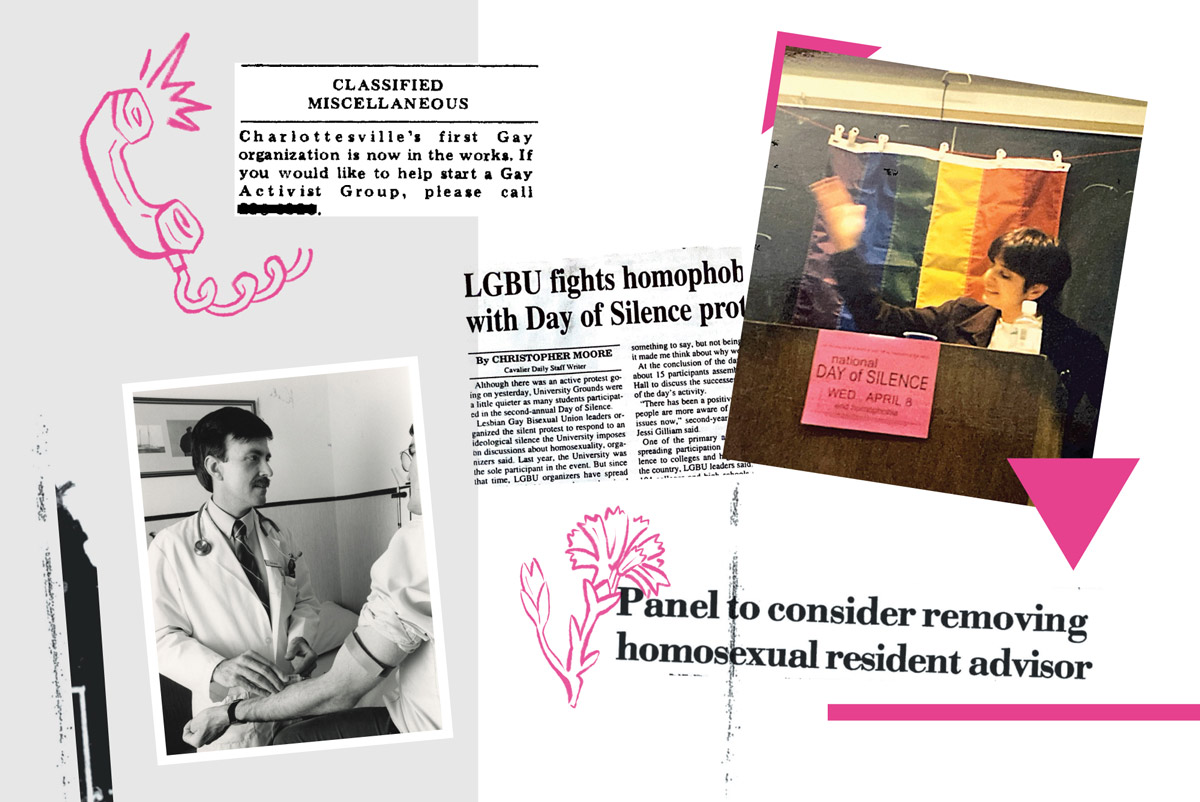
The classified ad appeared in the back of the Cavalier Daily in March 1972, under the Miscellaneous section. It got right to the point. “Charlottesville’s first Gay organization is now in the works,” said the ad. “If you would like to help start a Gay Activist Group, please call …”
Just five or six people—“a pretty nervous lot”—showed up to an early meeting that same month, according to the organization’s September 1973 newsletter. “It seemed impossible to conceive of an organization like this in Charlottesville—indeed, some overzealous members of an unnamed fraternity, armed with rocks, bottles and a real shotgun, sought to prove that it would be impossible,” the newsletter article continues. “But the Union survived and matured. [Its] great achievement of that truncated first year … was simply existing.”
Over the decades, the experience for UVA’s queer community often tracked national sentiment. And in the early 1970s, “simply existing” was difficult enough for the LGBTQ+ community on Grounds and across the country.
In 1973, 8 in 10 people believed that same-sex relations were “always” or “almost always” wrong, according to the General Social Survey, a five-decade-old survey of U.S. adults, conducted through the University of Chicago. Sentiment remained about the same, subsequent social surveys found, until the early 1990s.
UVA “was a hostile environment for anybody gay or lesbian,” says Bob Elkins (Col class of ’79), whose status as the “gay RA” at UVA made national headlines.
No two UVA students’ experiences are the same, and that especially goes for LGBTQ+ students as they navigate their own coming-out process and families and communities that don’t always embrace them. They have faced pranks, threats and violence, but they have also found community.
Sometimes it was behind-the-scenes support from faculty, staff and friends. Other times, it was through student groups like the Gay Student Union, now called the Queer Student Union, or the 24-year-old LGBTQ Center. Today, across Grounds, affinity groups provide a home base for LGBTQ+ students.
In 2018, while Chad Kamen (Col class of ’20) researched UVA’s queer history as an intern for the LGBTQ Center, he found plenty of moments of tension and strife. But he also turned up a robust collection of “records of queer joy” too, he says—goofy drag bingo nights or collaborations with other cultural organizations. His work built on the research by others before him, including Kyle Ranson-Walsh (Col class of ’02), who wrote a thesis that covered LGBTQ+ student history at UVA and helped build a repository of early artifacts and information.
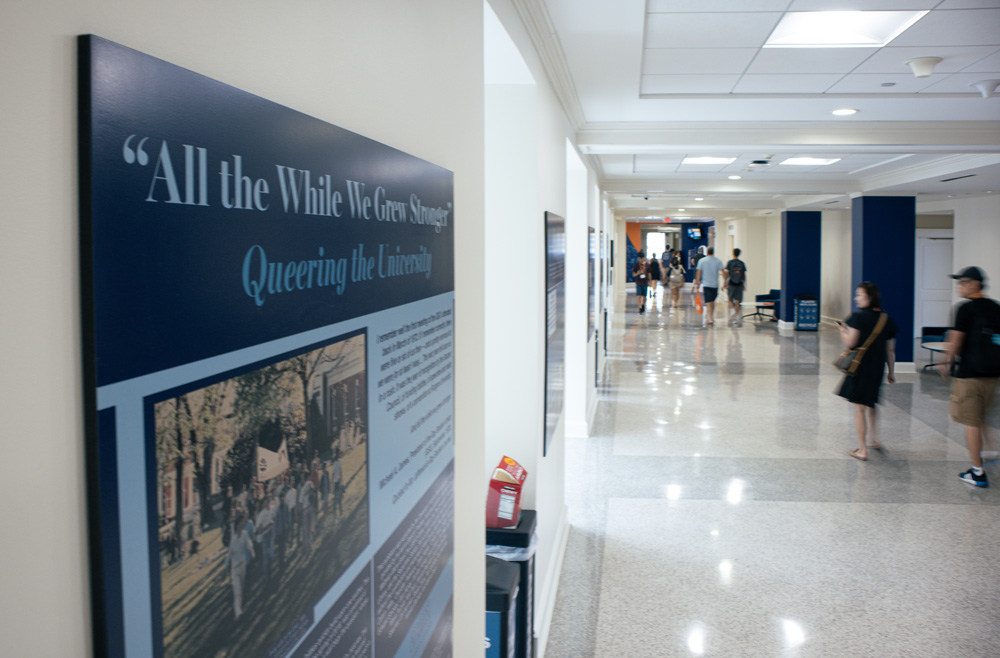
“They show moments of silliness despite it all, trying to laugh at situations that are hard,” says Kamen, whose exhibit on UVA’s queer history remains on display in Newcomb Hall. “That ability for humans to find joy and lightness and laughter amidst unspeakable circumstances is something that is a thread throughout all this work.”
1970s: The RA
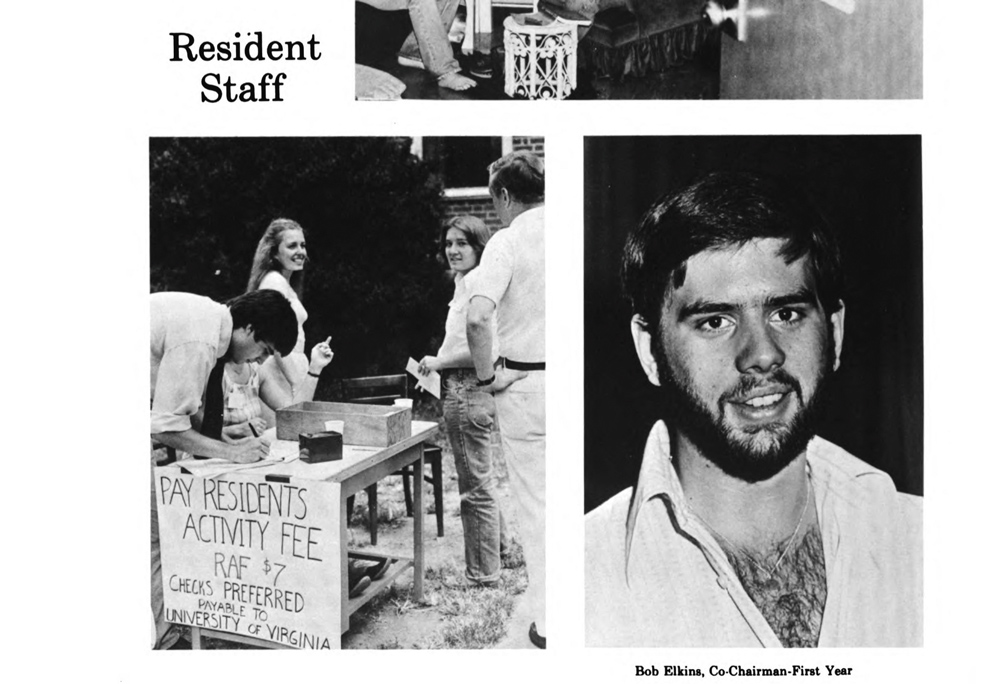
“Panel to consider removing homosexual resident advisor.” The story led the Cavalier Daily on Sept. 20, 1976, and made it into newspapers across the country, via the Associated Press wire. It went on to detail that President Frank L. Hereford Jr. (Col class of ’43, Grad class of ’47) had assembled a committee of faculty, administrators and student representatives, including the Student Council president and a Resident Life co-chairman, to determine whether the RA in question—Elkins—could remain in the role.
By all accounts, Elkins was excelling as an RA, the Cavalier Daily story reported. Twenty residents on Elkins’ hall in Hancock had signed a petition stating that he was performing well. Then–Dean of Students Robert T. Canevari (Educ class of ’59) agreed, saying Elkins was “doing an excellent job.”
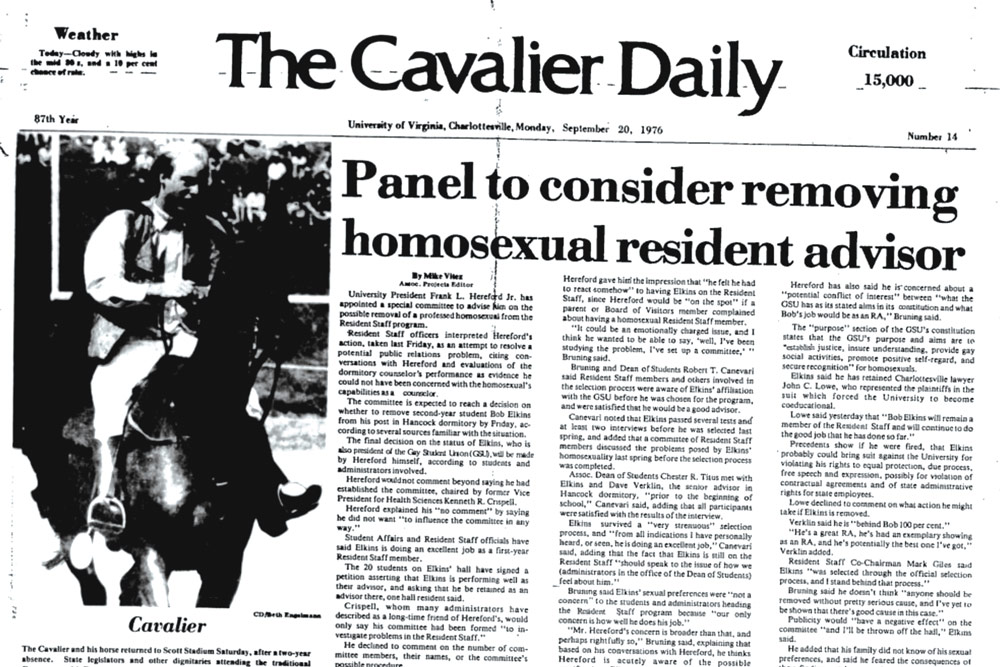
Elkins also was president of UVA’s 4-year-old Gay Student Union. And, as the newspaper reported, Elkins had been transparent about his sexual orientation, discussing it during interviews the previous spring.
“I acknowledged it,” he says. “They asked me some questions about how I would handle myself with my residents. Apparently, I answered those questions in an acceptable manner, and they just moved on.”
Still, being gay carried plenty of stigma on Grounds and across the country. At UVA, Hereford had a public relations situation on his hands.
Not much has been written about the LGBTQ+ experience on Grounds before 1970. In his book Love in America, Julian Green (Col 1922), who would become a prolific writer in the French langauge, recounts his time on Grounds from 1919 to 1922, including his attraction to men. Amid the 1950s Lavender Scare, when LGBTQ+ individuals were removed from government positions, popular UVA history professor William Ewart Stokes Jr.’s contract wasn’t renewed in 1957 after his arrest in Richmond for “indecent conduct related to solicitation,” according to a 1990 Cavalier Daily article.
But by the 1970s, the LGBTQ+ community across the country was becoming more vocal. Cities were holding the first Pride parades, and states began repealing anti-sodomy laws. (Virginia’s would stay on the books until 2014, after it was ruled unconstitutional.) In 1971, the University of Michigan opened the first center in higher education to support LGBTQ+ students on campus.
At UVA, the launch of the Gay Student Union was giving the community more visibility, but it still faced an uphill battle. In 1973, amid questions from conservative students and despite support from the Student Council, the Board of Visitors denied $45 in funding from the Student Activity Fee, saying that the group “cultivates and advocates a style of sexual life … which has no relationship to the educational purpose of the University.”
But the GSU kept fighting. To plead its case, the 50-member group documented its activities as a service organization in a 26-page report to the Student Activities Committee. It had brought nationally recognized speakers to Grounds; made presentations at UVA and across Virginia; took part in trainings about LGBTQ+ life and support; and held dances in Newcomb Hall as fundraisers. It ultimately won funding in 1975.
The union also had launched a Gay Hotline with Elkins as its director. Most of the 468 calls during its first month were hang-ups or prank calls. But in about 100 cases, the hotline was able to answer questions or send callers to the appropriate resources.
And it found support in faculty, staff and counselors at UVA and elsewhere who wrote letters on the group’s behalf. “Because of their role in providing information and serving as a focal point for gay individuals, a highly ostracized and stereotyped minority group, I feel the GSU should continue to function in Charlottesville,” wrote Keith Howell, then an assistant professor of education at UVA, who had invited members to speak at his class on human sexuality.
It was against that backdrop that Elkins became the Gay Student Union’s president because few felt comfortable taking leadership roles for the organization; interviewed for the RA role, acknowledging his sexual orientation; and ultimately faced questions about whether he could do the job.
For more than a week, the story played out on Grounds and nationally. Elkins’ personal life, he would later tell the Cavalier Daily, was left in shambles. He stepped down as president of the Gay Student Union. His parents, who hadn’t known he was gay, cut him off.
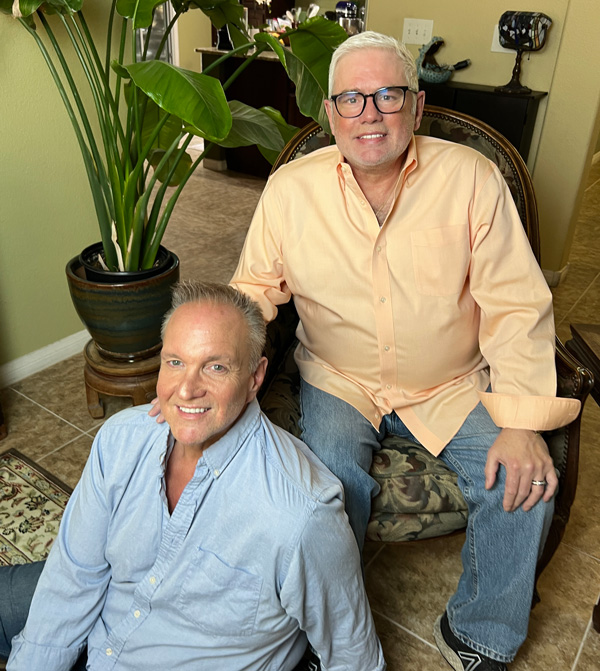
But amid the turmoil, Elkins says he found community on Grounds. John Herring (Grad class of ’63), then-director of Newcomb Hall, covered his tuition and helped him find a lawyer—John Lowe (Law class of ’67), who six years earlier had successfully argued a lawsuit against UVA to require full coeducation. Groups such as UVA’s Law School Council and Black Student Alliance issued statements in support. And he had a close-knit group of friends—gay and straight—to rely on.
By the end of the month, the panel recommended that Elkins remain on the job, and Hereford agreed. “There was a lot of support there, and I never thought I did anything wrong,” Elkins says. “I was just being a student and being an RA, and I wasn’t going to back down.”
It still wasn’t easy. During an October 1977 Gay Student Union dance inside Halsey Hall, lit firecrackers were thrown onto the dance floor, and a smoke bomb disrupted another social event, according to a Cavalier Daily story. The story also recounted several incidents of members being harassed.
Elkins immersed himself in UVA life. He rose to the position of co-chair of the first-year resident staff, one of four student leaders running resident staff. He worked as a disc jockey for WUVA. “I just kept my head down, did my academic work, socialized with my friends and tried not to let it bother me,” Elkins says of the overall climate.
By the time Elkins was ready to graduate in 1979, however, he had no plans to return. In a column that ran in April 1979 in the Cavalier Daily, Elkins wrote that the University was suffering from a disease called “tradition.” That included the degradation of women, exclusion of Black students and the non-acceptance of different lifestyles like his. “It was an ugly environment, and it was always like, ‘Oh, it’s tradition,’” he says.
“It was an ugly environment, and it was always like, ‘Oh, it’s tradition.’”
Just a year later, as a new decade opened, the Gay Student Union was attempting to partake in a UVA tradition—painting Beta Bridge. The group was hoping to draw attention to events planned for Gay-Lesbian Celebration Week, which included a concert; dances; a book fair; and a speech by Franklin Kameny, a prominent gay rights activist.
But during what should have been a celebratory week, the group faced violence. In April 1980, as members painted the bridge, nearby fraternity brothers hurled firecrackers at them and painted obscenities over their work.
After that week’s celebration, an anonymous student penned a column in the Cavalier Daily recounting why they hadn’t participated and come out themselves. “It is impossible to describe the way it feels inside (almost as if the insides of you twist up and retch), when you hear your apartmentmate say, ‘If I found out I had a roommate who was [gay], I’d beat his face in and throw all his stuff into the street,’ you do not conjure up a pleasant vision,” they wrote.
1980s: ‘More to Be Done’
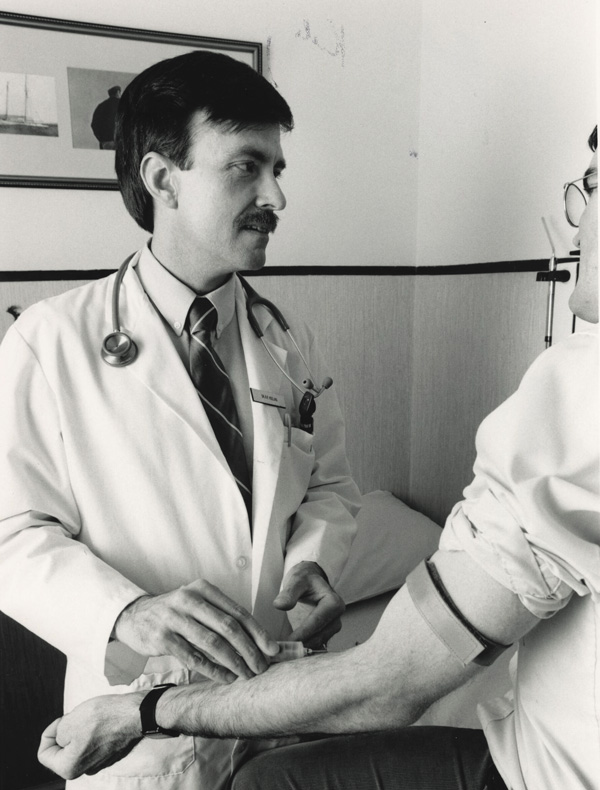
In late 1981 Dr. Richard Keeling (Col class of ’69), UVA’s director of student health service and associate professor of medicine, treated a 26-year-old man with an unusual case of pneumonia. It ultimately killed him and left Keeling hunting for the possible cause. Weeks later he came across the first academic article on AIDS, according to a 1987 UVA Alumni News article.
The next year, Keeling launched an AIDS education program at UVA—one of the first on a college campus. He collaborated with groups across Grounds, including the Gay Student Union. UVA’s tradition of student leadership was the heart and soul of the program, the article says, relying heavily on students teaching other students about AIDS prevention and healthy lifestyles. “We started AIDS education before it became a problem. We didn’t wait for a crisis or for a dozen students to get the disease,” Keeling told Alumni News.
Across the country, as the AIDS epidemic emerged, animosity toward the LGBTQ+ community remained high. In a June 1982 Gallup poll, 51 percent of respondents said homosexuality should not be considered an “acceptable alternative lifestyle.” In the 1984 General Social Survey, 81 percent of respondents said they believed that homosexuality was always or almost always wrong.
On Grounds, disparagement of queer people was one reason Gary Nimax (Col class of ’87) opted not to come out as a first-year. “There were a couple of people who were openly gay, and they were really subject of a lot of discussion and gossip and negative comments that I wasn’t ready for as a first-year student,” says Nimax, now UVA’s assistant vice president for compliance and co-chair of UVA’s LGBTQ Committee for employees.
But when he started sharing more openly about himself with friends as a second-year, he was surprised by the reaction and support. Friends either didn’t care, already suspected he was gay or had another gay friend or relative.
One good friend, who is straight, was more upset that Nimax had waited to tell him. “His brother had just come out to him, and so his reaction was, ‘Why are these gay people in my life not willing to share this with me?’” Nimax says.
By then, the Gay Student Union was entering its second decade and becoming more vocal, mirroring activism and awareness efforts across the country. In 1982, Parents and Friends of Lesbians and Gays launched as a national organization. Down the road in Richmond, the second Pride event occurred in 1983. UVA’s Gay Student Union became the Lesbian Gay Student Union to reflect its changing membership in 1984.
“We started AIDS education before it became a problem. We didn’t wait for a crisis or for a dozen students to get the disease.”
More faculty members also were becoming vocal about their sexuality, helping to build visible forms of support for themselves and students. From 1985 to 1988, rhetoric professor Bernard Mayes and psychology professor Charlotte Patterson, both out, conducted “speakers bureau” engagements in dorms and sororities, according to an LGBTQ+ timeline that Patterson created.
The Lesbian Gay Student Union also was holding meetings, collaborating with more groups across Grounds and had launched a roommate referral service. “The LGSU is more visible than it has been in a long time,” the president wrote in a 1985 newsletter. “In perspective, we’re doing OK. This doesn’t mean that there isn’t more to be done.”
The dances continued too, and Nimax attended a few. “This was not the kind of dance where you’d put up a flier and put up signs all over Grounds,” he recalls. “There was no email or social media … so it was really more of a phone tree and having a friend tell a friend kind of thing that these events were coming up.”
He suspects there are few—if any—photos of the events. Nobody had a smartphone with a camera attached to their hand, he notes. But students were also more discreet. “People were much more conscious about whether someone was out or not than they are now,” he says. “There was more of an assumption that you shouldn’t say anything about this person being gay unless they told you it was OK.”
The stigma of being queer was always in the back of their minds. Nimax remembers a friend debating whether to include their leadership role in the union on their resume. “We had this conversation about, on the one hand, do you really want to work somewhere that would see that as a negative?” he says. “But it was also the reality of the late ’80s. It’s easy to take this high road … if you already have a job. It’s different when you’re unemployed.”
In March 1988, national sentiment was on full display on the Lawn as the union held a public display of affection that drew more than 1,500 spectators. As members wrapped their arms around each other and sang “The Good Old Song,” some of the spectators booed and chanted “Transfer,” the Cavalier Daily reported. Two people wore masks and rubber gloves, and fliers were distributed supporting gay genocide.
“Yesterday’s events brought out a revolting display of fear and prejudice toward people who do not conform to a perceived norm,” the student newspaper’s editorial board wrote.
1990s: A Day of Silence Speaks Loudly
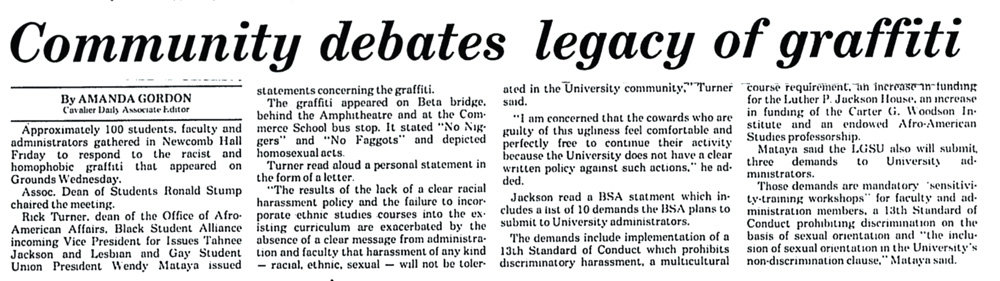
In the early 1990s, homophobia on Grounds and elsewhere wasn’t difficult to find. A couple of months into the spring 1990 semester, racist and homophobic graffiti appeared across Grounds. The graffiti brought light to an “ugliness” that some felt comfortable and free to continue, in part because UVA had no clear written policy against the actions, Rick Turner, then-dean of UVA’s Office of Afro-American Affairs, said in a statement at the time.
On the faculty side, Patterson, Mayes and others hoped to build a more visible network of queer faculty and staff members. They launched UVA Pride, a faculty support group, in 1992.
Both Patterson and Mayes had spent time in San Francisco, where they’d found a vibrant LGBTQ+ culture. They believed it important for more people to be out. For Patterson, being in the closet had been a horrible experience. “We did not want to be hidden,” she says. “I was unusual and Bernard was unusual at that time among UVA faculty. People who we believed to be gay were not often very open.”
The parties were held in Mayes’ basement Pavilion apartment, and there was only one condition to attend. “You didn’t have to bring anything, but you had to agree that you were open and that, if you came, we could say to somebody that you’re gay. You wouldn’t be hidden anymore,” Patterson says. “And it worked. People really wanted free parties and free booze.”
By the mid-1990s, the country was still split on civil rights for gays and lesbians. According to a 1996 Gallup poll, 47 percent of Americans believed that gay and lesbian relations between consenting adults should not be legal, compared with 44 percent who believed they should. That same year, the General Social Survey found that 66 percent believed homosexuality was always or almost always wrong, down from 80 percent in 1973.
In some ways, UVA was ahead of its time. In 1991, then-President John T. Casteen III (Col class of ’65, Grad class of ’66, class of ’70) banned discrimination of staff and students based on their sexual orientation. (By comparison, by 2020, nondiscrimination statutes in most states didn’t call out sexual orientation and gender identity as protected characteristics, according to a report from the Williams Institute at UCLA’s School of Law.)
Around the same time, students were lining up to take a class taught by Patterson, whose landmark research focuses on the study of child development in lesbian- and gay-parented families. Patterson titled her class “Sexual Minorities and Human Development” so that when the registrar abbreviated it on transcripts, it became, “Sex Min Hum Dev.”
She’d heard that some students worried their parents might find out they were taking the class, and that title was sufficiently opaque that it allowed some students to take the course without alarming family members, she says. “It was overenrolled the very first hour it went on the books.”
But while the LGBTQ+ community’s visibility was growing among faculty, staff and students, their experiences were disparate.
While touring UVA as a high school student, Jesse Gilliam (Col class of ’99), who grew up in Alaska and Northern Virginia, felt relieved when he saw a sign for the Lesbian Gay Student Union, which added Bisexual and Transgender to its name in the 1990s.
“I remember thinking, ‘OK, there is a place for me even though this is a perceived conservative institution in a conservative state,’” Gilliam says. Once he got to UVA, however, he realized that “it was very much a situation where you found your pockets for you to be who you are and be safe,” Gilliam says.
Not every corner of UVA felt friendly. For example, Gilliam never ventured to a football game where tens of thousands of fans shouted “not gay” with each singing of “The Good Old Song.” “It’s a real, overtly hostile act,” he says.
Matt Paco (Col class of ’95) did attend football games. To him, the “not gay” shout was annoying. “It’s kind of one of those things that you just live with,” says Paco, who was active in University Union while a student and later co-founded Queer Virginia Alumni. “It wasn’t a good feeling.”
But Paco, who started coming out during his third year, never experienced anything “terrible,” he says. “I was very blessed [with] my friends that I did pick,” he says. “A lot of them were in University Union, and a lot of them ended up being LGBTQ. We all came out later on. I found friends that have been my friends forever since.”
When Maria Pulzetti (Col class of ’99) reached Grounds in the fall of 1995, she was struck by the “invisibility” of the LGBTQ+ experience. It felt very different from her Massachusetts high school, which had a gay-straight alliance.
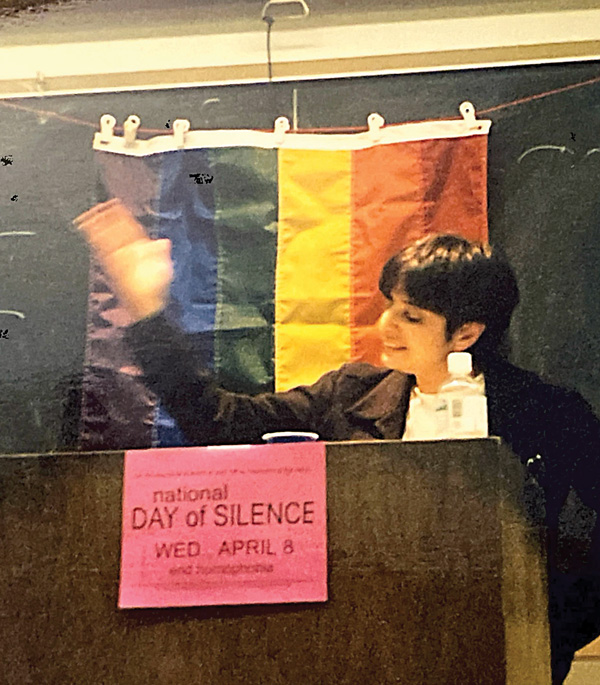
Pulzetti came out during her second semester when she happened to be taking Julian Bond’s popular class covering Bond’s experience organizing student nonviolent protests. She wondered if UVA students could do the same for LGBTQ+ rights.
Her idea turned into the Day of Silence—April 10, 1996—when LGBTQ+ people wouldn’t speak so that the greater community would realize what they were missing. Pulzetti and other members of the now Lesbian Gay Bisexual Union spread the word across Grounds at meetings of student groups, including the Inter-Sorority Council and Inter-Fraternity Council. “People were actually pretty great,” Pulzetti says.
As many as 150 people joined in, including many straight supporters, wearing stickers and distributing note cards that explained why they weren’t talking for the day.
For Gilliam, the most powerful moment that day was seeing participants in a dining hall, not saying a word. “It just made a real statement to me and helped me realize that I was not alone,” he says.
Pulzetti and Gilliam joined forces to expand the Day of Silence beyond UVA. Today the event is part of GLSEN, a national organization dedicated to creating safe and inclusive educational environments for LGBTQ+ students, and reaches hundreds of thousands of students annually.
Broader support for LGBTQ+ students was coming from other directions too. By the late 1990s, 351 students and faculty members had signed on to a letter calling for the end of shouting “not gay” during “The Good Old Song.” It took time and a public relations effort from UVA for the tradition to weaken. Today, many fans are shouting an epithet directed at Virginia Tech instead.
“[The Day of Silence] just made a real statement to me and helped me realize that I was not alone.”
2000s: Building Community
By the late 1990s and early 2000s, years of organizing on Grounds made it possible for students like Ranson-Walsh to jump right into gay student life and activism once he arrived. Ranson-Walsh, whose father is gay, was already immersed in gay-rights activism. Even before he arrived on Grounds for his first year, he’d met Pulzetti and Gilliam and was familiar with Patterson’s research. During his first weeks as a student at UVA, he joined the union, attended the first meeting of the year with hundreds of others, got elected as an officer and was planning Proud to Be Out Week, he says.
That year, he also met Eddie Nelms (Arch class of ’00). The two, brought together by their mutual interest in architecture and placemaking, eventually began seeking a way to open something Ranson-Walsh had seen on college campuses elsewhere: an LGBTQ+ resource center. Before it opened, the gay student group had met at the Wesley Foundation just off Grounds.
The two went on a “hearts and minds campaign,” lobbying for a dedicated space and funding, Ranson-Walsh says. Their work paid off.
The LGBT Resource Center opened in 2000 in the basement of a building off Rugby Road with funding for a graduate assistant staffer. Soon the center moved to the basement of Newcomb Hall, and it now takes a central space across the hall from the third-floor ballroom.
Into the 2000s, the LGBTQ+ community across the country experienced growing acceptance. In 2015, the U.S. Supreme Court legalized same-sex marriage. In 2021, a Gallup poll found that 79 percent of respondents agreed that same-sex relations between consenting adults should be legal.
In 2019, independent group The Campus Pride Index ranked UVA No. 7 among the most welcoming colleges or universities to LGBTQ+ students across the country, in part because of its active resource center.
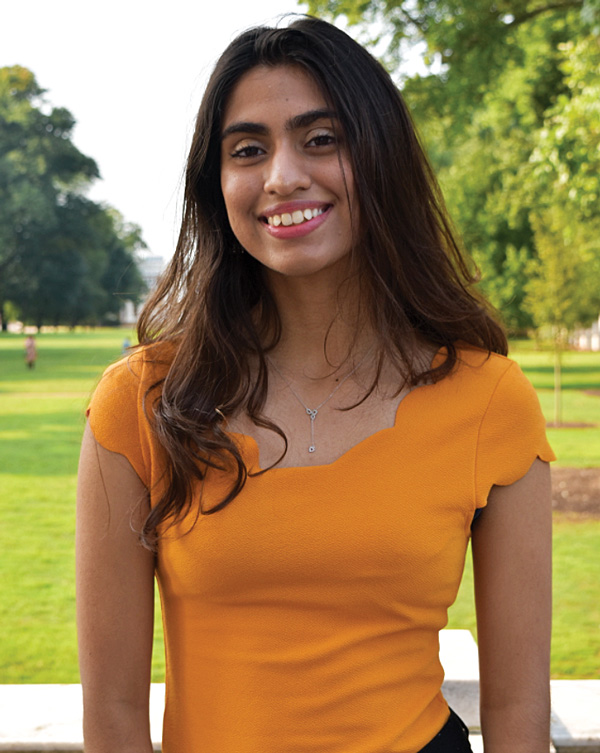
Today, the Gay Student Union has a new name: the Queer Student Union. It continues to provide mentorship and support through programs such as a house parents initiative that pairs upper-class members with first-years and transfer students. Drag bingo remains a popular event. And as it collaborates with other student organizations, such as multicultural or performance groups, it’s also filling up the LGBTQ Center during events, says Anushka Dar (Col class of ’25), now in her second term as president.
New groups have popped up too, like Sigma Omicron Rho, which is now part of the Multicultural Greek Council.
Like any other Greek organization, the gender-inclusive group operates with a rush and pledge week, but new members take part in education programs about various queer identities, President Katrina Clark (Arch class of ’25) says.
She remembers attending her first rush meeting to learn more and instantly clicking with the group’s leaders. “I just loved them as people instantly,” she says. “I had a really good time, and I was laughing. It just felt like a very accepting environment.”
And then there’s QVA, formerly the Serpentine Society, UVA’s LGBTQ+ alumni network. Conceived in 1998, it’s an active force, providing nearly $300,000 annually in scholarships and support for students, including those who have been kicked out by their families after coming out. It also provides networking and events for alumni.
In fact, QVA’s work helped persuade Elkins to return to UVA—something he had had no plans to do. In 2002, he stepped back on Grounds for the first time since he graduated and has been involved with QVA ever since. “I’m very happy with where the University is today,” he says. “It has grown tremendously just in terms of being a welcoming place for LGBTQ folks.”
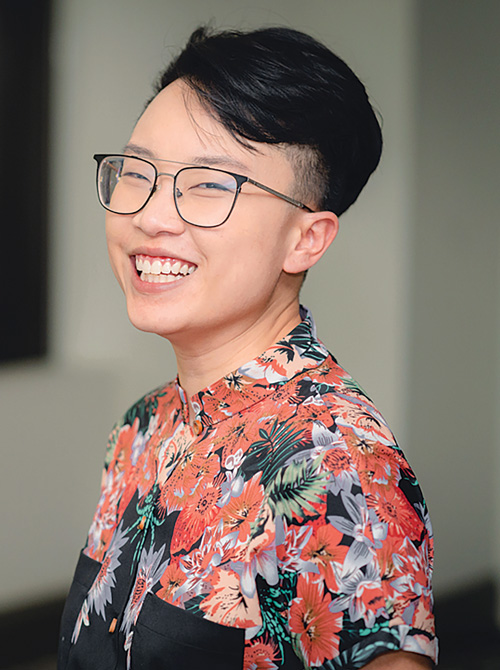
The work of students like Elkins to build that welcoming place over the decades might have been buoyed by another UVA tradition—student self-governance, suggests Felix Nguyen-Dalton (Col class of ’13), QVA’s scholarship committee co-chair. UVA values and cultivates student self-governance and provides the infrastructure to support student-led initiatives. As a result, “students keep organizing,” Nguyen-Dalton says.
“I’m very happy with where the University is today. It has grown tremendously just in terms of being a welcoming place for LGBTQ folks.”
And as new students come in, each on their own journey and amid new personal, societal and political challenges, the need for spaces, places and community remains.
For her part, Dar spent time researching the Queer Student Union’s history to create a presentation of its journey since that first classified ad. As she dug deeper into the archives, she remembers thinking, “This is the most amazing thing I’ve ever seen,” she says. “It gave me so much hope. When I feel burned out, I just think about that history, and I think about how others have been doing this before and how they’ve succeeded. It really drives me as a leader, but also as a queer person just existing in the world.”