“One of the fastest machines on Earth”
A room-sized calculator launched UVA into the future
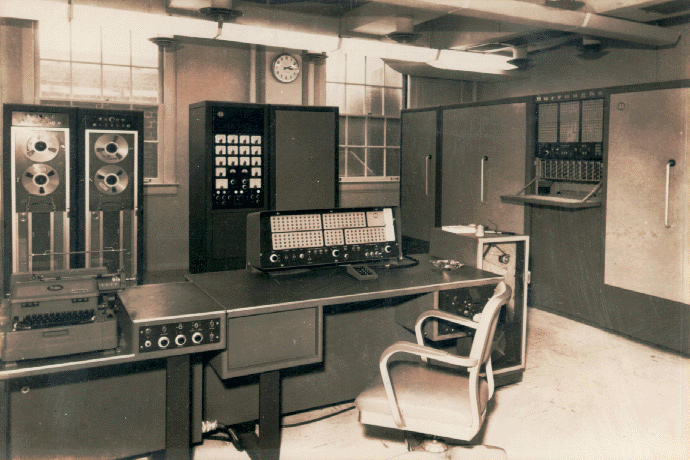
In the early 1960s, UVA’s first computer, a Burroughs 205, took up an entire room in the basement of the physics building off McCormick Road. By today’s standards, the computer—with its big magnetic tape reels and panels of blinking lights—looks like something out of an old science fiction movie. And it was. The same model was featured in dozens of TV shows and movies, including running the Jupiter 2 in Lost in Space and aiding the caped crusader’s navigation in the 1966 movie Batman.
But in those campy Hollywood creations, the computer usually was a minor character. At UVA, it played a leading role. The B205, as it was nicknamed, launched the University into the computer age far ahead of most higher education institutions across the country at the time. And it provided a foundation for academic research that relied on the fast calculations of the newfangled machine.
“It propelled UVA, by leaps and bounds, into the future,” says Gabriel Robins, UVA computer science professor and creator of the UVA Computer Museum, a collection of modern and historical computer-related artifacts at the University. It allowed for “more efficient research and more productive faculty output in terms of papers published, discoveries … of all kinds, in all fields.”
Batson to the rescue
Before it got the B205, UVA had tried and failed to secure National Science Foundation funding for a computer because, President Edgar Shannon would later tell the Board of Visitors, it had a “lack of experience in the operation of a computer center.”
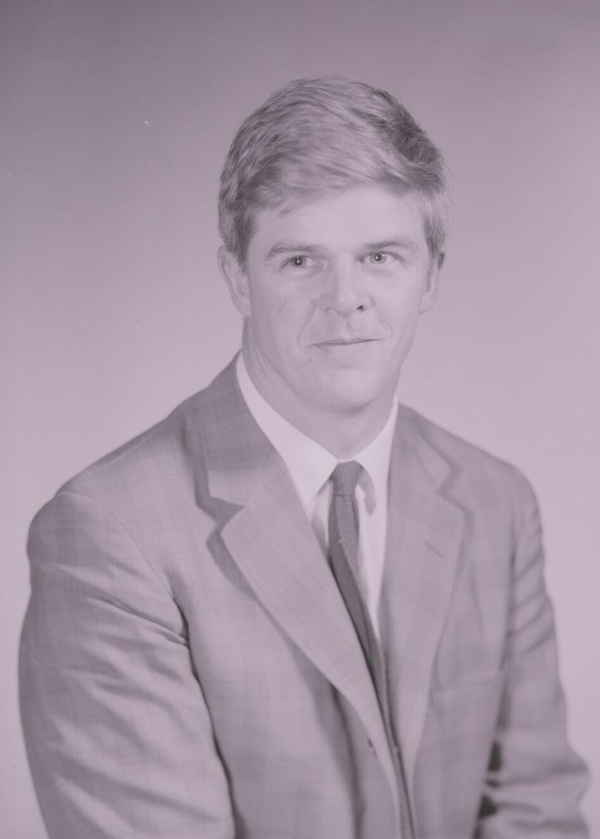
But in 1958, UVA finally had at least one person with a little knowledge of how computers worked. Alan Batson, then a 20-something with a Ph.D. in physics from the University of Birmingham in England, had just moved to UVA to become a physics lecturer. He’d been lured by future UVA President Frank Hereford (Col class of ’43, Grad class of ’47), then a UVA physics professor who studied at Birmingham as a Fulbright Scholar.
“I was the only one at the University who had ever used a computer,” Batson told Virginia Engineering in its spring 2000 issue. “I had used computers in England but had decided to put all that behind me and pursue a respectable career in physics.”
Batson, who would become UVA’s academic computing director, was involved in the effort to bring the B205 to UVA. But he didn’t come to UVA to become its “father of computing,” as he is now widely described. He was simply a young guy with tech experience. And not long after he arrived in Charlottesville, Batson and chemistry professor Paul Schatz were asked to study how UVA might win that grant, the Virginia Engineering story says. They figured it out.
At a June 1960 BOV meeting, Shannon announced that UVA had won a $60,000 science foundation grant for the purchase of a computer. The board agreed to supplement the grant with $150,000 to cover the cost of the computer and its operations for three years; altogether, that price tag would equal about $2.2 million in today’s dollars.
‘One of the fastest machines on Earth’
After it was installed in the physics building in November 1960, Batson and others quickly got to work. By the B205’s official dedication in February 1961, Batson told a Daily Progress reporter that he’d already taught 180 faculty members and students how to operate it.
He also used it to play Nim, a simple mathematical strategy game—though not that often because it wasn’t fun to lose to a computer all the time, he told the reporter. There was more important work to do anyway.
At the time of the B205’s dedication, research using the computer was already underway, according to the article. Those included projects measuring the speed of disturbances in the ionosphere, studying the apportionment of political representation in the United States, and calculating the neutron flux in UVA’s nuclear reactor.
“The computer center is of singular importance for the whole University,” Shannon said at the dedication ceremony, “and useful to many departments that may not immediately be obvious.”
By today’s standards, the B205 was essentially a giant calculator, helping to churn out calculations in two seconds that, as the Daily Progress story noted, would take a human two hours to complete. The B205 relied on vacuum tubes and a magnetic drum memory system, along with punch cards, to store and process information.
“It can do hundreds of computations per second, which is faster than a human but literally millions of times slower than today’s smartphone,” Robins says. “But at the time it was a great innovation and one of the fastest machines on Earth.”
Science researchers were especially eager to harness the capabilities of the new computer. Until then, they’d been doing calculations by hand, which took time and was prone to error or—depending on the number of calculations required—was simply impossible.
Then, and now, computers have enabled not only calculations that humans can’t do, but also those that might not even be tried because it could take years to do all that math, says Alice Howard (Col class of ’75, Engr class of ’79), who served as UVA’s special assistant to the vice president and chief information officer until she retired in 2016. She is also Batson’s widow.
With the Burroughs 205, Robins says, UVA’s academics could more easily process the data that came from their telescopes or microscopes to uncover statistical significance or deviations, spikes or aberrations that deserved more investigation.
But Batson, whose master’s thesis was about ballet, was also eager to see professors in the humanities use the computer, Howard says.
A screwdriver party
People were “awed” by the B205, according to the Virginia Engineering article. Then an undergraduate engineering student, Ted Foster (Engr class of ’63) remembers getting a chance to see it but not fully understanding its significance. “We didn’t even know what a computer was,” says Foster, who would soon work on computers elsewhere.
While the B205’s existence on Grounds was a novelty to some, it quickly became a draw for tech-minded students and researchers. In a 2015 interview, William Wulf (Engr class of ’68), who would become a world-renowned computer science pioneer, told the Charles Babbage Institute that when he was applying for teaching jobs in the early 1960s, he considered only the dozen U.S. universities with a computer, including UVA.
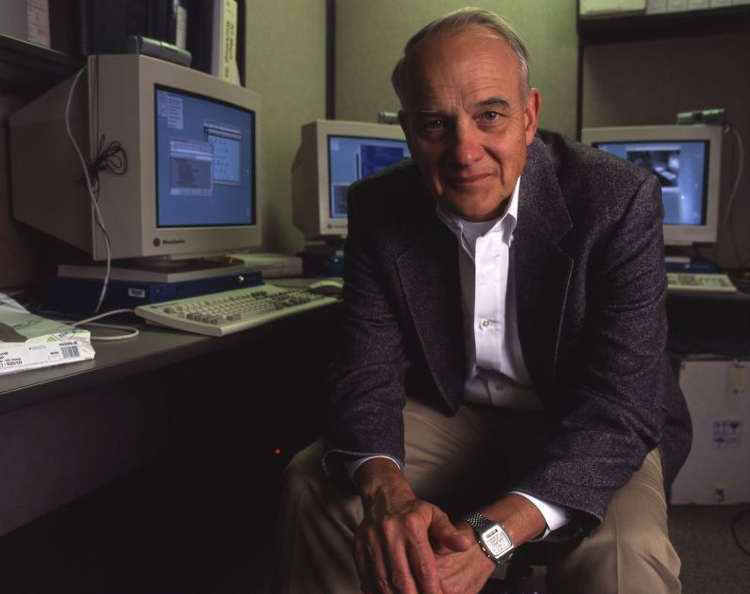
Wulf, who died in 2023, eventually received UVA’s first Ph.D. in computer science. Batson, who died in 2020, served as his dissertation adviser. Wulf retired from UVA as a professor emeritus of computer science in 2012.
In those early years, just like today, the development of technology moved fast. By 1964, Batson, Wulf and UVA had moved on to a bigger, better and faster computer, another Burroughs machine, costing $1 million, that was in a specially designed 9,000-square-foot computer science center in Gilmer Hall’s basement.
The B205 was “faster than a human but literally millions of times slower than today’s smartphone.”
Wulf told Virginia Magazine in 2014 what ultimately happened to the B205: Batson “declared we would have a ‘bring your own screwdriver’ party,” he said. “We took the machine apart.”
But they didn’t forget about it. Decades after the computer was sent out of commission, Batson and Wulf kept reminders of the B205 in their home studies—a photo of it for Batson and its control panel for Wulf.