No ifs, ands or bots? How to control AI

It is 2 a.m., and a student is stumped. Where to turn for a translation of some opaque academic jargon? Where to go for an inspired idea for a project?
Since November, when the research laboratory OpenAI released ChatGPT, some students have turned to the popular, dazzlingly futuristic and even somewhat scary generative artificial intelligence platform. In a conversational style, ChatGPT and other programs like it can serve as a tutor and collaborator—an endlessly patient adviser that will never make you feel stupid for asking a question. It can also, to address the 800-pound chatbot in the room, generate students’ work for them, given the right prompts, whether the assignment is an essay, lines of computer code or virtually any other academic deliverable.
At an April town hall, Andy Pennock, an associate professor at the Frank Batten School of Leadership and Public Policy, demonstrated how ChatGPT can be used by students. Pennock typed in prompts, and ChatGPT came up with an idea, created an outline, and wrote and edited a brief portion of a paper analyzing a plan to address the mental health crisis among high school students by putting peer support groups in schools.
AI-generated text raced across Pennock’s computer screen after each prompt.
“Student learning will take place in a world where AI is undetectable, ubiquitous, and transformative.”
“Accountability and transparency are critical components in the effective implementation and management of high school peer support programs,” the chatbot began, after being prompted to write two paragraphs on the topic. “By fostering a culture of openness and responsibility, schools can demonstrate their commitment to providing consistent, high-quality support for all students.”
Pennock had some nits with what ChatGPT produced. The ideas it generated fell short of what he would expect from his students, he said. Still, they were a good start. At one point, he prompted the AI to rework what it wrote. ChatGPT apologized and tried again, seeming, for a computer program, affably human. The exercise took about five minutes.
Certainly, Pennock told those watching, the program passes the Turing test—an evaluation of whether a computer’s response to a question is indistinguishable from a human’s.
Navigating new questions
Trained on massive sets of text and data, ChatGPT and other such large language models grow smarter and more “human” by the minute, if not the second. For example, GPT-4, which as of this writing was OpenAI’s most advanced system, scored in the top 10 percent of all test takers on a simulated bar exam. Its predecessor, GPT-3.5, scored in the bottom 10 percent.
It’s no wonder that UVA and other universities are wrestling with the ethical, pedagogical and, yes, even existential questions raised by this rapidly evolving technology, and its effect on what and how students learn and how that learning is assessed.
“It gets at the core value proposition of the University,” Pennock said. “Can we differentiate people who are learning from people who aren’t? And can we help students learn? Do our methods help students learn the material that we need them to? Because that matters for developing responsible citizen-leaders. That’s our mission, and this matters to that.”
Those are a few of the key questions. Among the others: Does instruction need to change? If so, how? What about evaluation? And how does the Honor System police this new frontier?
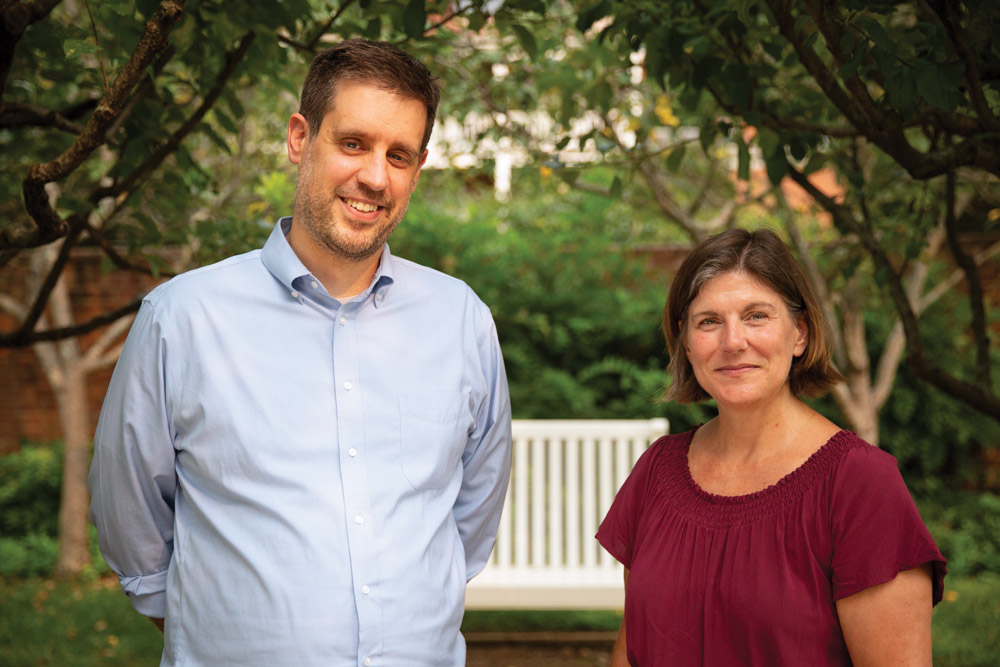
To begin a discussion of those topics, Vice Provost for Academic Affairs Brie Gertler formed the Generative AI in Teaching and Learning Task Force. It was co-chaired by Pennock and Natasha Heny (Col class of ’95, Educ class of ’13), an associate professor in the School of Education and Human Development. It held six town halls in March and April in which it engaged with 300 faculty members. It also surveyed students and faculty on their use of AI.
In July, it released a report of its recommendations. It warned that “starting this fall, student learning will take place in a world where AI is undetectable, ubiquitous, and transformative.”
The task force’s recommendations focused largely on providing professional development for faculty grappling with how generative AI may or should change their teaching methods.
Among the immediate steps: developing a “Teaching in a Generative AI World” website providing background on Generative AI, guidance for anticipating how students will use it, suggestions for revisiting the learning goals of courses, and concrete strategies for teaching in the new world. That site was scheduled to launch in August.
The task force also recommended that UVA develop University-wide and department-specific workshops and develop a cadre of AI experts at the Center for Teaching Excellence. It called on the University’s Information Technology staff to provide clear guidance to faculty on how AI can be used, encouraged schools to create plans for how their curricula will adapt, and recommended requiring syllabus statements that draw clear lines on AI uses in courses.
Differing levels of comfort
For some faculty, help can’t come soon enough, said task force member T. Kenny Fountain, an associate professor of English and director of UVA’s Writing Across the Curriculum initiative. Like any new, disruptive technology, generative AI has many faculty members “nervous and anxious,” he said.
“I think some feel overwhelmed, and I get that,” he said. “Because if you didn’t pay much attention to it, it didn’t exist, and now, six months later, it’s all you’re hearing about.”
The pace with which generative AI entered the mainstream also took some students by surprise. According to the task force report, generative AI is the most rapidly adopted technology in history, with 100 million users in the first two months after ChatGPT launched. Though OpenAI’s ChatGPT is the best-known platform, Microsoft (Bing, Copilot) and Google (Bard) are also major players in the field, along with Anthropic, a company started in 2021 by former employees of OpenAI that has developed a rival chatbot named Claude. Task force members stressed that students will need to be prepared for a world and a workforce in which AI will be imbedded in everyday work products and tools.
Students are already getting up to speed. As a group, they are likely ahead of faculty in their familiarity with generative AI, which is no surprise given that they are digital natives who are accustomed to learning virtually, due to the pandemic.
Of the 504 students who responded to the AI task force’s survey, 42 percent reported using generative AI for coursework. Students said they most commonly used it as a study tool and as a generator of ideas for assignments. Because of the relatively small sample size, and because those who are interested in the technology might have been more likely to complete the survey, the task force does not consider it necessarily representative of the student body.
Anecdotally, students report experimenting with the technology for more than classwork.
“It seems like people, honestly, are having fun with it,” said Brianna Kamdoum (Com class of ’24), a McIntire School of Commerce student who serves on the Honor Committee. “It’s evident that more students are ahead of the curve, relative to AI, than faculty members.
“That is an information gap that hopefully we can mend.”
Danielle Stephens (Col class of ’24), an English and government double major, said a chatbot was incorporated into an exercise in a linguistics class she took in the spring semester. The exercise involved reading text and determining whether it was written by AI or an actual person. Some students guessed wrong. (All the passages were AI-generated.) None of her other classes had any AI component, and she said she would not use it for written assignments.
“For actual writing assignments, I think that needs to be purely from you,” she said.
Stephens also cited the Honor Code as another reason not to use the technology. Concerns with Honor and academic integrity are a major reason students have been hesitant to use AI in coursework, said former Honor chair Gabrielle Bray (Col class of ’23), who was the student representative on the task force.
“There are a lot of folks who still feel very uncomfortable with it being used in anything related to academia or writing,” she said.
Still, Bray said, in the spring semester there were students who used the technology in what she described as “academically dishonest” ways.
“It’s a really interesting moment where technology has been adopted faster than anybody can prepare a response,” Bray said. “There are students using it in ways that I would say are unethical, but without clear guidance on what is or is not academic dishonesty on an entirely new frontier, I can understand why it’s happening.”
Bray is not alone in believing some may be using AI unethically. In the task force survey, just 27 percent of faculty respondents and 23 percent of student respondents said they believed students who are using AI are doing so in ways that comply with the Honor code.
Students reported that just 23 percent of classes in the spring semester had clear AI statements. For the Honor Committee, getting clarity from instructors on what is allowable usage of AI in a particular class will be paramount, Kamdoum said. “It’s not something we can hide from or run away from.”
Pitfalls and complexities
Academic integrity is just one of many concerns with generative AI. There’s also real potential for learning loss, Fountain said. Students who use the technology to write papers would not engage with ideas in the way they would if they wrote the paper themselves, he said.
“Writing is also a way of thinking; it’s a form of cognitive elaboration,” Fountain said. “It allows us to think through ideas. It augments learning. But we have to actually be doing the writing for that to happen.”
Then there’s the matter of algorithmic bias, through the use of older and problematic sources and inputs. Gender bias has been shown to be an issue, with neutral searches producing male-dominated results in a study by psychology researchers.
There are also questions of data privacy, intellectual property rights and economic access. Paid versions of generative AI programs have more features than free ones. The version of ChatGPT that Pennock used in his demonstration costs $20 per month, he said. The committee recommended that the University develop a strategy to ensure equal access.
Another concern is that, for all its capability, generative AI often produces poor scholarship. Its writing tends to be hackneyed and formulaic. It makes word choices based on likely associations between words in its database.
“It relies on very conventional clichéd phrasing,” Fountain said. “Ask it to write a speech? Good Lord. Nothing but platitudes. A eulogy? This is the greatest person who ever lived.”
“It gets at the core value proposition of the University. Can we differentiate people who are learning from people who aren’t?”
“It doesn’t know anything, it doesn’t have any belief, it just knows that this word is the most likely next word,” said Lawrence Solum, a UVA law school professor who first wrote about legal questions of legal personhood for artificial intelligence in the 1990s.
“Sometimes if the query is right and the data is right, a paper written by AI may be quite good. Sometimes it will simply make up something that sounds plausible to us.”
Such an outcome is called a “hallucination.” It can occur when an AI does not have access to information, because it’s behind a paywall or simply not online.
Solum cited an instance of an AI making up a legal brief, complete with citations. A judge sanctioned the lawyers who submitted it. Fountain said he asked ChatGPT to write his biography. It said he was a famous artist who worked in various media, from sculpting to dance. (It could not have been more wrong, he said.)
Updated models will be better. Still, Bray stressed the need for students to be wary of what AI tells them. She quoted a tweet from the writer Neil Gaiman: “ChatGPT doesn’t give you information. It gives you information-shaped sentences.”
Knowing the difference will be crucial.
“We really have to start teaching our students how to be critical,” Heny said. “That’s the challenge. It’s an opportunity too.”
Seeing the potential
For those inclined to view AI through an optimistic lens, the opportunities to incorporate the technology into teaching and learning seem boundless.
Pennock, who is bullish on the possibilities, said one undersold strength of AI is how it can enhance reading. It can summarize difficult technical concepts for students and explain them at a ninth-grade level, for example. It can also be prompted to act as a tutor that asks students questions and lets their own answers guide them to a deeper understanding. He cited the example of a student asking an AI to create study questions for an economics exam. The chatbot can follow up with harder questions when a student gets one right, and easier ones when a student gets one wrong.
It can provide a means for students to enter a conversation, Pennock said.
“We as faculty, or even our TAs, could do that too, but we’re not there, because students are studying at 2 a.m. because they’re 18, and I’m asleep, because I’m 45.
“Is it 100 percent reliable? No, but your TA is probably not 100 percent reliable either, and (AI) has infinite capability.”
In quantitative disciplines, AI has been shown to enhance efficiency. Randomized controlled trials revealed that computer programmers worked 50 percent faster when assisted by AI, Pennock said.
Richard Ross, an assistant professor of statistics, encourages students to use ChatGPT as a collaborator in his course on data visualization and management.
Students edit code that the chatbot writes and also use AI to edit code they write.
“It can write code pretty well,” he said. “If you have a class where students are using a programming language you can learn a lot by looking at code that’s correct.”
Students ask the chatbot to write code that performs a function, such as running a statistical test or making a simple web dashboard.
“Oftentimes it’s at least very close to what you want. I present and recommend it to students as a springboard, to help get an idea started.”
They are also encouraged to use it, with citations, in their final projects.
Ross said that the level of familiarity with generative AI tools varies widely among students. He said students must be encouraged to look at ChatGPT and even Google with an appropriate level of skepticism and not as “solution centers” whose output can be taken as necessarily correct.
“One of the conversations we have very early on is talking about what generative AI is, and how it works, on a very, very basic level. I also try to highlight ways that ChatGPT in particular can be wrong in very obvious ways.”
He said he tries to promote a better understanding of how to best use AI tools, and where they fall short. In creating graphics, for example, the focus is more on the principles of design than the “simple repetitive coding” that can be done by AI.
“We think about the philosophy behind our graphics much more than we think about all of the specific mechanics.

“It’s getting students to realize they must be skilled at the things the chatbot does not do well.”
Kendall Sano (Engr class of ’26), a biomedical engineering major, said AI can help students think more critically about big-picture concepts without worrying about specific coding implementations.
“You don’t need to know how to do those little things, and you don’t need to hire a software developer. You can just ask the AI to generate a web page or help you do a small program,” Sano said at a town hall.
As an experiment, Pennock used AI to build a geographic information system map, which connects layers of data to a location, using data points he created. The AI printed the Python programming code required and walked him through the process of installing the code and creating the map.
“As somebody who doesn’t code at all, within 30 minutes I had done something I would not have even tried before,” he said. “So when we talk about students being able to do more, I would say a lot more, really quickly.”
In turn, instructors could expect more, he said.
“Maybe a bare-bones essay doesn’t get a C anymore. If that can be produced at the press of a button, maybe now your effort has to be what was previously A-level work.”
Other areas of assessment must be re-evaluated. According to the task force report, some faculty members are considering returning to in-class, pen-and-paper exams rather than take-home or digital work.
In many disciplines, writing is the primary tool used to demonstrate learning. Evaluating writing generated with help from AI becomes trickier. Students could cite passages where they had used AI, but it can be hard to discern where its work leaves off and a student’s begins.
“The idea that there’s going to be this easy line between the student and the student’s collaborator—it’s just not true,” said English professor Fountain, who worries that faculty will “overcorrect” in response to AI.
Added AI task force co-chair Heny: “How we assess will change. We have to ask: What is the content that we want to teach? What are our goals? Our goals, theoretically, don’t change. We all have learning goals. We may have to change the types of things we teach.”
Searching for footing
The types of assignments could change as well. Dorothy Leidner, an information systems expert and distinguished professor of business ethics at McIntire, said her approach to AI is to “give students things to think about that generative AI can’t answer for them.”
Leidner, who will teach a course on ethical application of artificial intelligence in the fall, said she sees the technology as a net positive. Among the benefits are the way it can potentially advance the democratization of information, and how it can level the playing field for students whose first language is not English.
“I’m probably more open than a lot of people,” she said. “I feel like students should use it whenever they can or whenever they want to. I think it’ll save some time on some things. At the same time, you’re going to have to spend a lot of time verifying whatever you get from it.”
As part of her ethics class, Leidner will discuss how norms and behaviors have changed as society has adapted to innovations in technology throughout history. She will raise the question of whether the rush to regulate the technology might be motivated by fear of the unknown.
“Are we applying too high a standard to AI because we’re scared?” she said.
It’s an important question, one of many that universities are reckoning with. And we knew just whom to ask for some thoughts on it.
We typed our prompt. Text raced across the screen, some 430 words in a matter of seconds, detailing familiar ethical, safety, legal and academic concerns surrounding generative AI.
“It is important to note that the cautious approach is not solely driven by fear of the unknown,” ChatGPT wrote. “Rather, it reflects a responsible attitude toward the development and deployment of powerful technologies like generative AI. While there may be debates and discussions around the appropriate level of regulation and oversight, most responsible researchers and universities understand the need to strike a balance between innovation and safety.”
Easy for ChatGPT to say. Unlike higher education, which it is threatening to disrupt, it has no soul to search.