Mounting Pressure
What the record shows about the events leading to Ryan’s resignation and what UVA faces now
This story is updated to reflect the outcome of the Aug. 28 General Assembly Senate Privileges and Elections Committee meeting.
On April 11, the U.S. Department of Justice sent UVA leadership and counsel a letter. Citing the 2023 U.S. Supreme Court decision striking down race-conscious admissions decisions, the DOJ requested that UVA certify that it did not use such factors in undergraduate admission. One week later, it made the same request for admissions at the law school.
At the end of the month, a third letter came, marking a shift in both tone and content. This one sought compliance not with a SCOTUS decision but with a resolution by UVA’s own Board of Visitors. It was also the first letter to cite complaints that had come in to the DOJ.
Over a period of 10 weeks in the spring, the DOJ sent seven letters to UVA leaders, ostensibly building an investigation focused primarily on admissions practices. Ten days after the last letter, UVA President Jim Ryan (Law class of ’92) announced his resignation.
Many questions remain about the DOJ’s ongoing investigation into UVA and the events that led to Ryan’s resignation. In reporting on these events, Virginia Magazine relied on publicly available information—documents that have been made public by news outlets, as well as websites and public statements. They show increasing pressure on UVA from inside the Trump administration’s DOJ—mostly coming through two alumni—on issues of race.
The landmark case
In June 2023, the Supreme Court ruled that the race-conscious admissions practices at Harvard College and the University of North Carolina were unlawful under the Equal Protection Clause of the 14th Amendment of the Constitution. Justice Neil Gorsuch, in a concurring opinion, wrote that such practices do not comply with Title VI of the Civil Rights Act of 1964, which prohibits racial discrimination by federally assisted programs.
The decision upended 45 years of precedent and is woven through Trump administration orders about higher education. The president first cited it in an executive order “ending illegal discrimination” on his second day in office, and then in an April order targeting accreditation.
In February, the Department of Education sent a Dear Colleague letter to colleges and universities seeking to broaden the scope of the ruling beyond admissions to race-conscious decision-making in “all other aspects of student, academic, and campus life.” It added diversity, equity and inclusion programs as potential sources of discrimination.
“The large majority of students were shocked and confused and hurt.”
The letter sought compliance with “the Department’s existing interpretation of federal law” within two weeks, threatening the loss of federal funding. (In April, the department said it would not enforce or implement the letter until further notice after a federal court ruled against it in a case in New Hampshire.)
The orders soon made their way to Grounds. In March, UVA’s BOV cited the SCOTUS decision, along with the January executive order and the February Dear Colleague letter, in its resolution to dissolve the university’s Division of Diversity, Equity, Inclusion, and Community Partnerships. The resolution, which passed unanimously, also directed UVA to transfer “permissible programs” to other organizational homes and to continue doing legally permissible research and activities. Ryan was also directed to update the BOV on compliance within 30 days.
“DEI is done at UVA,” Gov. Glenn Youngkin wrote on X. “Today, the University of Virginia Board of Visitors voted for commonsense saying NO to illegal discrimination and YES to merit-based opportunity. Students at Mr. Jefferson’s University—and across America—deserve unlimited intellectual freedom, not ideological gatekeeping.”
For his part, Ryan stated that he would comply with the orders in the resolution, just as he did after the 2023 admissions decision. Back then, Ryan wrote that admissions officers would not have access to “any self-disclosed ‘checkbox’ information regarding the race or ethnicity of the candidates they are considering.”
After the resolution in March, Ryan wrote that the central DEI office housed several important functions, including the Office for Equal Opportunity and Civil Rights and Title IX compliance, and that the university would review where they should go. He also wrote that the university had already been reviewing its policies and practices in recent weeks to ensure that they complied with federal and state antidiscrimination laws, and that it would continue to do so.
At some point in the meantime, the Department of Justice began investigating.
The Justice letters
The DOJ’s first two letters, to University Counsel and Senior Assistant Attorney General Cliff Iler, had the same structure. They cited the Supreme Court ruling and requested information about, first, undergraduate admissions, then law school admissions; admissions policies and procedures, and any changes since the 2023 decision; data including test scores, GPA, activities, essays and outcomes disaggregated by race; and any analyses the school had done about admissions trends or outcomes by race. Signatory Harmeet Dhillon (Law class of ’93) told CNN’s Jake Tapper in June that the DOJ had cast a wide net; similar letters went out to 70 colleges and universities.
The third letter, on April 28, was a departure.
This one went to Ryan, Iler and then-Rector Robert Hardie (Col class of ’87, Darden class of ’95, class of ’99), and was signed by Dhillon and Gregory Brown (Col class of ’89), two UVA alumni who work in the Civil Rights division of the DOJ. It indicated that they had received complaints that UVA may have failed to comply with the BOV’s March 7 resolution, which it said called for “the total elimination of DEI” at UVA. The letter demanded that the school produce a large amount of materials, some of which went beyond the scope of compliance with the resolution. The demands included all written or electronic records of BOV open and closed sessions and deliberations; detailed certifications from all UVA divisions regarding any positions with diversity, equity and inclusion responsibilities and whether and how those staffers were still associated with UVA; and all reports regarding the work outlined in the BOV resolution. The letter set an initial May 2 deadline for the materials.
That day, the letter was made public from an anonymous account on X.
While no public update on UVA’s compliance with the resolution has been made as of this writing, the day after this letter was sent, the BOV adopted a resolution stating, in part, that “the University of Virginia has made progress on implementing the directives of the Board of Visitors’ March 7 resolution on Diversity, Equity, and Inclusion.”
At some point in April, UVA also secured representation from the law firm of McGuireWoods, said Rachel Sheridan (Col class of ’94, Law class of ’98), who became rector on July 1 and as such speaks for the BOV, at the Faculty Senate meeting on July 11.
In May, Dhillon and Brown sent two more letters to UVA leadership. The first, on May 2, detailed an investigation into complaints of antisemitic hate-based misconduct and university retaliation against a fourth-year student. (In June, a grand jury did not issue a felony indictment in the case; another grand jury hearing was set for August.) The second letter that month, on May 22, added UVA’s med school admissions to the DOJ’s growing investigation list.
In June, the letters’ tone shifted again. On June 16, Dhillon and Brown wrote: “[T]he Department has received complaints that President Ryan, his administration, and certain faculty members have been actively engaged in attempts to defy and evade federal anti-discrimination laws and the directives of your board.
“Indeed, evidence supplied to the Department would suggest that President Ryan and his proxies are making little attempt to disguise their contempt and intent to defy these fundamental civil rights and governing laws,” they wrote.
The letter added to the growing investigation admissions practices at the School of Nursing, the Darden School of Business, and the undergraduate and graduate components of the School of Education and of the McIntire School of Commerce. It also added “allegations of antisemitism, anti-Zionism, and anti-Israeli (or American-Israeli) discrimination, harassment and retaliation” as part of the overall investigation, with compliance by an agreed-upon deadline of June 23.
The next day, Dhillon and Brown sent another letter of “considerable urgency,” writing that they’d received a complaint from an undergraduate student about the consideration of race in admissions for McIntire and the Frank Batten School of Leadership and Public Policy.
“The Department must insist that the University of Virginia, through its Rector and Visitors, take immediate corrective action to bring the entire institution within compliance of governing federal anti-discrimination laws,” they wrote. “Dramatic, wholesale changes are required, now, to repair what appears to be a history of clear abuses and breaches of our nation’s laws and our Constitution by the University of Virginia under its current administration.”
After that June 17 message, the letters stopped.
Ryan’s resignation
On the evening of June 26, The New York Times reported that the DOJ had privately demanded Ryan’s ouster to help resolve its investigation into the school. (Dhillon has publicly denied that it was a demand but has said that she lacked confidence in Ryan’s ability to “preside over the dismantling of DEI.”)
The next day, Ryan announced that he would resign.
“I am inclined to fight for what I believe in, and I believe deeply in this University,” he wrote in a message to the community. “But I cannot make a unilateral decision to fight the federal government in order to save my own job. To do so would not only be quixotic but appear selfish and self-centered to the hundreds of employees who would lose their jobs, the researchers who would lose their funding, and the hundreds of students who could lose financial aid or have their visas withheld.”
Before the news went out, 50 to 60 of UVA’s top leaders received an email calling for an emergency Zoom meeting at 1 p.m. with Ryan, said Faculty Senate Chair Jeri K. Seidman, an associate commerce school professor.
Ten minutes before the meeting began, The New York Times reported that Ryan planned to resign. The meeting lasted just 15 minutes, but it was charged with emotion. Many attendees were visibly upset, Seidman said. Attendees filled the chat with expressions of deep sorrow and appreciation.
“Many people cried,” she said. “Shock. Tears. Lots of people expressing how they’ve worked here for decades and had never had a president that they felt closer to or happier to support. He just largely seemed exhausted.”
Across Grounds and beyond, the reaction to the news came quickly. In a written statement to news media, Dhillon said the DOJ has a “zero-tolerance policy toward illegal discrimination in publicly-funded universities.”
“When university leaders lack commitment to ending illegal discrimination in hiring, admissions, and student benefits—they expose the institutions they lead to legal and financial peril,” Dhillon’s statement said. “We welcome leadership changes in higher education that signal institutional commitment to our nation’s venerable federal civil rights laws.”
Virginia’s U.S. senators, Mark Warner and Tim Kaine, both Democrats, issued a joint statement in response.
“It is outrageous that officials in the Trump Department of Justice demanded the Commonwealth’s globally recognized university remove President Ryan—a strong leader who has served UVA honorably and moved the university forward—over ridiculous ‘culture war’ traps,” they wrote. “Decisions about UVA’s leadership belong solely to its Board of Visitors, in keeping with Virginia’s well-established and respected system of higher education governance. This is a mistake that hurts Virginia’s future.”
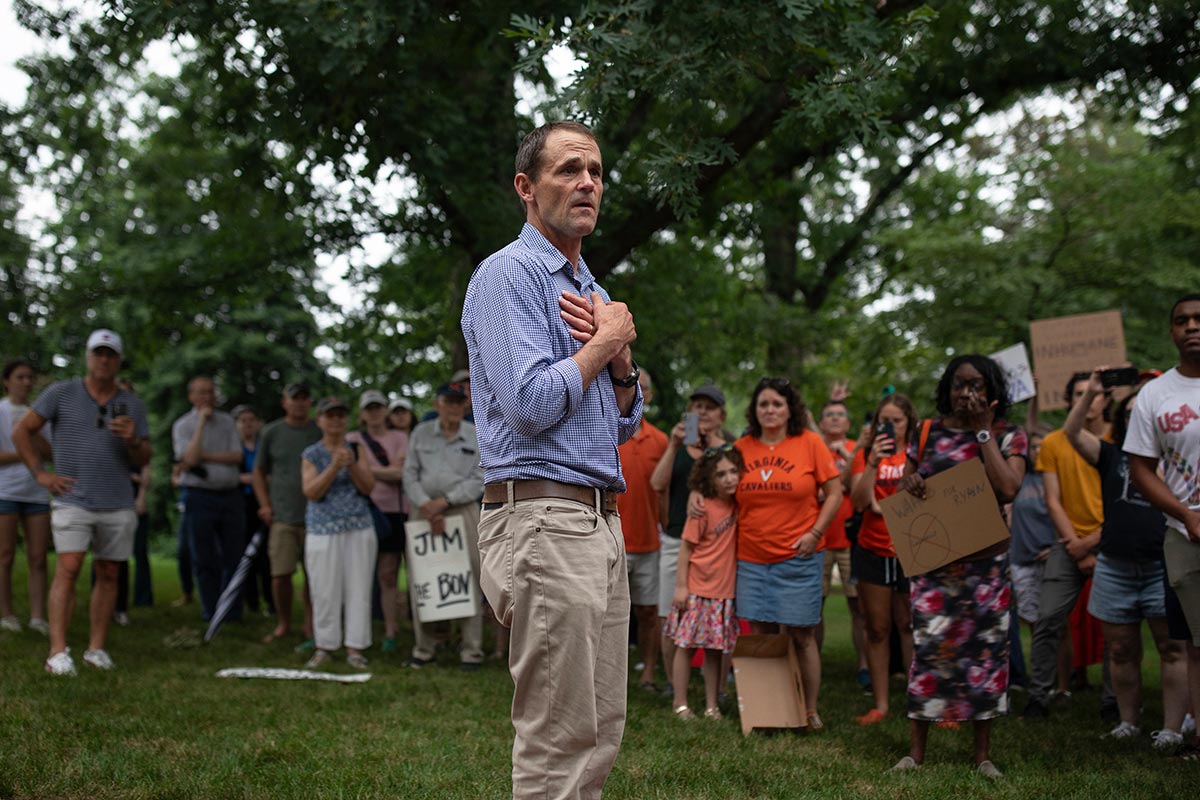
That afternoon, a couple hundred people gathered on the Lawn, and later at Carr’s Hill. From the Rotunda steps, Seidman read from a Faculty Senate resolution that affirmed its support of Ryan and called on the BOV to condemn the DOJ demands that led to Ryan’s resignation. English Professor Deborah McDowell hadn’t planned to speak, but she found herself drawn to.
“There are, in my view, some legitimate complaints against President Ryan, but they did not, for me at least, rise to the level of the decision to pressure him to resign,” McDowell said. So, she wanted to know, where is the evidence that DEI policies and practices remained or that UVA supported antisemitism?
“Let facts be submitted to a candid world,” McDowell later said, quoting from a line in the Declaration of Independence.
Among student leaders, the immediate reaction was surprise and chaos, said Student Council President Clay Dickerson (Col class of ’26). “The large majority of students were shocked and confused and hurt at the outcome of that weekend, even if they didn’t like President Ryan,” Dickerson said. “It was really, really frustrating.”
Dickerson called Ryan a “great ally” for students. He had been actively working with Ryan and the Honor Committee on a project aimed to elevate the importance of public service on Grounds, he said.
That day, the Student Council Executive Board posted a statement, “This is our University,” addressed to the BOV, Youngkin and the DOJ on social media. “The important right of a public institution to govern itself has been stripped and commandeered by federal forces, and the loss of President Ryan is the latest domino to fall,” they wrote. “In the wake of this resignation, student self-governance is more critical than ever. The will of the students, those who know this community best, is meant to guide this Great and Good University.”
The next day, students, staff and Charlottesville residents turned out for the final “Run with Jim,” organized by the Fourth-Year Trustees. They ran 2.8 miles with the president, the Cavalier Daily reported, from the Rotunda to Scott Stadium and back. After the run, Ryan thanked supporters.
Executive Vice President and COO J.J. Wagner Davis served as acting president until UVA law professor Paul G. Mahoney was named interim president in early August. He will serve while the BOV searches for UVA’s 10th president. The 28-member search committee includes alumni, professors, staff and students, as well as 11 current or former BOV members appointed by Republican governors and two former BOV members appointed by Democratic governors. At the Aug. 4 BOV meeting, Catherine Lindqvist of UVA’s Executive Search Group said they anticipated the search launching in late August or early September and taking four to six months.
Ryan will return to teach at the law school after a sabbatical, the university announced.
The BOV’s role
Under state code and board policy, oversight of the university president rests with the BOV, which may remove a sitting president with a two-thirds vote of its members.
That supermajority mechanism came into play in 2012. As it is widely reported, then-Rector Helen Dragas (Col class of ’84, Darden class of ’88) and then-Vice Rector Mark Kington (Darden class of ’88) informed then-President Teresa A. Sullivan that they had enough board votes to remove her and offered her a separation agreement, which Sullivan signed. She was reinstated two very tumultuous weeks later by a unanimous vote of the board at a special meeting.
Under code, four-year appointments to the board are made by the governor and approved by the General Assembly. One student and one faculty member also serve each year but do not vote.
Because of the staggered schedule of the terms, each governor can appoint all 17 members during their four years in office. Currently, all the members were appointed by Youngkin. This is the last year of Youngkin’s term; in November, a new governor will be elected. (In Virginia, governors may not serve consecutive terms.)
It’s unclear what role the BOV had in Ryan’s decision to resign. Sheridan has given few details, citing advice from counsel.
“The DOJ inquiry was discussed at multiple board meetings,” she told the Faculty Senate in July. “The unanimous motions that came out of those meetings are a reflection of conversations around those compliance issues: academic freedom, institutional autonomy, and freedom of expression.
“There were very limited interactions between the BOV and the DOJ during this time. All interactions with the DOJ occurred with Jim Ryan and [then-]Rector Hardie’s authorization or at their specific request. University counsel was present and leading every interaction.”
The board met on April 29, June 4-6, and Aug. 4. (A meeting on July 2 had briefly been scheduled but was canceled that day, according to UVA spokeswoman Bethanie Glover.) As of this writing, the next scheduled meeting is Sept. 11.
In a statement read at that July Faculty Senate meeting, former BOV faculty representative Michael J. Kennedy wrote that while the initial DOJ letters had been public during the June 4-6 meeting, he learned about the increasing pressure from the news.
“I trusted our administration was working on a response to the DOJ request’s demands and assumed that was being done in coordination with BOV leadership but have no specifics to share as I was not privy to them,” Kennedy wrote.
“I learned of the DOJ’s mid-late June letters and actions toward UVA and President Ryan’s potential resignation from the New York Times article the evening it was published June 26. I spoke by phone to four BOV members in the 12 hours post-article and all reported also learning of this from the New York Times article.”
Kennedy also wrote that he’d felt included and valued as a full member prior to the last 20 days of his tenure and had been removed from the room only twice all year.

Arranging to meet over the summer may have been complicated by the fact that the membership of the board has been in question and even subject to litigation. In March, Youngkin fired his appointee Bert Ellis (Col class of ’75, Darden class of ’79) from the board and appointed Ken Cuccinelli (Engr class of ’91) to fill out Ellis’ term, which ends in 2026. Cuccinelli sat as a board member during the April and June meetings.
A few days after the June meeting, the General Assembly’s Democratic-majority Senate Privileges and Elections Committee voted to reject a slate of Youngkin’s university board picks, which included Cuccinelli. It also rejected appointees to Virginia Military Institute, where the majority Youngkin-appointee board in February voted against extending its president’s contract, and to George Mason University, whose president is under a similar investigation by the Trump administration as of this writing. In late July, a Fairfax County Circuit Court judge upheld the Senate committee’s rejections of Youngkin’s appointees; the office of Attorney General Jason Miyares, a Republican, has said it will appeal the decision.
Youngkin also appointed four new BOV members who started their terms in July; on Aug. 28, the Privileges and Elections Committee rejected those members as well. That leaves 12 approved members of the BOV as of this writing. According to state code, 12 of the board’s 17 members must be from Virginia and 12 must be alumni of UVA. Currently, nine of the board’s members are from Virginia and nine are alumni.
In response to a question at the July Faculty Senate meeting, Rector Sheridan said there had been “consistent communication amongst the board as to appropriate changes in the status of the litigation.
“There has not been a need to update the board at this juncture, and we are communicating as a board as necessary. We obviously need to continue to function for the university, despite the pending litigation.”
Counsel structure
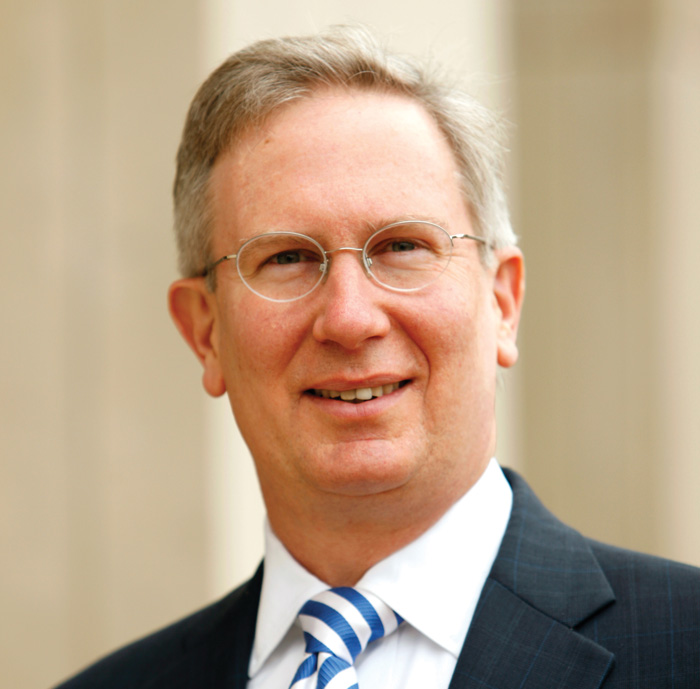
In a June 30 column in The New York Times, Tim Heaphy (Col class of ’86, Law class of ’91), who served as UVA’s university counsel from 2018 to 2022, wrote that, in his view, UVA faces a governance issue. In Virginia, the attorney general represents all state agencies, and as such appoints university counsel.
Wrote Heaphy: “This means rather than having an advocate loyal to the university and its interests, Mr. Ryan and the university were saddled with counsel aligned with the other side.” Various state universities appoint counsel differently. Michigan State, for instance, has popularly elected trustees who appoint legal counsel off of the president’s recommendation. According to the University of Texas System’s regents rules, the president of each university hires administrative officers, including its vice president for legal affairs and general counsel.
For Virginia Senate Majority Leader Scott Surovell (Law class of ’96), a Democrat representing Fairfax County, that governance structure is a central reason behind Ryan’s forced resignation. In 2024, Surovell introduced SB506 to allow public universities in Virginia to hire their own general counsel and clarify that boards of visitors’ duties ran to the institution first, and then the state. Right now, their primary duty is to the state, he said. Youngkin vetoed the bill. “I think those two things are a big source of conflict in what’s going on right now, because these schools can’t get accurate independent legal advice,” Surovell said.
A leadership void
Even before Ryan resigned, key departures had shaken the top of UVA’s organizational chart.
Among UVA’s four-member executive leadership team, which includes the president, only one leader was a permanent hire as of this writing. That’s Davis, who for a few weeks was also serving double-duty as acting president.
The first to leave, in February, was Craig Kent, former executive vice president for health affairs. Kent resigned after an investigation amid allegations from faculty that he and Melina Kibbe, UVA Health’s chief health affairs officer and dean of UVA’s School of Medicine, fostered a negative environment that compromised patient safety and created a culture of fear and retaliation, among other issues. Mitch Rosner (Res class of ’00, Fellow class of ’02) is serving in the interim role while a national search commences.
Then, in March, came the departure of Provost Ian Baucom, who left to become the president of Middlebury College. A search failed to find his replacement in June and was set to begin again this fall. Brie Gertler, formerly the deputy provost, is serving as the interim.
Leadership at some schools is in flux as well.
At McIntire, Amanda Cowen, senior associate dean for academic programs and a professor, began serving as interim dean in July after the departure of Nicole Thorne Jenkins. A search this spring failed to find a successor and is scheduled to resume in the fall.
And in July, turnover at UVA Health continued with the back-to-back announcements of leadership departures. On July 14, the University of Texas System announced that Kibbe will be named president of the University of Texas Health Science Center at Houston in August. A few days later, Wendy Horton, CEO of UVA Medical Center, announced her departure. She will assume a leadership role at the University of San Francisco Health Center in September.
Finally, Malo André Hutson, dean of UVA’s School of Architecture, announced in June his plans to leave at the end of the 2025-26 academic year. Gertler wrote in an email that they will use the time to recruit his replacement.
Hiring challenges
Even with so much senior leadership in flux, higher education institutions can still function by carrying out existing initiatives, said Sullivan, UVA’s eighth president, who recruited three executive vice presidents and nine academic deans, among other top administrators, while at UVA.
“It may mean that the board has to take a more active role, at least in staying in touch with what’s going on, but that’s going to depend on, really, what the board members want to do, too,” Sullivan said.
And, she said, it’s unlikely that it will impact prospective students very much. “If you’re going to graduate from high school next year, and you’re in the commonwealth of Virginia, and you’ve got a shot at UVA, I think you’re going to take a shot to try to get in,” she said.
But the uncertainty around top leadership could impact the recruitment of faculty and of graduate students, especially in fields with heavy federal funding, she said. A July 4 letter to the BOV from 12 of UVA’s 14 academic deans, printed in the Cavalier Daily, said some donors were withholding pledges and new hires were rethinking plans to come to UVA.
“We wish to underscore that the level and number of leadership transitions now underway create significant risk and instability,” they wrote. “We can be your partners in supporting the very best outcomes for our students, our patients, and the broader University community.”
Still, Sullivan pointed out, UVA is far from the only higher education institution facing federal investigations or uncertainty around federal funding. What’s more, the number of empty spots on UVA’s leadership team could be attractive to some candidates for president. They may see all those openings as an opportunity to build their own leadership team.
It’s likely a disadvantage, however, if UVA tries to recruit people for those other roles, Sullivan and Seidman said. Top candidates may be leery of accepting the job of provost or executive vice president for health affairs, who report to the president, or dean, who reports to the provost, because they don’t know who they’ll report to.
Waiting to hire for those other roles, however, could mean UVA will be operating with interim leaders for quite a while. It took about nine months for it to find Sullivan’s successor—Ryan, who spent another year wrapping his job at Harvard. He began his tenure in August 2018.
It takes finesse to find the right person, and any attempt to hurry them into a decision could backfire, Sullivan said. “Basically the person you want for this job has already got a good job, and so you’ve got a bit of marketing to do to persuade them that you’ve got a better job in mind for them. That takes time and persuasion.”
“Where do we go from here?” Seidman asked. “And is the next person that we appoint going to have the exact same situation where, if the DOJ doesn’t love them, we’re going to be back in the same position?”
At the July 11 Faculty Senate meeting, Sheridan said negotiations with the DOJ are ongoing and that any voluntary resolution agreement will be made public. As of this writing, that has not occurred.