Letters to the Editor: Winter 2024
School Spirits
I was delighted to read your article in Virginia Magazine on “School Spirits” and its concluding reflection, quoting Professor Chen, who asks, “How do we square our rational modernity of the everyday … with experiences that … suggest that we don’t quite understand the world?”
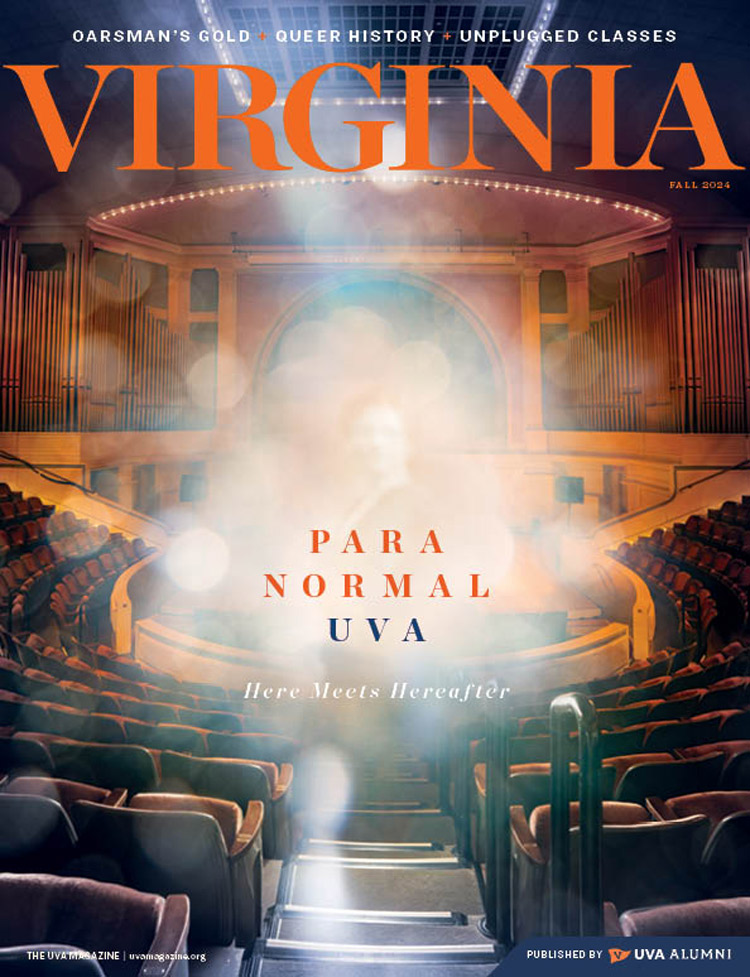
In 1972, in London, I dreamed one night that I stood on green grass, looking up at imposing pillars at an American university on the East Coast. I was puzzled and forgot about the dream. In 1981, then in India and in a dire personal crisis, I applied to graduate schools and saw the Rotunda on the materials sent to me by UVA, the only school that offered me admission and financial aid. I arrived in fall 1982.
I would also assist the late Dr. Ian Stevenson at UVA with a project related to his work on reincarnation. His considerable opus on the topic, and my own experiences and books, suggest that our existence stretches beyond our everyday ways of being.
Suchitra Samanta (Grad class of ’84, class of ’87, class of ’90)
Radford, Virginia
I enjoyed your story about ghosts and mysterious apparitions on Grounds. It reminded me of my two UFO sightings. I first saw the slowly rotating equilateral triangle of bright white lights slowly moving over the highway when I was en route to Neil Young’s “Rust Never Sleeps” concert at William & Mary in October 1978. The second time I was driving past old Scott Stadium and arriving at an intersection known as Fry’s Spring, where the object hovered above me and a friend in my Chevy Vega and then sped off without a sound. I was sufficiently freaked to remark, “Please, no, I don’t want to go,” because I had already seen it once before. I called the local airport and asked about any unusual activity, of which, of course, there had been none—or none that anybody would admit. Over the years, nobody has ever been able to give me a satisfactory explanation of this phenomenon. Many years later, a fraternity brother who saw how excited I was that evening reported overhearing people at a party discussing the “Fry’s Spring UFO.” Perhaps one of your readers knows what it was I saw? If so, it would no longer be an unidentified flying object.
Evan Cantor (Col class of ’78)
Boulder, Colorado
The story opened with this line: “Tales of things that have gone bump—or step-thump—on Grounds.” Even before I turned the page to continue my reading, I knew that the ghost that resides in Montebello was probably the spirit being referred to.
During our daughter’s four years in the engineering school at UVA, we served on the Parents’ Advisory Council. Occasionally, Jim and Sherry Aylor invited us to dinner at Montebello. It was at one of those dinners that Sherry shared the story of the thumping on the stairs in the mansion.
My husband and I thoroughly enjoyed serving on the Parents’ Council. However, when we think back on those times, we will always remember hearing firsthand the story about the ghost in Montebello.
Karen M. Hopke (Educ class of ’72)
Kenneth B. Hopke (Engr class of ’73)
Annandale, Virginia
Queer History
I loved reading the history of LGBTQ+ students at the University. Beginning my time at the University in 1988, I did not see it as remotely possible to come out. Racial tensions at the University were high and conservatism was a dominating force. While there was talk of acceptance from some, the overall atmosphere was deeply unwelcoming. I first went to an LGSU meeting in 1991, terrified of what it might be like and whether I would be safe there. It was safe and welcoming, and I found a tremendous sense of community among undergrad and graduate students. I came out at UVA in 1991-92 and was an officer in the newly renamed LGBU for the 1992-93 school year. We worked hard to build awareness about activities on Grounds during Pride Week and were able to do so, facing some rejection and some embraces. It is wonderful to see ongoing progress at the University and to consider just how far we have come. Thank you for telling this story.
Dan Redding (Col class of ’92, Educ class of ’93)
Keswick, Virginia
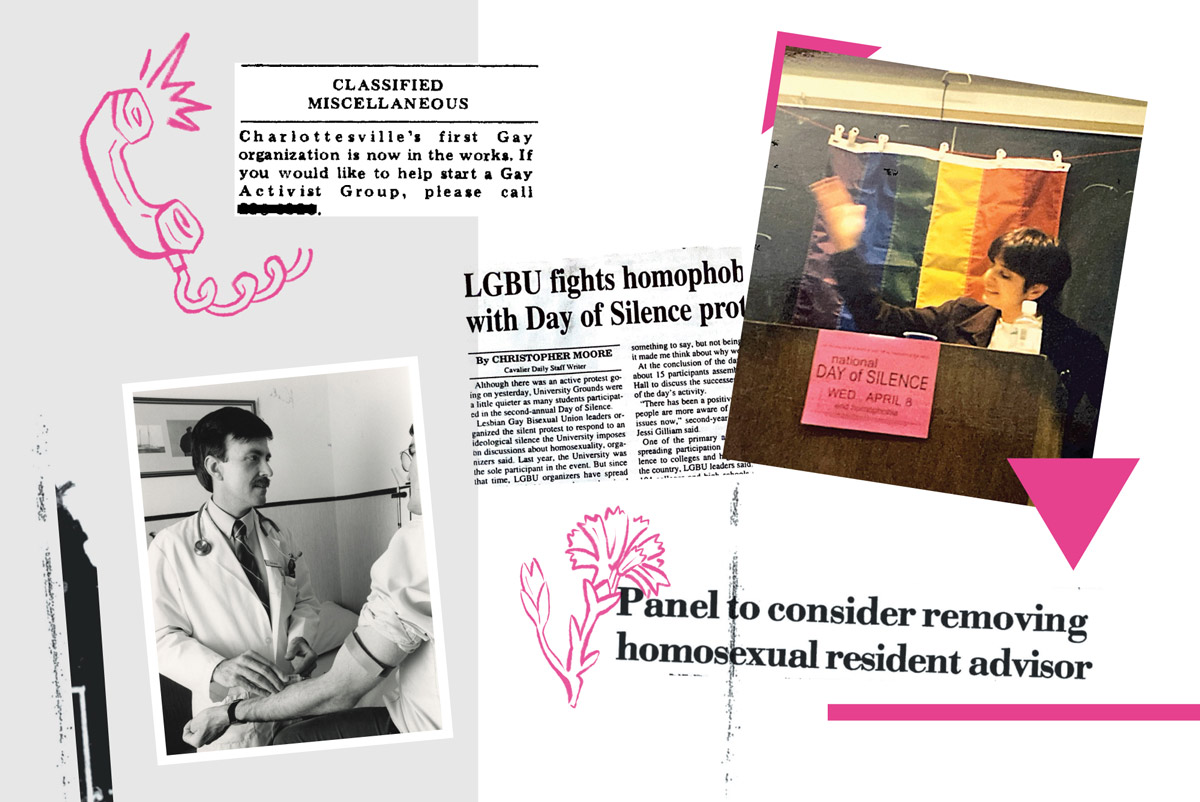
I have the sense the Gay Student Union was about 1 year old the year I started at UVA. My mom had seen the ad for the GSU in the newsletter sent to incoming students and suggested I check it out. I met several members, including Michael A. James, whom I believe was the first president. I spent much time with this group doing grunt work. During my second year, Jenny Turner volunteered to be president and I volunteered to be vice president, just to keep the group going. A bit later, Bob Elkins showed up at a meeting and identified himself as “Alex Michaels.” He was a firebrand as he grilled us about our purpose, which I had assumed was merely to be a safe place for coming out. He wanted more than that. Later, he admitted to using the false name, and “came out on roller skates,” as we used to say. I recall the controversy about him being a gay RA, and his bravery. I want to give a shoutout to Michael A. James, whose incredible bravery to be there at the very beginning was an inspiration to me. I wish Michael were still alive to see this article, and I wish he had been mentioned.
Larry M. Haines (Col class of ’77)
Wilton Manors, Florida
I was thrilled to read Sarah Lindenfeld Hall’s article. The article helps to fill one aspect of Virginia history that for many decades was left untold.
Unfortunately Ms. Hall left out an important part of that history. The article is titled “Queer History,” but it presents the story exclusively of lesbian and gay students. The T in LGBTQ+ is left out almost in its entirety. The word transgender is mentioned only once in passing in the section about the 1990s, and the words nonbinary and genderqueer do not appear at all. Are we to take it that transgender, nonbinary, and genderqueer were left out because there were no students who identified as such?
Please note that we were there during the period covered by Ms. Hall. We were always there. Ms. Hall has written an excellent L and G history, but the history of the other letters of the LGBTQ+ rainbow at UVA has yet to be written.
Robyn McCutcheon (Col class of ’76)
Burlington, Maine
It was refreshing to see an article on LGBTQ+ history and some of the key players and milestones over the course of the past 50 years. It did seem, however, that there was a lack of source material for a very active period in LGBTQ+ history at the University: the early to mid-’80s. I found many refreshing and positive attitudes in my time at UVA and my personal journey. While nestled in the Reagan years of political conservatism, music and culture were pushing a different agenda with the rise of the new wave era, which pushed the boundaries of dress and accepted norms of the time.
At UVA, the Gay Student Union had dances in Newcomb Hall. Outside the University confines, however, was where life was fun and engaging. Eastern Standard, Fellini’s, the Silver Fox and the “14th Street Late Night Party” provided venues where LGBTQ+ students felt welcomed and the community flourished. It was as close to an NYC vibe as one could find in Charlottesville.
Therefore, while I am sure there are stories of hostility, I found comfort in many of my friends in and beyond the LGBTQ+ community.
Dale C. House (Col class of ’86)
Arlington, Virginia
“Queer History” deftly wove together LGBTQ stories by honestly confronting challenges and sharing hope. The article was enriched by exploring the opening of queer life in the wider cultural and political context. Reading the article filled me with deep gratitude for the people who made UVA a welcoming place for queer people. As someone who came out in the early 2010s while at UVA Law, I now know more about the lives and organizations that created the supportive environment I experienced in the UVA community. Thank you for sharing this history.
Matt Jobe (Grad class of ’13, Law class of ’13)
Minneapolis, Minnesota
Thank you for your survey of LBGTQ activities within the University. I was a returning Army veteran in 1970 and remember well the Cavalier Daily ad calling for a meeting. Friends attended; my recollection is that there were more than the five or six on hand you mentioned. A number of my Army buddies were openly gay even though it was a dischargeable offense. I found the meeting a breath of fresh air. Going forward, my wife and I have worked within publishing for 50 years and found it a much more open, accepting community. Of course, the horror of the AIDS crisis was an education for a lot of straights. We lost a lot of friends. I find the University community much more conservative than when I attended. I can’t believe the community is as broadly accepting as the article suggests. I would be happy to be wrong. Thank you for your article.
Chris Kerr (Col class of ’73)
Boston, Massachusetts
Ding! Ding! Ding!
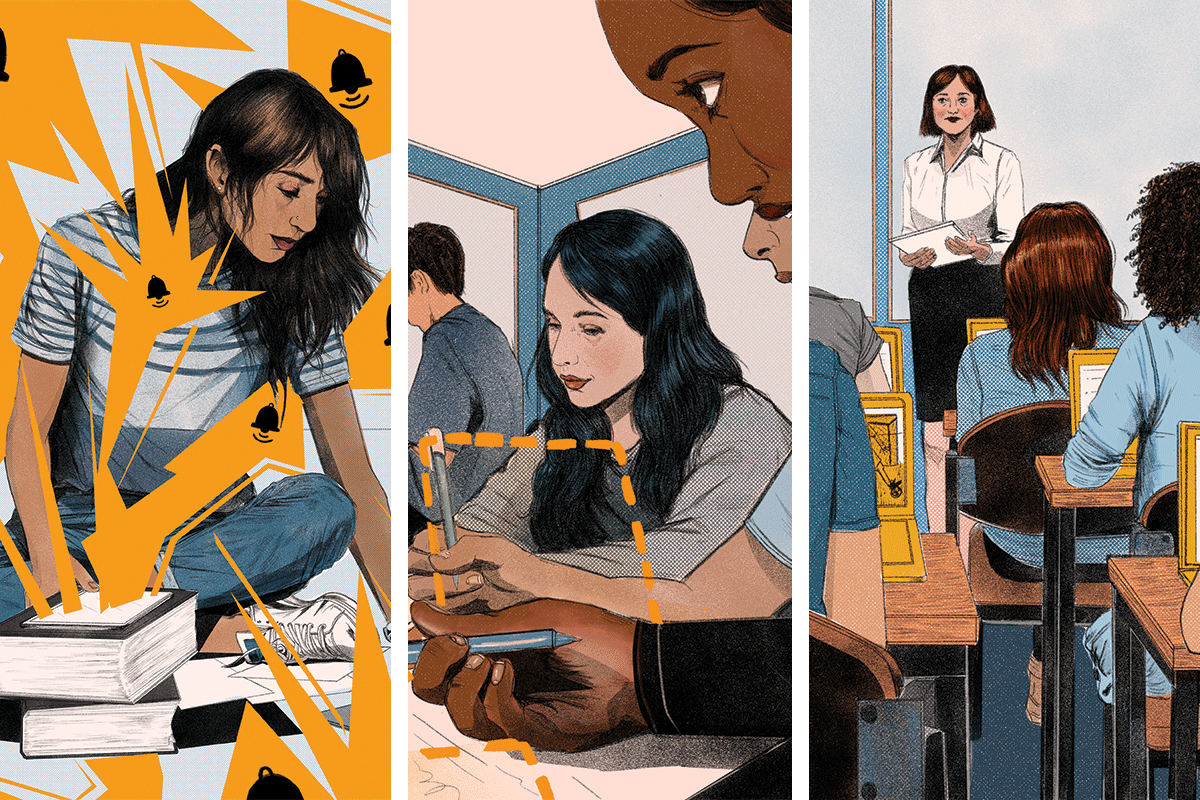
I read with dismay Ed Miller’s article about the obstacles to effective reading and class participation many students face from social media.
One student’s favorite class was the one in which electronic devices were forbidden; several students couldn’t read for 90 seconds without checking their phones; viewing the natural world during a simple stroll was a “revelation”—all very discouraging!
But then I wondered, if social media is such a handicap, has there been a dramatic increase in failing grades and students on academic probation?
Christopher Purcell (Col class of ’74, Educ class of ’77)
Kansas City, Missouri
From the Editor: A Tip of the Hat and Farewell
Here’s wishing outgoing editor Richard Gard nothing but the best in the next chapter of his writing career. With the touch of a maestro, Gard has guided the magazine through a period of significant challenges, tragedies and accomplishments at the University and around Charlottesville.
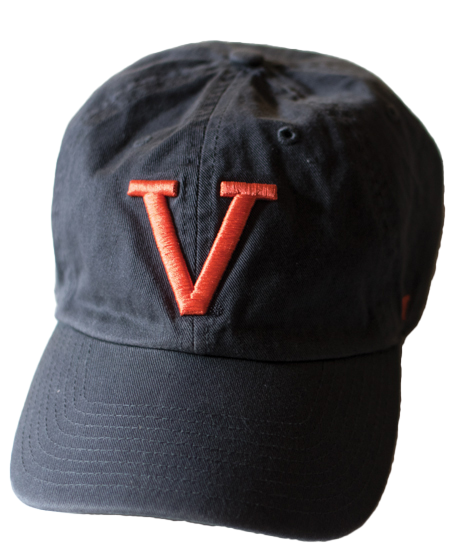
I also salute Gard’s parting comments about UVA hats leading to new friendships far from C’ville. About a year ago, I was in Gloucester, Massachusetts, to see a small art exhibition, and as I scampered across the quiet cobblestone street I heard, “Wahoowa!” I looked up and saw a smiling face shadowed by an orange Virginia baseball cap identical to the one I was wearing (but for the deeper sweat stains on mine). Pleasantries ensued, a “Go ’Hoos!” completed our exchange, and my wife provided the head-shaking eye roll you knowingly predicted.
Mike Moriarty (Grad class of ’91)
Charlottesville
Letters to the Editor
An alumnus wrote to express his regret at the renaming of Alderman Library and the “unfortunate results” of “judging historical figures by 2024 standards.” While it’s one thing to recognize the contributions of some of UVA’s leaders who were blatant racists, it’s quite another for the University to honor them by affixing their names to its buildings in perpetuity. People who think similarly could instead choose to recognize that Mr. Alderman had his name on the library for a very long time and got the recognition he deserved. Many of us, myself included, won’t forget Alderman Library, where we, too, spent many hours. And still, we as individuals, and UVA as a community, can move forward in ways that are respectful and inclusive, and use the opportunity of change to bestow honors on the many outstanding leaders who have come since Alderman and are every bit as worthy of recognition.
Jonathan Kagan (Col class of ’75)
Potomac, Maryland
The student voice: Serving on the BOV can be a 24/7 role
I read with interest your article on the student representatives to the Board of Visitors and wanted to express my gratitude for the actions of one in particular.
In the spring of my fourth year, I learned that Parents Weekend for the coming autumn conflicted with Yom Kippur, the most solemn day of the Jewish year. I approached Angela Cleveland, the student representative, who promised to speak to someone. A week later she told me that she had approached the Board’s faculty secretary, who responded that one never knows when “those” holidays are going to be, and that if the University scheduled around Jewish observances it would have to do so “for everyone.” I suggested that Angela remind the board that the dates of various religions’ observances could be obtained by checking calendars available in almost any local bookstore, and that, at “Mr. Jefferson’s University”— whose founder wrote the Virginia Statute for Religious Freedom, but that nonetheless operated according to the Christian calendar—having to make accommodations “for everyone” if you did so for one was the point. Angela agreed and spoke to President Robert O’Neil, who rescheduled Parents Weekend. Angela’s willingness to raise this issue spared the University the risk of alienating its Jewish students (and their parents) and any embarrassment resulting from adverse publicity.
Eric Michael Mazur (Col class of ’87, Grad class of ’89)
Norfolk, Virginia