Letters to the Editor: Spring 2025
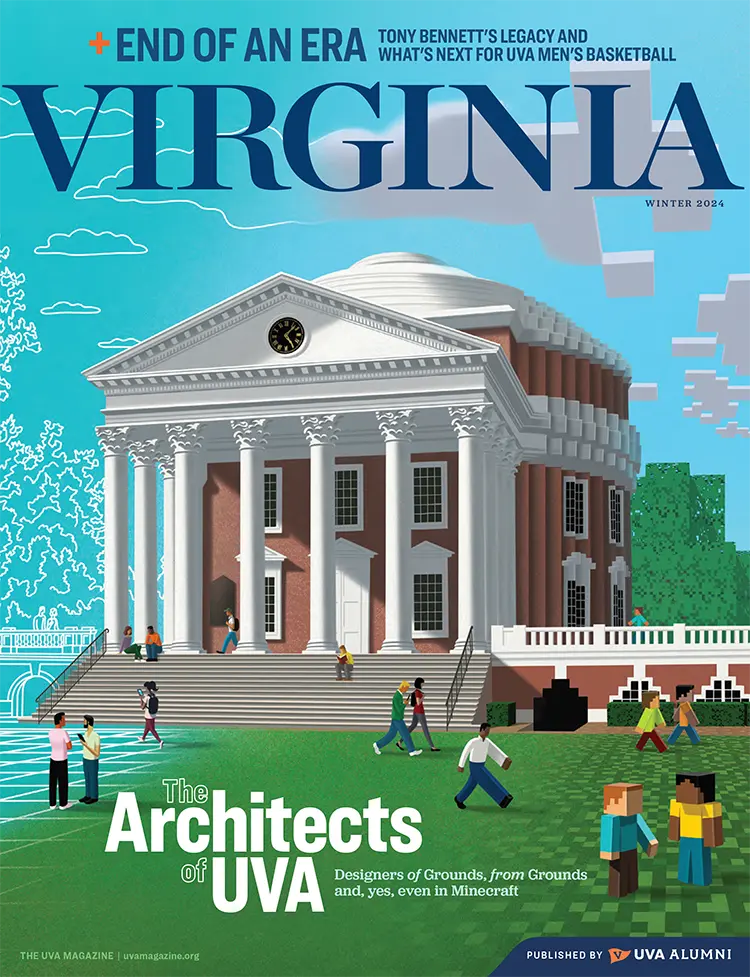
Game Changer
I read with great interest Ed Miller’s article regarding the retirement of Coach Bennett. Without reservation Bennett deserves the accolades he has been showered with both before and after his retirement announcement. But as I reflected on his character, his steadfast demeanor and his “five pillars,” I was overcome with a puzzling question: If one of his players had come to him and expressed the same qualms about the state of collegiate sports and was considering quitting, how would he have counseled that player? I feel that he would have said something to the effect of, “You have made a commitment to your fellow players, the coaches and the university, and you should honor that commitment.” That is the Coach Bennett I knew and respected, and I am bewildered by the Coach Bennett who retired midseason, leaving players, coaches and the university community reeling.
Charley Dillard (Col class of ’84)
Charleston, South Carolina
Now is a good time to consider whether the university should operate what are rapidly becoming professional basketball and football teams whose coaches already require multimillion-dollar contracts. The university could instead just focus on higher education.
Neil O’Donnell (Col class of ’76, Law class of ’80)
Anchorage, Alaska
A wonderful story and description about a great man, legend and true Christian: Tony Bennett. Wish him all the very best.
Albert Tsu Chiang (Engr class of ’76)
Richland, Washington
I am certain I am not the only alumnus who feels the UVA basketball team should be discontinued in its current format since the idea of a four-year team, a geographically cohesive conference and a roster of unpaid players has ended, withering away any Cavalier authenticity. UVA should just have a non-scholarship team composed of the best who enroll as regular non-athlete students and play Division III or other schools that have yet to transform into crypto-teams. Bennett helped us finally win a national championship. There is no other goal to accomplish. Take Bennett’s lead and go back to a focus on academics and actual full-time Wahoos playing basketball for fun and not a career. It used to be four and done and more recently one or two and done. How about just done!
Michael Darren Ullman (Com class of ’84)
Bangkok, Thailand
The visionaries behind Grounds
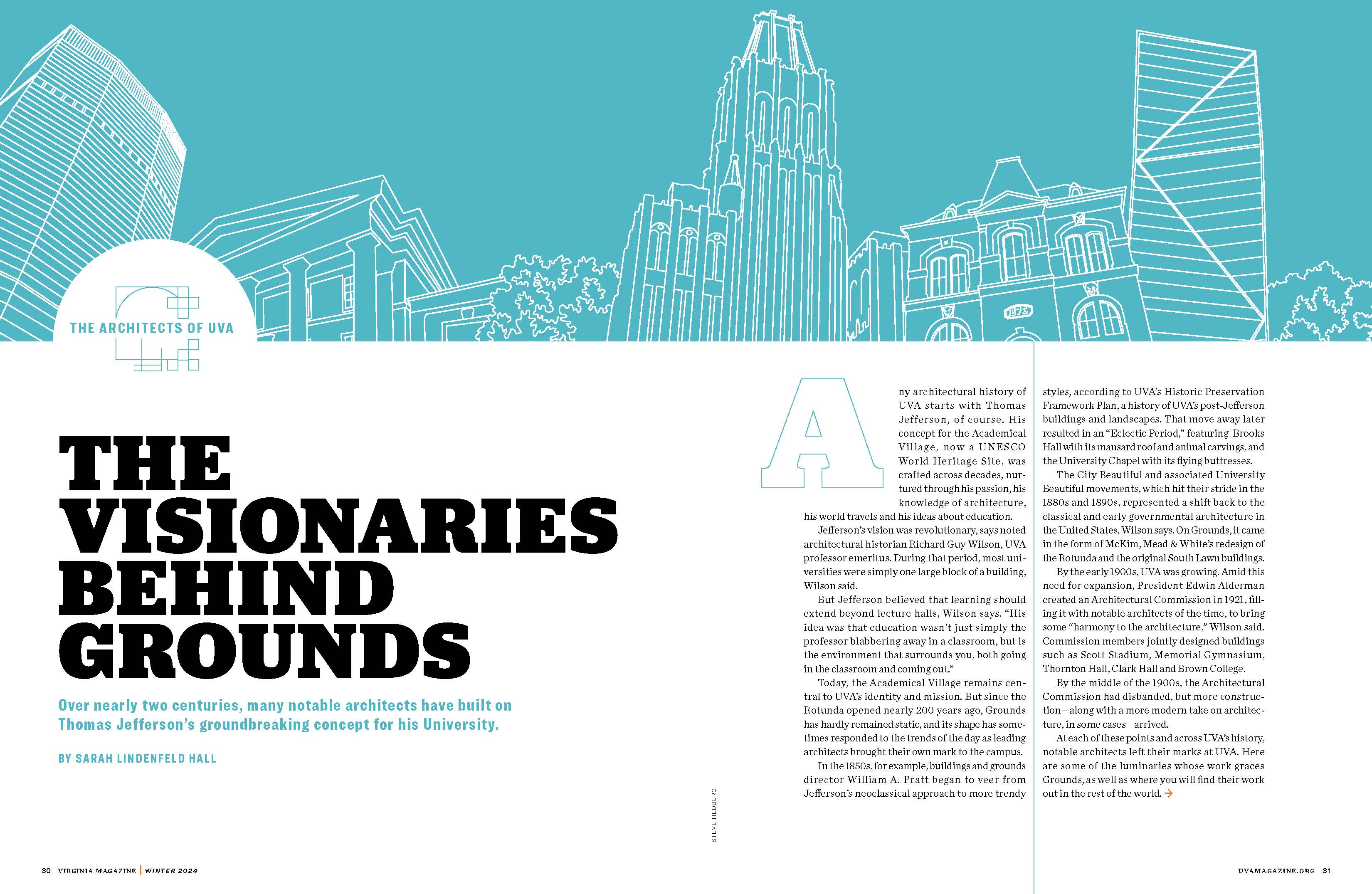
The article by Sarah Lindenfeld Hall omits architect Stanislaw J. Makielski. He studied architecture at UVA, where he eventually became a professor at the School of Architecture. He was one of the first instructors there and served from 1923 until just prior to his death in 1969. He was famed for having traditional designs with an eccentric twist. Of particular note is the Phi Kappa Psi house at 159 Madison Lane. The Makielski twist to this fraternity house is the rustication of the facade’s center, unique in Charlottesville. His prominence as an architect won him many commissions, such as a major addition to Shannon Library (then Alderman Library), Memorial Gymnasium, fraternity houses and local mansions.
Jack Cann (Col class of ’63, Darden class of ’70)
Charlottesville
Thank you for Sarah Lindenfeld Hall’s wonderful article on prominent architects and architecture. Paul J. Pelz’s work on the West Coast includes the Point Fermin Lighthouse, beautifully restored and maintained as a museum by the city of Los Angeles. The design was used for six lighthouses built between 1873 and 1874, of which three are still standing: Point Fermin, East Brother in California and Hereford Inlet in New Jersey.
Peyton Hall (Arch class of ’74)
Sierra Madre, California
Immediately before I attended Darden, I was a Pan Am flight attendant, and upon receiving my M.B.A., I returned to my beloved airline as a newly minted staff associate, working in the Pan Am Building in New York City. Designed by Belluschi (who went on to design Campbell Hall), Gropius and Roth, the building may be known now as MetLife, but will forever remain the Pan Am Building to the former airline’s employees and many
New Yorkers.
Ann Wilkerson (Darden class of ’78)
Hoffman Estates, Illinois
In Bricks and Bits
I enjoyed the article and seeing the different mediums students have used to capture the Rotunda. On a related note, there is another Lego model of the Rotunda, featured in Virginia Magazine’s 2014 article “A Different Kind of Red Brick.” It’s built to a larger scale (the same scale as a Lego minifigure). It is interesting to compare the two because many of the pieces in the newer model didn’t exist at the time, since this was just over 10 years ago. The model now resides in the Special Collections Library.
Thomas Lockwood (Engr class of ’14)
Portsmouth, Virginia
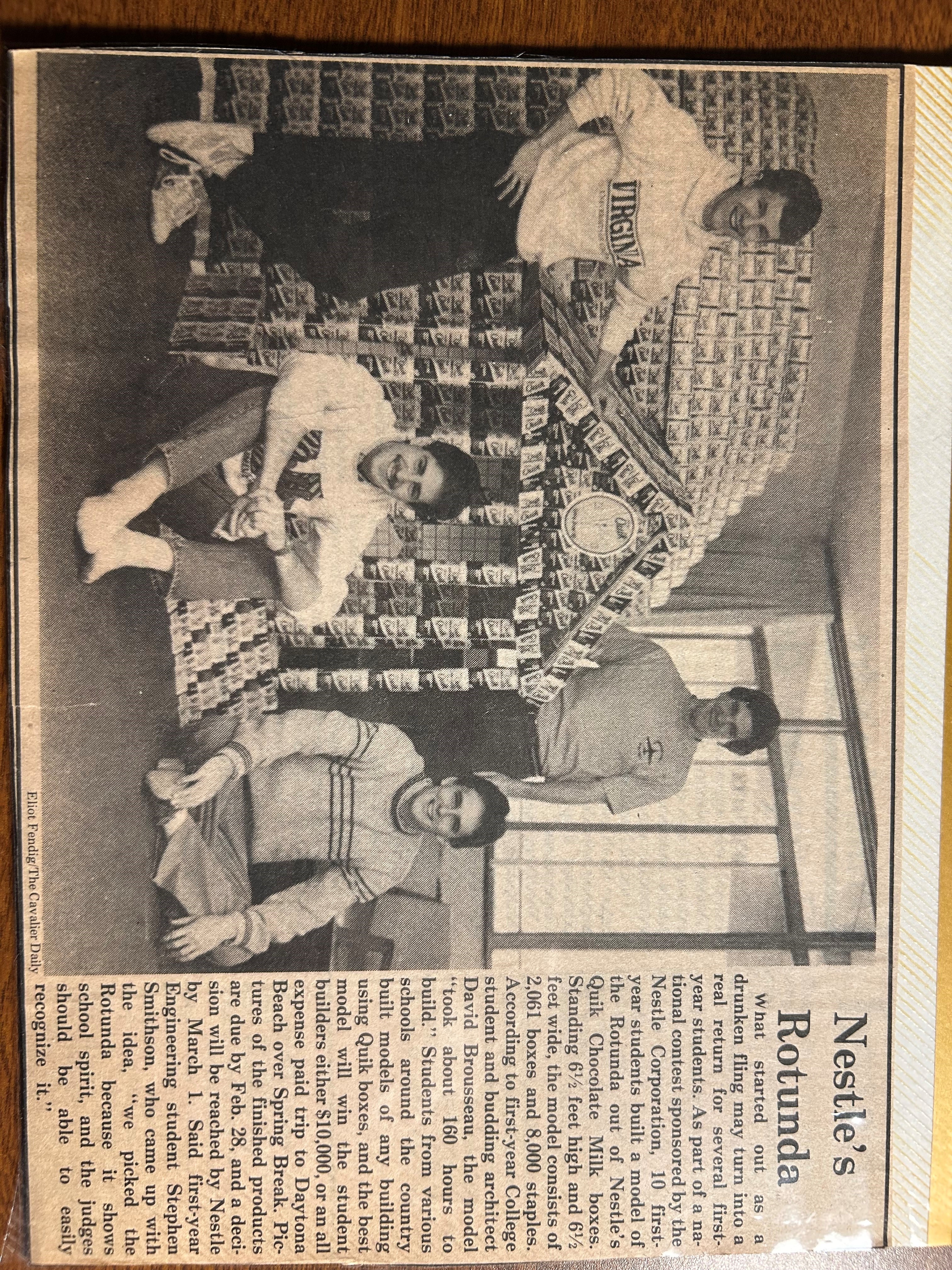
I enjoyed your article describing various models of the Rotunda that recent students have created. Their renderings in Minecraft, Lego and The Sims were all truly impressive. But students have been doing low-tech projects along these lines for many years. Back in 1986, our first-year suite (Watson 140s) created a replica Rotunda from over 2,000 Nesquik chocolate milk boxes. Most of us were neither engineering nor architecture students; we just saw an opportunity for some fun and jumped on it. While we didn’t win the Nestlé competition (the winning team constructed a replica Mayflower that actually floated!), we placed third nationally, winning Swatch watches for our team. The architecture at UVA is an integral part of what makes this place so special, and Rotunda-inspired building projects will never go out of style.
Charlie Scarborough (Col class of ’89)
Arlington, Virginia
What, the duck? [Retrospect]
I read this story with fond nostalgia. I was there at the time, and John Serpe was a classmate of mine for college and law school. I had forgotten all about the election, but reading the story brought it all back.
John, if you’re reading this, I’m almost positive I voted for you and not Howard.
Irwin Shur (Col class of ’80, Law class of ’83)
Green Oaks, Illinois
School Spirits [Fall 2024]
In 1826, when Edgar Allen Poe attended UVA, he may have been exposed to the paranormal activity that set the tone for his stories.
The Raven suggests that Poe experienced auditory hypnagogic hallucinations, which can be difficult to distinguish from reality. A similar state was mentioned by Aristotle, Charles Dickens and Albert Einstein. Thomas Edison, with his notorious fragmented sleep, used these hallucinations for creativity and problem-solving. Some have suggested that hypnagogic hallucinations facilitate extrasensory perception, telepathy and mind-reading.
A recent survey found that those reporting poorer quality sleep were more likely to believe in ghosts, demons and the ability for some people to communicate with the dead.
Poe, a bright student, likely slept poorly because of binge drinking that began at the age of 17. An unstable home life, the illness and death of a young wife, and likely depression, along with any poltergeist pal he picked up at UVA, could have contributed to his fame from his skilled writings.
J. Catesby Ware (Col class of ’69)
Norfolk, Virginia
Queer History [Fall 2024]
I appreciated your article on “Queer History” and also felt it was long overdue. I’ve had negative feelings about my time at UVA for many decades. In 1984, at 19, I transferred to UVA and came out as a lesbian. I had so many difficult moments being gay there, from being told by a health care counselor that I was going through a phase to being assigned only male authors in my literature program. I went to my first Gay Student Union meeting and was appalled that the name didn’t include lesbians, so I voted to add it to the organization’s title. Additionally, I and several other women started the group “Lesbians, Bisexuals and Questioning Women,” which wasn’t mentioned in your piece. We met weekly to discuss issues relevant to us, from artificial insemination to handling homophobia. It gave us a sense of community in an otherwise hostile campus culture. My gay friends saved me from total despair, but soon after I graduated, I fled to San Francisco, where I felt like I could breathe more deeply and be truly myself. I’m grateful that students now don’t have to experience the isolation and treatment that I received.
Claire Drucker (Col class of ’86)
Sebastopol, California
Virginia is for lovers: An ode to Cavalier couples [uvamagazine.org]
I can only imagine the challenge of curating and editing all the original and memorable romance stories that crossed your screen for your “Virginia is for lovers” feature.
What I appreciate most is the rich, meaningful and loving diversity of couples—including a same-sex couple too—which matters to thousands of us alums, students, faculty and staff.
Kudos and gratitude to your team.
Bob Witeck (Col class of ’74)
Arlington, Virginia
Seeing the Chapel in a new light [Summer 2024]
I have very fond memories of the Chapel. In my first year, I became active in the Virginia Christian Fellowship. We prayed for each other, for friends at the university and for the several Bible studies that met in the dorms around Grounds. We averaged six to eight people each evening, although they were not always the same people. By my fourth year, attendance had increased, and it wasn’t uncommon to have two dozen or so people gather.
I am sure that other individuals went to the Chapel for reflection and prayer at other times, and of course it was a popular setting for weddings, but it was used regularly by our group and sometimes by other groups for prayer and worship.
Charles F. Sutton Jr. (Col class of ’69)
Uxbridge, Massachusetts
As a first-year I was puzzled by the Christian Chapel on Grounds—right next to the Rotunda, no less. Why and how could it have come to be here, and moreover, why is it still here and what should be done about it?
I have long thought that it should be sold and moved off Grounds. Then I thought we could erect a symbolic Wall of Separation between the Christian Chapel and the university. Probably not doable. So then I thought, if it’s going to stay there, let’s at least make it a secular space; let’s remove all the Christian iconography and symbols. Let it be a place where we worship the religious liberty Jefferson proudly enshrined in the Virginia Statute for Religious Freedom. Alas, I concede that the historians and traditionalists would also nix this de-conversion of the Chapel.
So what is left? I propose the placement of two plaques, which would state in so many words:
That the presence of this Christian worship space in no way implies that UVA endorses Christianity or any other religion.
That UVA is a secular safe space for those of any religion or none, as long as they do not impose upon or inhibit others.
Steven C. Lowe (Col class of ’72)
Washington, D.C.
“One of the fastest machines on Earth” [Summer 2024]
Interesting article about the Burroughs computer. I had learned BASIC computer programming in high school before going to the university in 1961. With friends in the engineering school, I was among the first to take classes to learn how to program the Burroughs. In 1966 and 1967, I was programming IBM computers at what was then the largest computer center in the world at the Social Security headquarters. Later in my career, I went to the Computer History Museum in Silicon Valley and found that I programmed almost all the computers in the museum that were built after 1965.
So one never knows what a casual interest in college may lead to!
Harry F. Swope III (Col class of ’65, Darden class of ’69)
La Crescenta, California