Letters to the Editor: Fall 2025
Editor’s note: These letters were submitted before UVA President Jim Ryan (Law class of ’92) announced his resignation on June 27. For related Vox Alumni coverage, click here.
Summer 2025 Issue
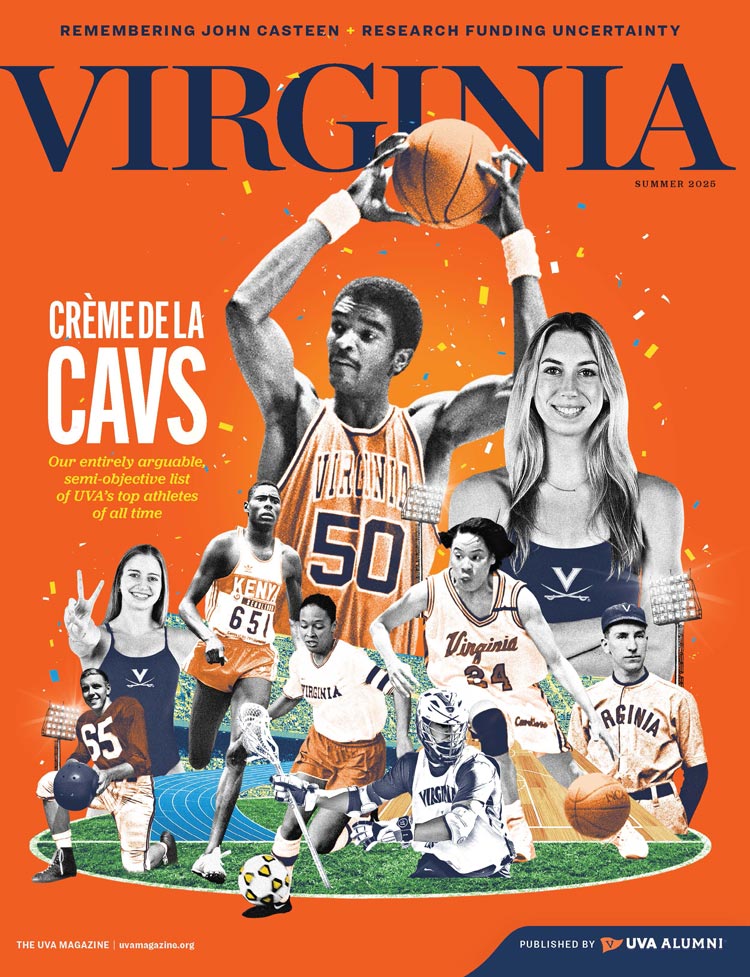
The thoughtfully conceived issue encapsulates the volatile mixture of despair, anger and hope that countless Americans are living with every day at this point in our nation’s history. Both the university and American society writ large are faced with unprecedented sabotage via massive and entirely nonsensical cuts to research in medicine and the sciences. Meanwhile, despite any legislative mandate from the state, our Board of Visitors votes to eliminate hard-won and broadly beneficial advances in diversifying the university, an effort that has spanned many decades and multiple generations of good-willed and deeply committed people. The odd memorial for the McCarthyite former professor who was shown the door by no less than President Colgate Darden reminds us that we are sometimes called upon to fight old battles over again, even those we thought had been decisively won.
All of this a perfect setup for your deeply moving remembrance of President John Casteen, a person adored and indeed idolized by pretty much every UVA alumnus, we English majors perhaps most especially. In an era when the simple but foundational concept of a leader and leadership is cast into grave doubt, we see in Mr. Casteen a brilliantly intelligent but humble man capable of long-term planning and stewardship toward the collective good; a man of honor and integrity, of kindness and generosity and easy good humor; a man of tremendous personal accomplishment and success who singularly commits himself to the uplift and enfranchisement of those he could equally well condescend to, disdain, ignore, or worse still, stigmatize and blame for their own misfortunes.
The best of the best
I was more than surprised not to see the name of Jim Bakhtiar on the list. Among other attributes, “he became one of the top players in the nation, leading the ACC in rushing in 1956 and earning All-American honors in 1957.” I ran into him in the fall of ’62 when he was in med school and I was a first-year in the college. The “Persian Prince” was not only Hollywood handsome but also very down to earth when I briefly spoke with him.
While I recognize that your best of the best list was touted as “semi-objective” and “entirely arguable,” I was stunned to see that Chris Long was not included. As a unanimous All-American, the 2007 ACC Defensive Player of the Year and the second overall pick in the NFL Draft—not to mention a two-time Super Bowl champion who was critical to bringing the Lombardi Trophy to Philadelphia for the first time ever (go Birds!)—Chris represents the very best of what it means to be a Wahoo, both on and off the field.
His impact at Virginia wasn’t just about stats or accolades. He was a dominant force, a respected leader, and has continued to make his alma mater proud through his philanthropy and advocacy.
Might I suggest another candidate, baseball pitcher Ricky Horton, whom I met at a first-year lecture from baseball commissioner and UVA alum Bowie Kuhn. Ricky had a stellar career pitching at UVA before being drafted by the St. Louis Cardinals. While not an All-Star, during his seven-year MLB career, Ricky was renowned for his pick-off move and contributed to three World Series teams and was the Chicago White Sox Opening Day starter in 1988. Since retiring from baseball, Ricky has been the voice of the St. Louis Cardinals and is the director of the St. Louis Chapter of Fellowship of Christian Athletes.
I believe my sister Lesley Welch Lehane’s contributions as a student-athlete at the University of Virginia warrant inclusion as well.
Lesley and I attended UVA from 1981 to 1983, and we were both members of the women’s cross-country teams that won back-to-back NCAA national championships in 1981 and 1982. In 1982, Lesley was the individual NCAA cross-country national champion and also claimed the TAC/USA (now USATF) individual national title—the first woman to win both in the same year. That year, our team also captured the USA Open team title, defeating Nike’s professional team, Athletics West.
While we left UVA after our second year, Lesley’s athletic career continued at the national and international levels. Highlights include breaking several U.S. road racing records, winning additional national titles, and placing fifth at the 1987 World Cross Country Championships in Poland as part of the USA’s gold medal-winning team. Additionally, on Jan. 25, 1986, Lesley ran the fastest ever indoor 5000m time in the world. She was also the first UVA female athlete to receive the Broderick Award, honoring the nation’s top female collegiate athlete in cross-country.
I appreciate your disclaimer that the list of UVA’s best of the best is arguable, and I am certainly not arguing the merits of those that were chosen. My observation is that the National Lacrosse Hall of Fame offers four men’s lacrosse teammates that, as Hall of Fame selections, are well worthy of mention: Pete Eldredge, Jay Connor, Jim Potter and Tom Duquette, who was also a noteworthy lacrosse coach.
How is John Harkes not on this list? MAC award winner, member of the National Soccer Hall of Fame, arguably the best American player of the ’90s.
Virginia’s visionary
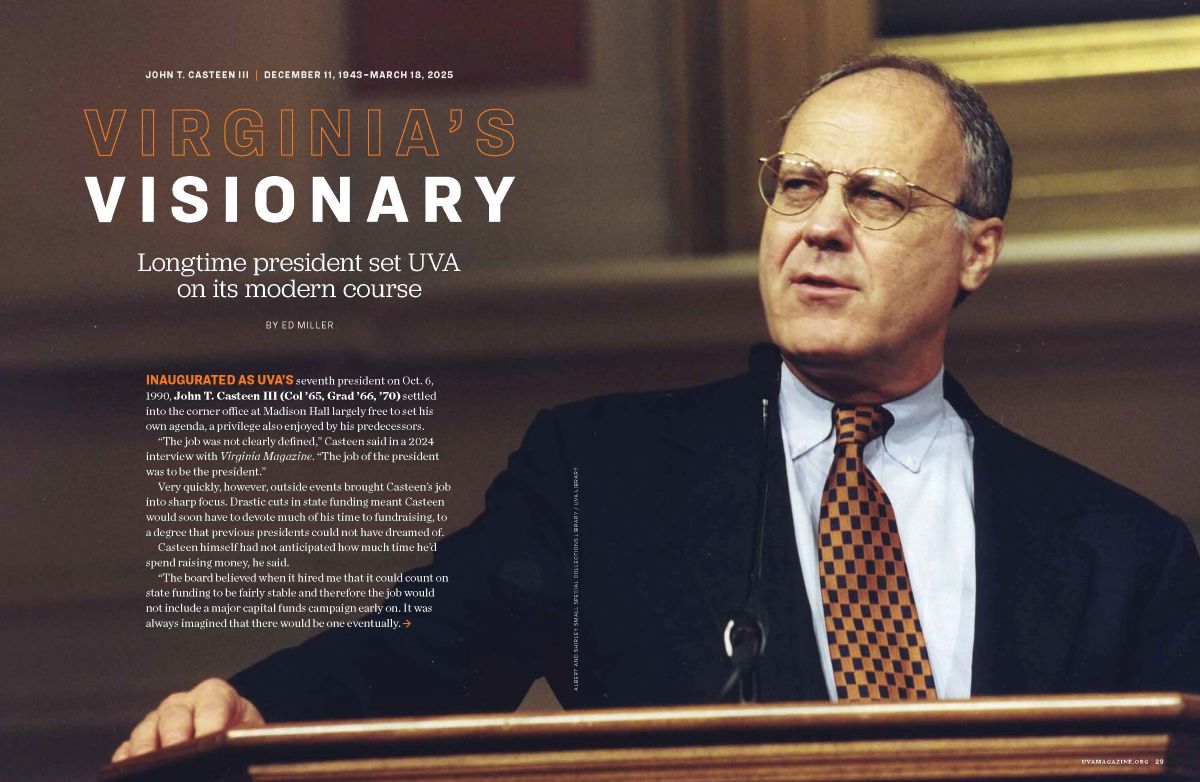
I had the great fortune to develop an academic relationship and friendship with President Casteen. I was writing my undergraduate art history distinguished majors thesis on Holocaust memorialization under the guidance of both an art history professor and a German professor. The German professor suggested that, with his expertise in Germanic languages and literature, President Casteen might have some valuable insights to share. I couldn’t imagine that someone as busy and important as President Casteen would be willing to meet with a lowly undergrad like me, but I couldn’t have been more wrong. I met with him on several occasions. He was warm, encouraging and genuinely curious and interested in my research. He put me at ease while sharing his considerable expertise. President Casteen regularly met with some of the most important scholars and powerful donors in the country, and he still made me, a 21-year-old fourth-year, feel that my ideas mattered and that I had value. I am grateful for his guidance and for the small but treasured slices of time we spent together.
My father, Edgar Shannon, and John Casteen were great friends. Both did a lot to make the University of Virginia a great school. I am proud to say that I graduated from the University of Virginia.
Research’s new unknowns
This is a good update on the situation. It’s quite a complex situation with interaction on several levels and dimensions. We’re creating a social reality, and we want to make the best of it.
The article ends in a hopeful tone with good management and workable compromises with the funders. Hopefully, the courts will help us too. Much of this seems so ignorant and wasteful, but we have to make the best of it and continue moving forward and growing. Patience is another important ingredient. Charity from others is another dynamic. There is great content for specific “asks” in the current situation. The potential outcomes are so wonderful. I look forward to your next installment of how it’s going.
I personally do not find it convincing to point to the very impactful, positive results from past research. No one is talking about eliminating all federal government research to universities. I also suspect that few would debate that there is federally funded research that is not meaningfully targeted toward having a positive impact on society.
I personally do not find a 15 percent overhead cap unreasonable. At 61.5 percent, the government is really funding much of the basic infrastructure of the department/institution. Businesses would not survive with a 61.5 percent overhead rate. I also suspect that classifying expenses as overhead meaningfully reduces the government’s ability to know and track for what those expenses are really utilized. This opens the door to abuse. It may be that part of the answer is to include the relevant expenses as direct costs of the research, thereby providing greater transparency to the government funding entities. Time and more data will tell whether these changes are beneficial or detrimental or some of both.
As a UVA alum and a current basic science/translational researcher at a major research university, researchers are undergoing the same daily-changing trauma as clearly and eloquently described in this article. This is deeply concerning because research grants represent investments in the future of the U.S. An analysis shows that the $36.94 billion awarded to researchers in the United States in FY2024 supported 407,782 jobs and $94.58 billion in new economic activity nationwide—or $2.56 for every $1 invested. The U.S. is leading the world in many areas of scientific and engineering research. However, there is no sustainable source of funds for basic research other than the U.S. government because the discoveries take time to develop to become profitable so that companies will have incentive to invest in and market a product. In the current climate, the U.S. will lose at least one generation of researchers, and probably 20 percent to 33 percent of established researchers will lose their jobs over the next two to three years if things do not change. This carnage is self-induced, and it certainly will not make America great. The U.S. is now China’s best friend.
BOV votes to dissolve university’s DEI office [U-Digest]
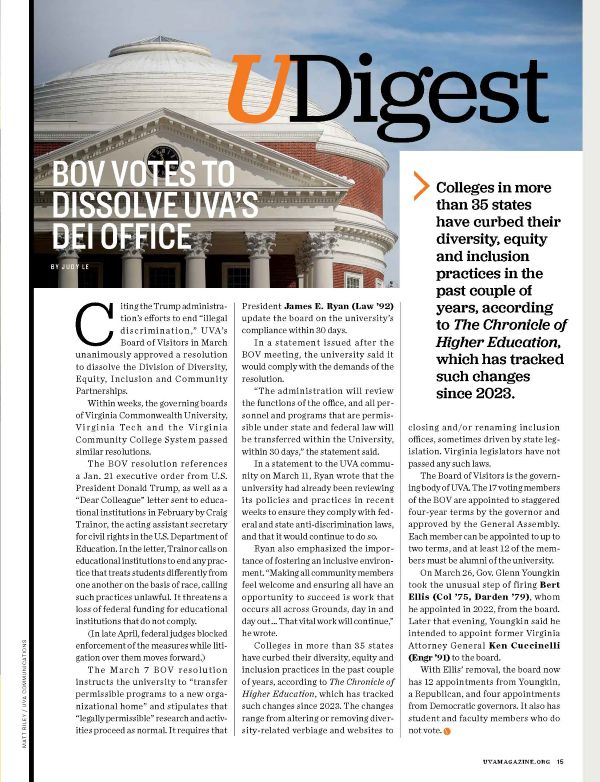
It is deeply disturbing that UVA’s Board of Visitors has bowed to the bully in the White House in eliminating the DEI office and initiatives. Hasn’t diversity enriched the university experience for the students, faculty and community? Which people will the university not include in the future? DEI may seem like a new idea, but it is a cornerstone in our country’s founding and implicit in “All men are created equal.” To not push back on the idea that DEI programs are a form of discrimination is cowardly.
It’s great to have individual merit and initiative restored to prominence at the University of Virginia. DEI was a misguided and discriminatory attempt of group social engineering. Good riddance. Thank you, BOV and the Jefferson Council.
I have always been proud to be a UVA alumna, so I can hardly express the degree of my disappointment and dismay at the BOV’s dissolution of the DEI office at UVA. The university’s response is lukewarm and in no way sufficient to respond to this move against equality. Will no one stand up to racism, misogyny and the attempt of the white oligarchy to take over our country? Shame on UVA.
There is a perfect symmetry with the BOV vote coming on the 175th anniversary of Daniel Webster’s “Seventh of March” speech in support of the Compromise of 1850 and the Fugitive Slave Act. History may not repeat itself but sometimes it rhymes.
There was a time when the University of Virginia would have laughed at this kosher butcher’s granddaughter’s application to the College of Arts and Sciences. But in 1971, I was admitted as one of 550 women under a transition plan toward full coeducational acceptance. My admission that year was based not only on merit, but also on gender. You could say I was a DEI admission.
A first-generation college student, I was an Echols Scholar, resided on the Lawn, and graduated in 1975 with highest distinction. I went on to become a physician in Baltimore’s medically underserved southeastern neighborhoods.
It was my calling to help repair the injustices of the world by providing health care at publicly funded community health centers. In Judaism, we call this principle “tikkun olam,” to repair the world. Equity is a key component of this principle.
Diversity, equity and inclusion are not buzzwords to me, and those principles should never be eliminated based on computerized screening for words or initials offensive to elected officials. The University of Virginia is a better place because taxpayers’ funds have been spent on ensuring the highest-caliber education to a wide variety of people.
I greatly endorse the decision to dissolve the DEI office. DEI initiatives have evolved into an anathema to the university’s core values. In short, the university should apply a uniform set of standards in recruiting and accepting students, professors and employees. It is that simple.
Shame on the Board of Visitors for voting to dissolve UVA’s Division of Diversity, Equity, Inclusion and Community Partnerships. Given the university’s checkered history on race and discrimination, it, of all places, should recognize the moral necessity to ensure that African Americans and other racial and ethnic minorities, women, the LGBTQ+ community and the economically disadvantaged are welcomed, supported and encouraged. UVA made so much progress on this front over the past 60 years, especially under John Casteen, whom you correctly lauded for his vision and empathy in your last issue. It’s sad and disheartening to see us cave to the voices of hate and division.
UVA’s external review of 2022 shooting released [U-Digest]
The university should reconsider redactions to statements about the murders of the UVA students. If UVA again produces heavily redacted reports, it will only cause greater and continued pain to the men’s parents and other family. Yes, they may sue the university for any culpability in not removing or further investigating the perpetrator prior to his action.
UVA’s greater obligation is not protecting the university but public safety of students and faculty, revealing the truth, and taking consequences from any neglect or miscommunication. The university must act differently from a private corporation or individual.
A Century of Mem [Spring 2025]
This was a great article about Mem Gym’s music history. I still brag about seeing Bruce Springsteen and the E Street Band in 1974.
Another wonderful feature harkening back to its original purpose as an athletic facility was the pool on the south side of the building. It was abandoned by the athletes quickly—I think when U-Hall was built with an Olympic-size pool. That small pool survived in the ’70s. We repurposed it for inner tube water polo (I think we created that as a co-ed intramural sport). It was intensely chlorinated and magical. I’m not sure the pool has survived, but I hope our kids carry on the water polo tradition!
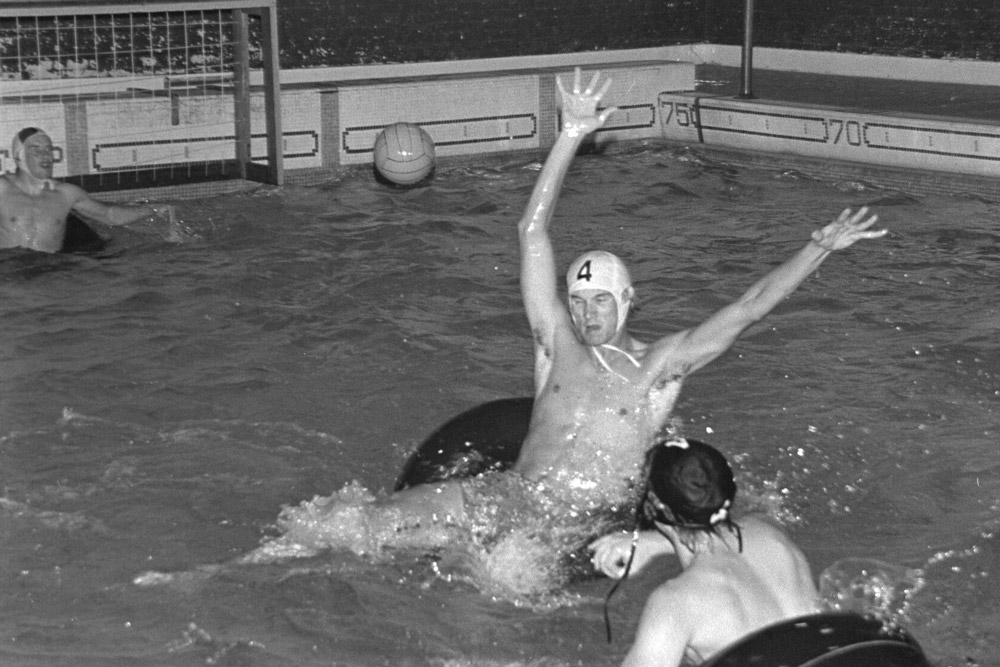
As a former resident of Mem Gym, I am inspired to add two more chapters to the record. First, the article doesn’t mention the swimming pool that occupied the south end of the building and served as the home of the swimming & diving team until 1972, when the U-Hall natatorium opened. The pool continued to be used for intramurals (including inner tube water polo) and recreational lap swimming until 2007, when it was sadly closed and filled in. In the ’60s and early ’70s, a few lucky varsity athletes who referred to themselves as gym rats lived in rooms on the second floor. As a swimmer, I lived there during the 1973-74 academic year, which I believe was the final year of Mem Gym’s status as a dorm. We shared the showers in the basement locker room with other gym users and massive cockroaches, and we had the run of the building after hours.