Letters to the Editor: Fall 2024
Crazy Fast

I wanted to tell you how much I enjoyed the article on Coach Todd DeSorbo and the UVA swim team that has been dominating NCAA competitions in recent years. I was at UVA when Bruce Arena was building the men’s soccer program that led to five consecutive NCAA championships (early 1990s), and that makes this next year more exciting to the program than ever. Pass the men’s soccer team—records were made to be broken! Also, in a time when athletes are pushing for compensation in competition for their universities, the brilliant article in Virginia Magazine reads with a love for the game in the coaching staff and for both the women’s and men’s swim teams. It reads like a team that was built to have fun and break records. Without that love for the sport, no amount of money can make a team as successful as Coach DeSorbo and our student-athletes have done. In fact, don’t our student-athletes attend UVA for the education and the competition, or do they choose a team for the money?
For fellow alumni, pay attention to the run of this swim team in the coming year, as this type of success comes along once in a generation, and consider taking the time to read the article about our team and their love for swimming. “Crazy Fast” was a crazy-good article and fed the information that tells this UVA sports junkie why the team is so successful under Coach DeSorbo and his staff.
Don Rissmeyer (Engr class of ’90)
Powhatan, Virginia
Seeing the Chapel in a new light
My husband, Hank Chambers (Col class of ’88, Law class of ’91), and I chose to be married at UVA’s Chapel in 1992 because we met as first-year students in the same dorm and built our relationship over six years spent in Charlottesville. I appreciated the article about the Chapel’s recent renovation and the column at the end of the magazine with postcard photos.
Paula Peters Chambers (Col class of ’89)
Richmond, Virginia
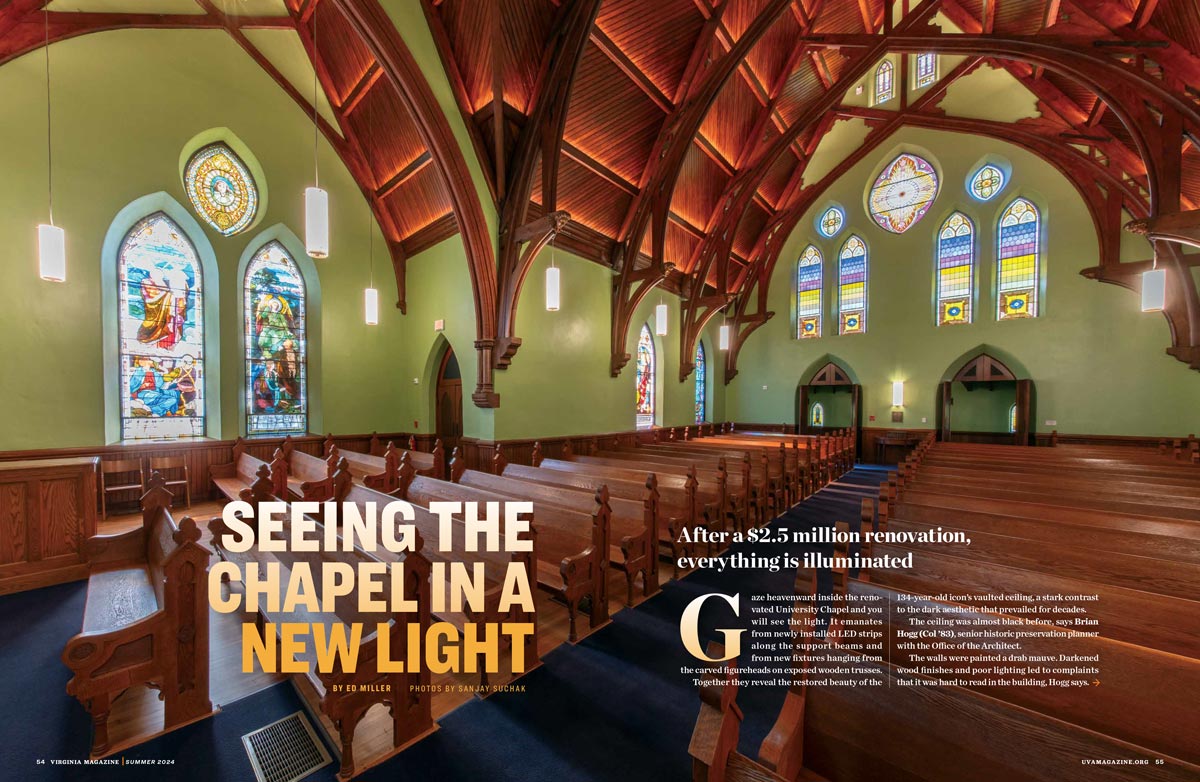
Upon the laying of the cornerstone of the University Chapel, Maximilian Schele De Vere commented that the features of the structure would “all lead the eye upward, and with the eye the heart also is lifted up, aspiring to heaven.” The remark invokes the very essence of the Gothic architectural style that informed the Chapel; vertical space and detail replace horizontal emphasis as an expression of grandeur.
Externally, the Chapel is conspicuous in juxtaposition to the classical features of the Academical Village, while its expressive interior has endured limitations in lighting when compared with Gothic exemplars such as the Cathedral Church of St. Peter in Exeter. Scale and circumstance may account for this imbalance; the Chapel’s light sources are much smaller, and the interior wood finishing underwent darkening perhaps in reaction to an early structural fire. Under the new life afforded by the renovation, the Chapel finally shows off its vertical space with restored and perfected wood finishes illuminated by the unobtrusive artificial lighting. Renovation meets refinement in a flash of light as visitors gaze upward into the heavens.
Robert J. Smith III (SCPS class of ’24)
Richmond, Virginia
“One of the fastest machines on Earth”
Thank you for the Time Capsule question about “cutting-edge technology” and the article “One of the fastest machines on Earth” in the Summer 2024 issue. I worked in the basement of Gilmer Hall in 1967-1968, shown in the photo on Page 28, for Eugene Grabman (Com class of ’55) and Alan Batson as a burster and operator of the Burroughs B5000, misplacing output, dropping card decks, mounting magnetic tapes wrong, and having a great time, while also taking classes from graduate student William Wulf (Engr class of ’68). The machine came with an engineer from Japan named Ted. The only thing I ever heard him say in English was “cold start,” ’60s jargon for “reboot.”
William H. Joyner Jr. (Engr class of ’68)
Crozet, Virginia
I thoroughly enjoyed this article! As an undergraduate taking a humanities-oriented approach in the ’80s, the goings-on in other disciplines’ basements seemed exotic and unknown to me, and fascinating now that I’ve learned the genesis of real computing power as I was there. (I knew such buildings more for having auditoria where groups would screen films on Saturday nights.) The research on this story looks time-intensive, as threads come together nicely, and a vital story unfolds through the decades. Thank you for writing this story, Ms. Hall. Your article informs of past endeavors, so we all know more about how constituent things at UVA came about and the University could become the place it is. Truly a fine piece of writing.
Doug Harris (Col class of ’84)
Richmond, Virginia
New lan bans legacy preference [U-Digest]
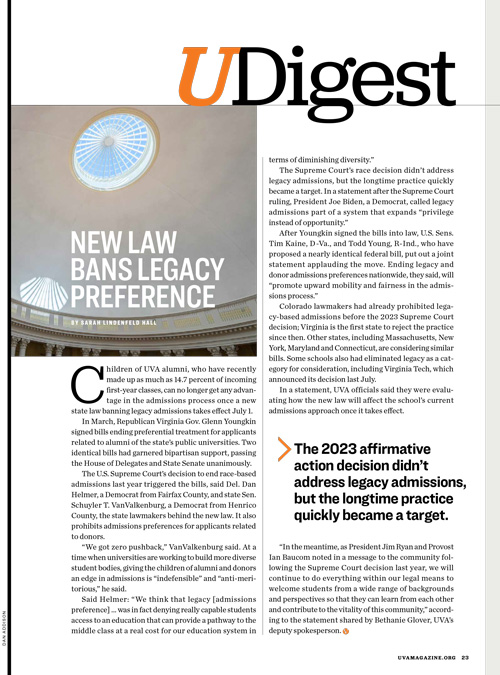
In the discussions around legacy admissions and preferences, there is an unmentioned aspect that needs to be considered. Much of the criticism regarding legacy admissions asserts that the overwhelming majority of applicants who benefit from this are white. While this is objectively true, a new concern needs to be raised. Nonwhite alumni exist in ever-increasing numbers, and now their children will be unable to take advantage of such preferences. The commonwealth’s new law denies nonwhite alumni a heretofore significant benefit of being a college graduate just as they were in a position to take advantage of it. While a well-intended law (focusing on academic merit instead of familial status), the result denies an advantage to the children of nonwhite alumni that the children of white alumni enjoyed for decades. Perhaps a middle ground can be struck—legacy status can be used as a tiebreaker between two applicants who are otherwise equal in merit. This would correct an imbalance between less-qualified legacy applicants who were advantaged at the expense of more meritorious applicants while preserving the multigenerational family connections that are indispensable to the University.
In the interest of full disclosure, I was a legacy applicant and most assuredly benefited from that status during the application process.
Bradford Moore (Col class of ’07)
Princeton, New Jersey
Record-breaking admissions [U-Digest]
In your recent article “Record-breaking admissions,” much was made of the record-breaking number of applications received by the University. Of course, with more applicants for a relatively fixed number of spots, such increases serve to make the University (and others like it) appear more selective than ever. I am proud of my UVA education and believe it is still among the best in the country. It will always be a dream school for many, as it should be.
My issue is not really with the University’s admission process, per se, but with the advent of the Common Application, which incentivizes students to apply to too many schools. When each school’s application had to be completed separately, students calculated how many schools they were truly interested in and willing to devote the time to preparing essays and completing academic reporting. In the 1990s, my generation applied to five schools at the most. Today, students routinely apply to 12 or 15 schools. They need only customize an extra essay or two. This new paradigm serves neither students nor colleges well. The flood of applications means too many wonderful students are getting lost in the shuffle, unable to gain access to any of their top-choice schools. And many remarkable students are taking up admissions spots they have no intention of accepting because they’ve applied to more schools than they can possibly seriously consider.
The increased revenue of application fees may be attractive for universities, but admissions offices are inundated with more applications than they can reasonably process in any kind of meaningful, personalized way. It’s time for the Common Application to be discontinued—just one piece that would restore some sanity to the college application process.
Ellen Dreyfuss Lee (Col class of ’96)
Dallas, Texas
Renovating the name, too [Spring 2024]
First, I would like to thank and compliment you on your numerous articles in Virginia Magazine. The issue with photos of the renovated library is especially meaningful as I spent many hours studying in the reference room during my years on Grounds.
I was, however, disappointed to see the name change. Had I been aware the Board of Visitors was studying the issue I would have written to them directly months ago. Your article “Renovating the name, too” explains the logic behind the change nicely, but I remain disappointed. I would hope that Alderman Library, after 86 years, would remain outside the scope of the Naming and Memorials Committee.
Judging historical figures by 2024 standards has again led to unfortunate results.
Stephen M. Hoster (Col class of ’64)
Apple Valley, Minnesota
Not without a fight [Fall 2020]
Having just returned from my 50th reunion and the special alumnae activities honoring the women of the Class of 1974, I was delighted to read the article describing the legal battle that preceded our admission to the University in the fall of 1970. Perhaps I was vaguely aware of all the decisions made prior to our arrival, but it was certainly enlightening to read this detailed account of the history of our arrival on Grounds. Had I known then that my favorite French professor, T. Braxton Woody, author of the Woody Report, had played a role in the decision, I would have hugged and thanked him profusely when the class concluded!
Diane Dougherty McKinnon (Col class of ’74)
Cincinnati, Ohio