In the Midst of the Storm
Interim President Mahoney is suited for the moment, colleagues say
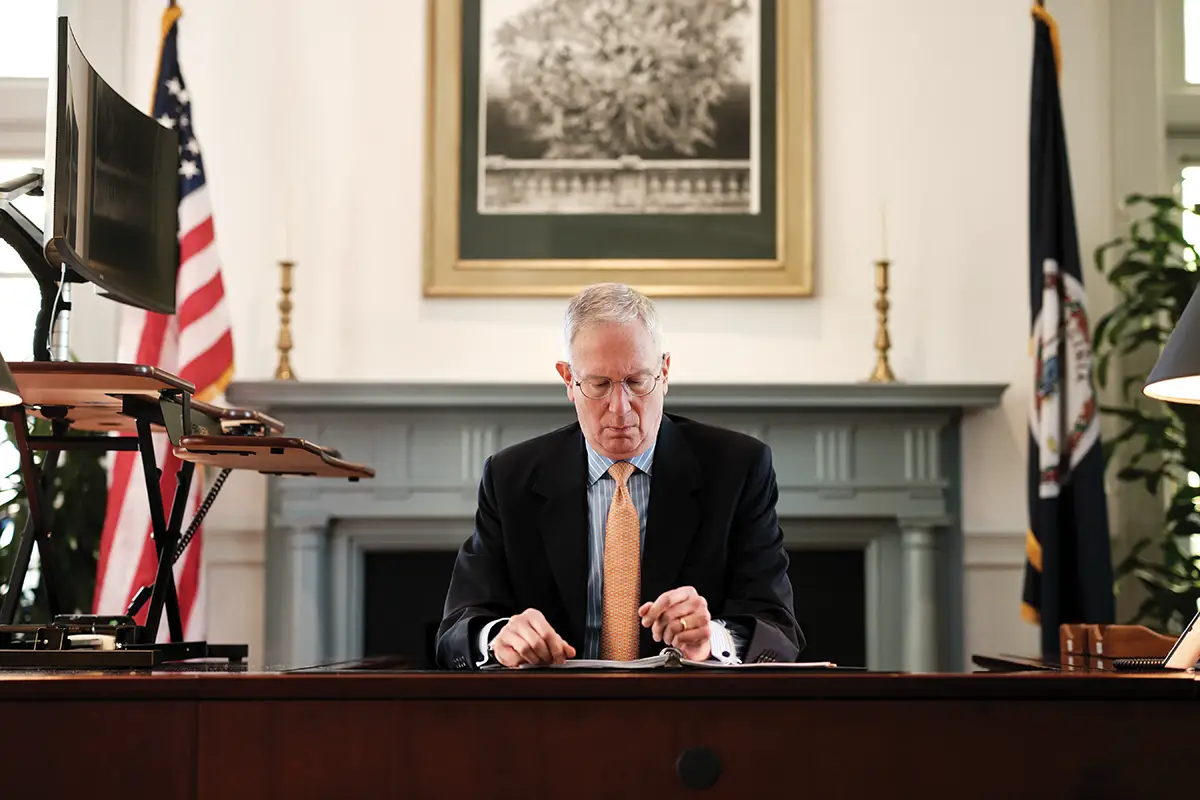
A month into the job, Paul Mahoney was still settling into the corner suite at Madison Hall, his home since becoming UVA’s interim president on Aug. 11.
It had been a “whirlwind,” Mahoney told the Board of Visitors on Sept. 12. The meeting was his first since being named the interim replacement for former President Jim Ryan (Law class of ’92), who resigned in July under pressure from the Department of Justice over an investigation focused on admissions practices.
Mahoney, 66, took over at a delicate time, with the DOJ investigation yet to be resolved and a strongly negative reaction to UVA’s handling of the events that preceded Ryan’s resignation. UVA’s Faculty Senate, Student Council and chapter of the American Association of University Professors passed votes of no confidence in the BOV. Alumni reaction was also overwhelmingly negative, with 83 percent of 1,900 respondents to a Vox Alumni survey administered by the UVA Alumni Association saying they were upset or concerned about the situation.
Against that backdrop, Mahoney in late October signed an agreement with the DOJ to pause the investigations.
Also in October, the Trump administration asked UVA and eight other schools to agree to a set of conditions it called a “Compact for Academic Excellence in Higher Education” in return for a promise of priority access to federal funding.
After forming a working group and asking for community feedback on the request, which called for allegiance to Trump administration policies, Mahoney sent a letter Oct. 17 saying that while UVA agreed with many of the principles outlined in the compact, “We seek no special treatment in exchange for our pursuit of those foundational goals.
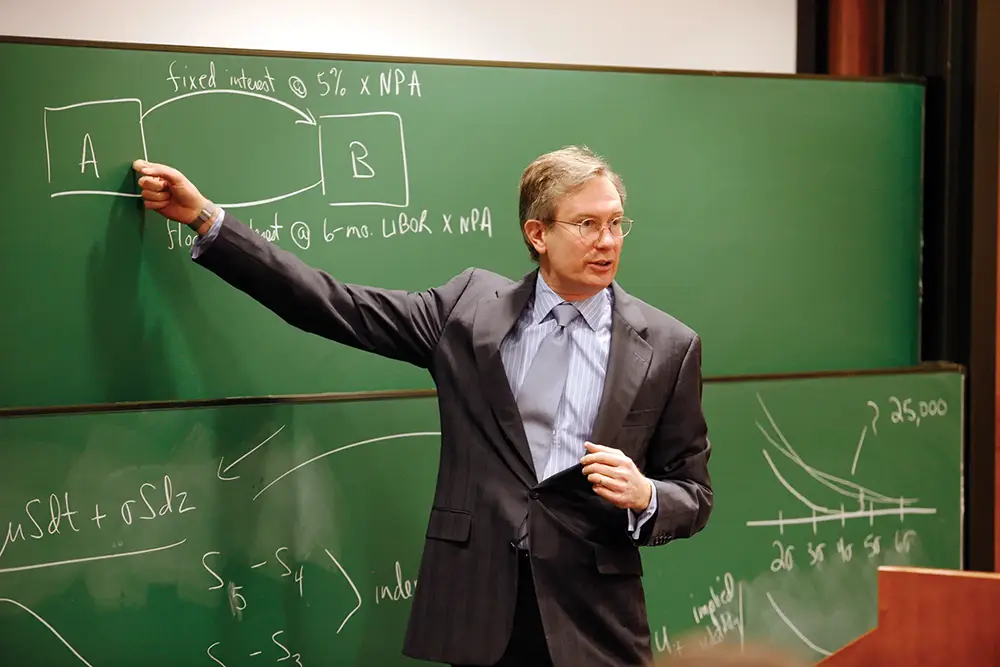
“The integrity of science and other academic work requires merit-based assessment of research and scholarship.”
It was one more task on a very full list for the former law school dean, who has made returning a sense of stability and continuity to the university community his top priority.
“We had a turbulent summer, and that caused not only anxiety but a little bit of discord among our community,” Mahoney said. “And I’m trying to refocus us on the fact that we all love this university, that the university has a clear mission of teaching, research and patient care, and that if we all rededicate ourselves to that mission, we’ll be just fine.”
There’s no precedent in modern UVA history for Mahoney’s role. In June 2012, then-McIntire School of Commerce Dean Carl P. Zeithaml was briefly tapped as interim president during President Teresa Sullivan’s short resignation. In 1931, John Lloyd Newcomb (Engr 1903) was named acting president after President Edwin Alderman died; he served in that capacity for two and a half years before being named president. Newcomb had been president “in all but name” since 1926 due to Alderman’s poor health, according to a UVA history of its presidents.
Mahoney has no template or model to follow. But current and former colleagues say his equanimity, intellect and experience guiding the law school through the 2008 financial crisis make him well-equipped to restore a sense of normalcy on Grounds.
“Paul is uniquely suited for the moment,” said Lu Alvarez Jr. (Col class of ’85, Law class of ’88), president and CEO of the Law School Foundation, who has worked with Mahoney since 1999.
The Mahoney File
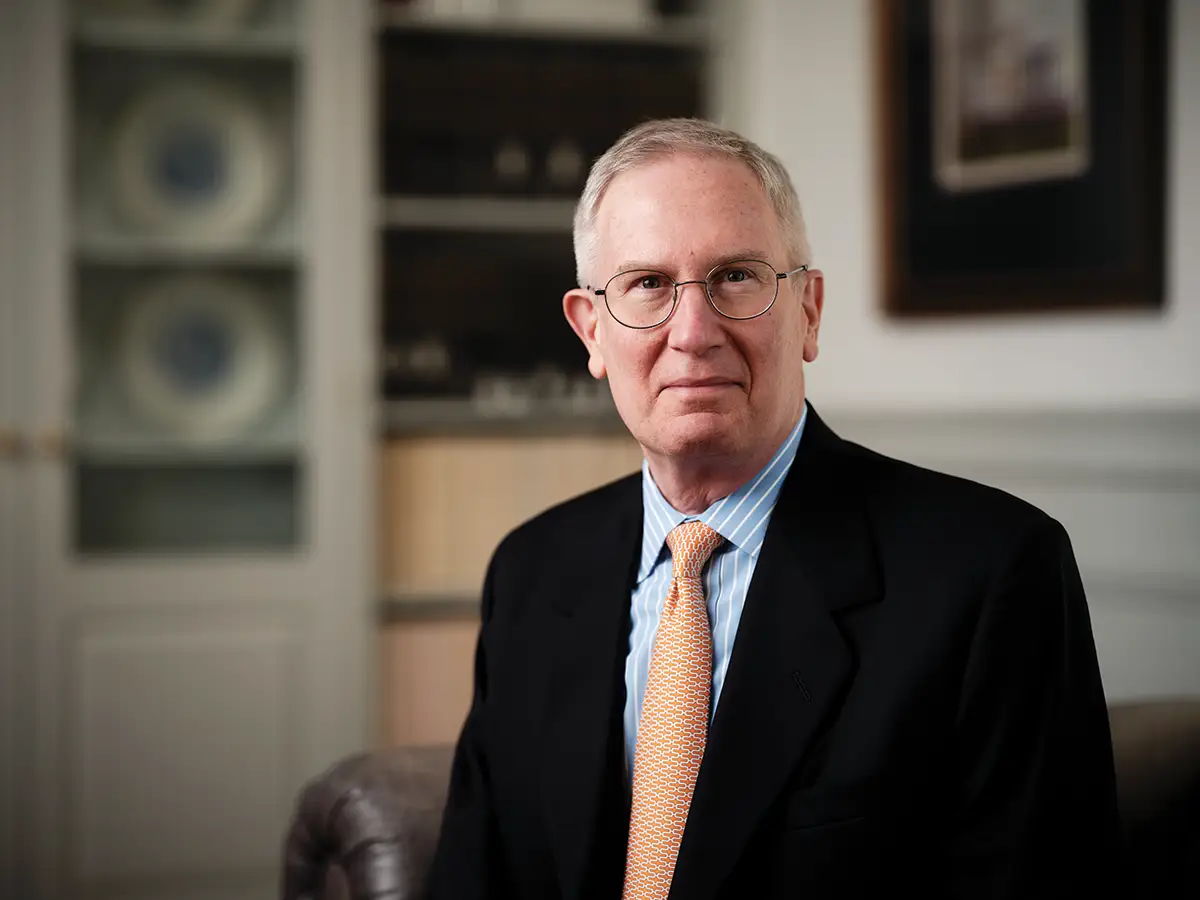
- Hometown
- St. Louis, Missouri
- Education
- B.S., Electrical Engineering, Massachusetts Institute of Technology, 1981; J.D., Yale Law School, 1984
- Clerkships
- Judge Ralph K. Winter Jr., U.S. Court of Appeals for the 2nd Circuit; Justice Thurgood Marshall, U.S. Supreme Court.
- Professional experience
- Associate, Sullivan & Cromwell, 1986–1990; UVA law professor, 1990–2008; UVA law dean, 2008–2016; professor, 2016–2025.
Indeed, in response to a question at a meeting with the Faculty Senate on Sept. 5, Mahoney somewhat dryly allowed, “I have a little bit of experience in dealing with challenging circumstances.”
Mahoney took over as law school dean on July 1, 2008. Before the fall 2008 semester was over, the nation was in the throes of what became known as the Great Recession, the worst financial crisis since the Depression.
Mahoney got out in front of the crisis, Alvarez and others said. He invested in student career services and expanded a public service fellowship program named for Robert F. Kennedy (Law class of ’51). The program uses foundation money to pay the salaries of graduates working in public service jobs.
Several hundred recent alumni participated, Alvarez said. It helped mitigate a collapse in the legal job market and gave UVA graduates a leg up, Mahoney said.
“I’m very proud of the fact that very few students ended up with the dreaded resume gap,” he said. “They may not have gotten exactly the jobs they anticipated, but they had jobs as lawyers. And that helped them in their subsequent careers.
“We really focused hard on the fact that we are an educational institution, and the students come first.”
“I’m trying to refocus us on the fact that we all love this university, that the university has a clear mission of teaching, research and patient care, and that if we all rededicate ourselves to that mission, we’ll be just fine.”
More broadly, Mahoney kept the law school on solid financial footing during the crisis. Many law schools laid off staff in response to the economic downturn, according to an article in UVA Lawyer. UVA did not, Mahoney said.
Mahoney did not impose austerity but kept a sharp eye on costs, Alvarez said, remaining a careful steward of resources.
He was also an effective fundraiser. At the end of his term in 2016, the law school’s endowment had grown 41 percent, from $344 million to $486 million, according to UVA Lawyer.
The financial crisis was not the only challenge Mahoney faced during his deanship, said professor George Geis, who served as Mahoney’s vice dean from 2012 to 2016. Law schools nationwide also faced an identity crisis.
“There was national conversation going on about whether going to law school had value,” Geis said. “The New York Times was running articles on the ‘law school scam.’”
It wasn’t just talk, Geis said. UVA Law saw its applications drop by 44 percent.
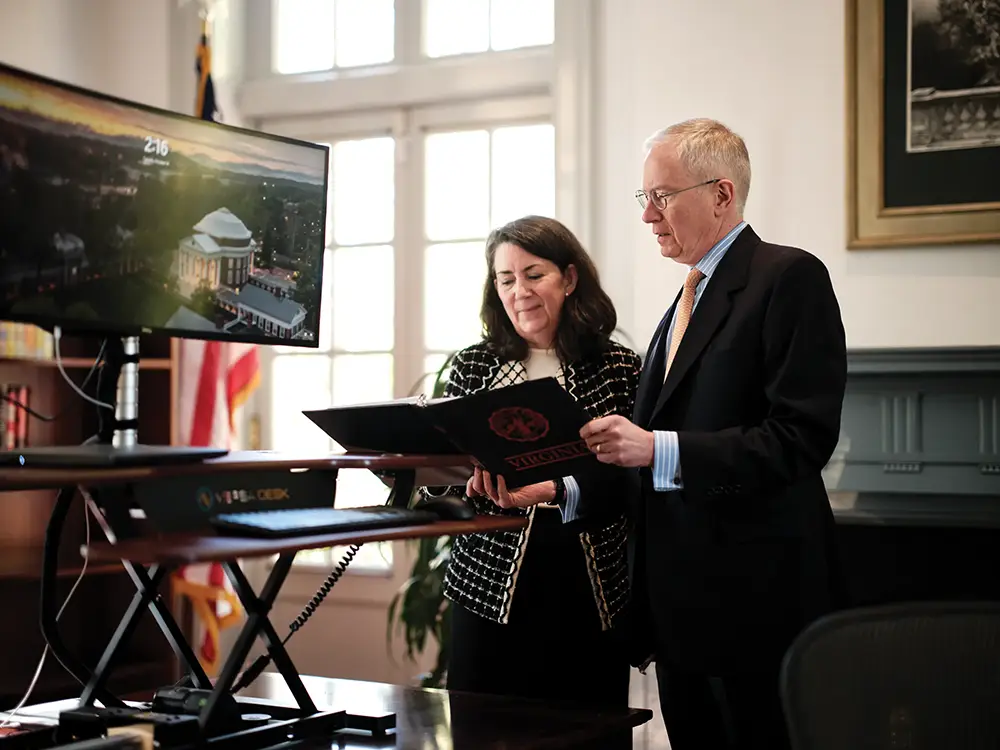
Mahoney responded by cutting the size of UVA’s incoming classes and by focusing on curricular reform that moved UVA “further in the direction of practical education,” Geis said.
Mahoney added clinics in consumer law, nonprofit law and entrepreneurial law, among other areas. He expanded the Law & Business Program, which he had taken a lead in designing in 2004 while serving as vice dean under John C. Jeffries Jr. (Law class of ’73), Geis said.
Mahoney hired Geis to beef up the program, which he now directs. UVA now offers more than 30 courses focused on the intersection of law and business, Geis said.
“He was one of the architects of thinking about what we might do differently as part of this program in order to distinguish what the University of Virginia law school can offer from some of the other peer schools,” he said.
Mahoney’s own plans for the 2025 fall semester included teaching contracts and doing research involving initial public offerings in the 1920s. It would have been a continuation of the life of scholarly seclusion he’d enjoyed since finishing an eight-year run as dean of the law school in 2016.
“Just holed up in my office, reading, writing, thinking,” he said.
As much as he was looking forward to that—his fascination with financial history dates to childhood, when he was riveted by the stock market report on the nightly news—he said he didn’t hesitate when the BOV called.
“Once you’ve been part of an organization for as long as I’ve been part of this university, you feel like, if the university needs me to do something then of course I’m going to do it,” he said.
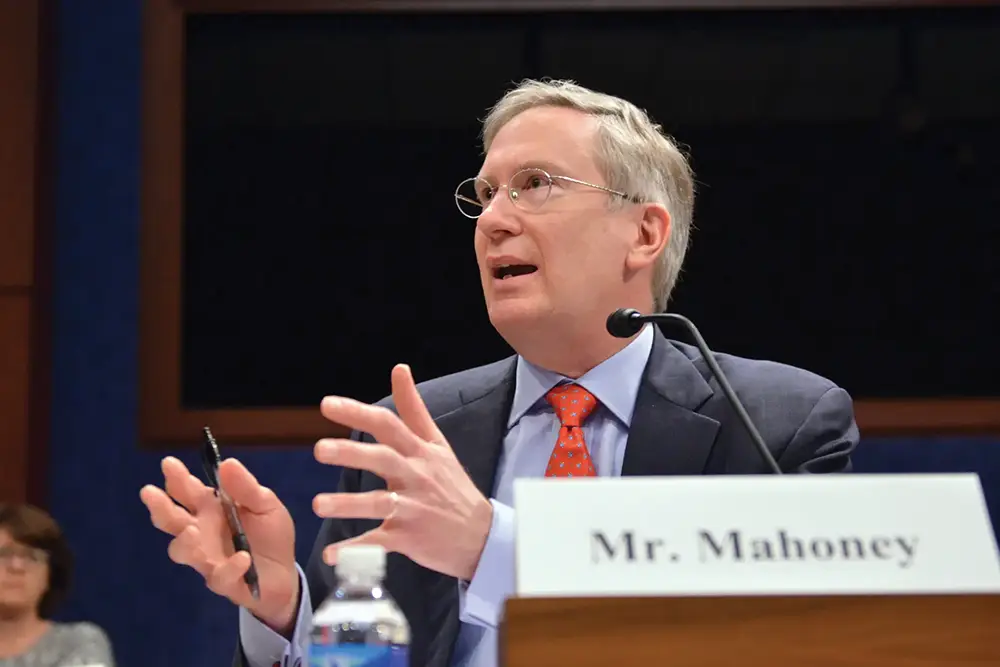
Mahoney told the Faculty Senate that his reputation as a “calm and no-drama sort of person” may have attracted the attention of the BOV.
“I think that’s probably a useful quality to have at this point,” he said.
Michael Horvitz (Law class of ’75), who served as law school foundation board chair during Mahoney’s deanship, said Mahoney’s measured style served the law school well and is just what is needed in this moment at UVA.
Horvitz described Mahoney’s leadership style as “quiet strength.”
“He is a very strong leader, he’s a very reasonable person, but this strength comes more from his intellectual capacity than from any sort of outgoing personality,” he said.
“He’s very good to work with because he’s so smart and he’s so reasonable. He understands all the issues immediately, and he gets to the heart of the matter very quickly.”
“He’s very good to work with because he’s so smart and he’s so reasonable. He understands all the issues immediately, and he gets to the heart of the matter very quickly.”
Given the situation, Mahoney had no choice but to dive right in. While his first priority is restoring stability, he has said, his second is bringing the Department of Justice investigations to a close. In his remarks to the BOV in September, he said UVA had received letters from the DOJ saying that investigations into admissions at the McIntire School and Batten School and antisemitic discrimination at the university had been closed.
Mahoney worked directly with the DOJ on the agreement to pause the remaining investigations, he said.
“I’m the CEO of the organization, so it falls to me to make strategic decisions,” he said before a deal was reached.
After, he called it “the best available path forward.”
Mahoney’s other stated priorities are promoting free speech and viewpoint diversity, and capping tuition increases at 3 percent or the rate of inflation, whichever is lower. As a first-generation college student from a blue-collar family, that issue is personal for him, he said.
Mahoney told the BOV he can only “tee up” those priorities for the 10th president. Asked if he’s a candidate for that role, he said that’s yet to be determined. In early October, UVA announced that candidates would be interviewed in late November.
It’s one of many things still to be determined. Given all the uncertainty, he is staying focused on the work—all part of his effort to send a message of business as usual, he said.
“It’s an example of the old maxim: You control what you can control,” he said. “We can’t control a lot of things that are going on in the world, but we can control whether we are doing an excellent job at our mission.”