High stakes in higher ed
Federal funding, DEI, research and international students are under attack at UVA and elsewhere
On June 26, news broke in The New York Times that the Trump administration’s Department of Justice had opened an investigation into UVA’s diversity, equity and inclusion practices. The paper reported that officials believed the university had not ended its DEI program in accordance with a January executive order, and in an “extraordinary condition” to help resolve the investigation were demanding the resignation of President Jim Ryan (Law class of ’92). At stake, according to the report, were hundreds of millions of dollars in federal funding that could be stripped from the university.
The next day, Ryan resigned, ending his tenure as the ninth head of the university.
As U.S. President Donald Trump and his administration dismantle and reshape a wide swath of longstanding American institutions—from the federal workforce to the foreign policy establishment—the situation at UVA and many other schools shows that higher education is one of the administration’s primary targets.
These institutions are facing demands across a variety of fronts, including ending diversity initiatives, cutting funding and restricting international student enrollment. And while most of the attention has been focused on Ivy League schools such as Harvard and Columbia, UVA is enmeshed in each of these battles as well, as the pressure campaign for Ryan’s ouster succinctly demonstrated.
“Without the federal funds, without the ongoing federal and state investment in financial aid, we simply wouldn’t be able to really give that full financial need package to every student.”
Before the demand for his resignation was made public, Ryan weighed in, cosigning onto an April letter from the American Association of Colleges and Universities decrying the “unprecedented government overreach and political interference now endangering American higher education.” The letter, which was signed by more than 650 higher education leaders, signaled that reforms and oversight are justifiable, but that the administration’s current actions were “coercive” and threatened “the defining freedoms of American higher education.”
Here’s a summary of the many issues colleges and universities are reckoning with under the Trump administration, both within UVA and at other institutions across the country.
Federal cuts back colleges into a corner
As the Justice Department’s investigation into UVA and Ryan’s resignation show, the threat of revoking federal funding has become a powerful political tool for the Trump administration, as well as a common thread that ties many of its higher education policies together. This includes pulling federal financial aid for colleges and universities with DEI programs, as well as terminating research grants from federal agencies.
In many instances, these aren’t just threats. After issuing an executive order in February on transgender athletes, the Trump administration froze $175 million in federal funding to the University of Pennsylvania, citing the school’s transgender athlete policy as the reason. UPenn is the former home of Lia Thomas, a transgender swimmer who last competed for the school in 2022. University President J. Larry Jameson wrote in response to the funding freeze that the school had no transgender athlete policy and was complying with NCAA rules at the time. In July, UPenn announced that it had resolved the investigation by agreeing to remove Thomas’ records from the 2021-22 season and to send an apology to student-athletes “who experienced a competitive disadvantage or experienced anxiety because of the policies in effect at the time.”
Another executive order in January to “combat antisemitism” on college campuses resulted in allegations against 10 universities that the Justice Department said “failed to protect Jewish students and faculty members from unlawful discrimination.” Two of those 10 schools—Columbia University and Harvard University—had very different responses to the administration’s accusations.
In March, Columbia yielded to the administration’s demands after it withheld $400 million in federal funds from the university. It agreed to establish new oversight over its Middle Eastern studies department, hire internal security personnel with the power to arrest students, ban the wearing of face masks in campus demonstrations and other measures.
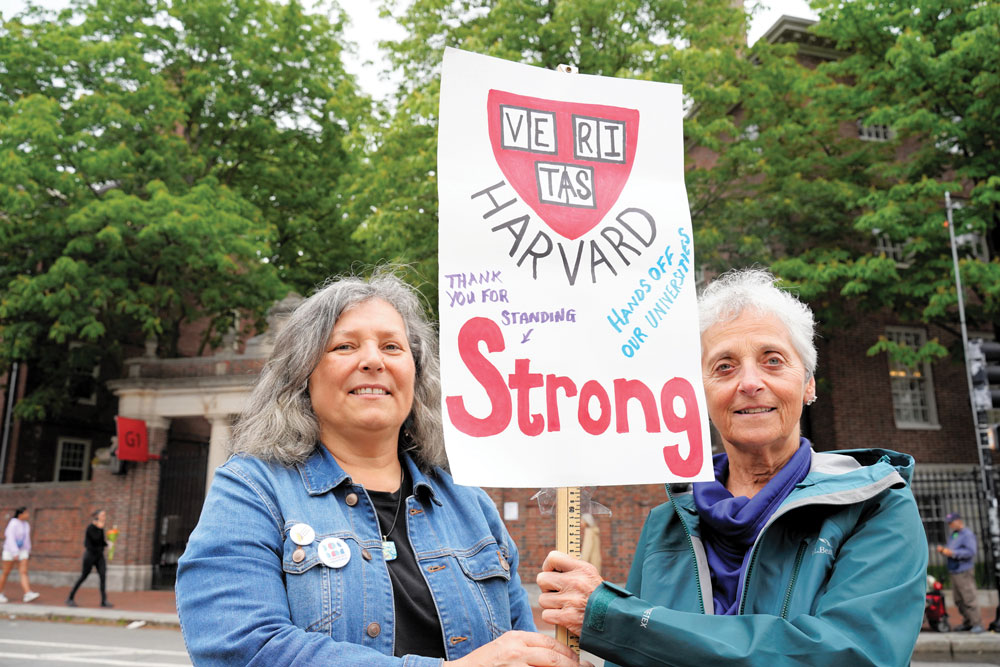
Columbia reached a broader deal with the administration in late July when it agreed to pay $200 million to settle allegations of campus antisemitism. It also committed to end all DEI programs, provide the government with detailed admissions data broken down by race, and report arrests of international students to the Department of Homeland Security, among other orders.
Harvard, on the other hand, rejected similar demands, which university President Alan Garber said amounted to an effort to “control whom we hire and what we teach.” Subsequently, the Trump administration froze over $2 billion in federal funding to the university, which Harvard is pursuing a lawsuit to restore. And in a major escalation of the fight this May, the administration revoked the university’s ability to enroll international students, which is another critical source of funds. Harvard is also suing to stop this action; a Massachusetts judge blocked the administration’s effort in the interim.
“This is a real power play by the White House, and with Columbia and Harvard, they’re really trying to establish oversight over these universities without any very strong legal basis, and they’re going to face serious legal challenges,” said Sidney Milkis, a professor of politics at UVA. “Columbia acquiesced rather quickly. But even with Harvard’s fight, I think higher education is under assault here, which could have an enduring influence on the academy.”
Trump’s March 20 executive order initiating the closure of the Department of Education could likewise have huge ramifications for higher education funding. The order is currently blocked via federal judge, but more than 2,000 department employees have already been fired, including many who worked on federal education grants and student loans.
Indeed, financial aid for students, such as student loans and Pell Grants, is an area in which universities are particularly reliant on federal funds. The administration has stated that management of student loans would be transferred to the Small Business Administration or the Treasury Department. But according to Helen Faith, UVA’s associate vice provost for enrollment and student financial services, “The federal student loan portfolio is huge, and I don’t think either of those agencies is currently in a position to handle those funds.”
The March executive order specified a requirement that “any program or activity receiving Federal assistance terminate illegal discrimination obscured under the label ‘diversity, equity, and inclusion’ or similar terms and programs promoting gender ideology.” This leaves the door open for further cuts in federal funds, which is what appears to be at stake in the Justice Department’s investigation into UVA’s DEI policies.
If federal student aid to UVA were cut, “I think there would be a lot of people who would not be able to attend the university,” said Stephen Farmer (Grad class of ’86), vice provost for enrollment. “And I think every other person who could attend the university would be poorer for the loss of the people who could not attend.”
According to the National Center for Education Statistics, almost 6,000 UVA undergraduates were receiving Pell Grants or federal student loans in 2022-23 (the most recent available data). In total, this amounted to around $33.7 million in federal financial aid.
Faith added: “Without the federal funds, without the ongoing federal and state investment in financial aid, we simply wouldn’t be able to really give that full financial need package to every student. Every single dollar of that picture really matters.”
Stripping federal financial aid funding away from a college would mean that fewer students, especially those from disadvantaged backgrounds, would be able to afford an education. And when specific institutions are targeted, as UVA has been, it can have a “chilling effect” on students from lower-income and lower-middle-income backgrounds who may be considering those colleges, according to Faith.
“Just the threat to an institution that they may be thinking about I think is enough to dissuade a lot of families from planning to go into higher education and go to college,” she said.
The Trump administration’s signature domestic policy bill, signed into law on July 4, will put further restrictions on student loans by capping federal borrowing at $100,000 for master’s degrees and $200,000 for doctoral, medical and professional degrees. Critics of this new policy say it will push students pursuing these degrees onto the private loan market, which can mean higher interest rates and ineligibility for federal loan forgiveness programs. Along with the phasing out of the federal Grad PLUS loan program and other changes, the end result may be fewer students going into critical fields such as medicine.
Former UVA President Teresa Sullivan, who has written in The Washington Post about the Trump administration’s attacks on higher education, said that in the long run, closing off this access to education is what worries her most.
“If you go after the undergraduate mission, I think you really go after the heart of the university,” she said. “Restricting the access to college impinges on the American dream, and I think that would be the ultimate effect. And I just can’t believe anybody really wants to do that.”
A rollback of diversity, equity and inclusion
The day after his inauguration, Trump issued an executive order titled “Ending Illegal Discrimination and Restoring Merit-Based Opportunity.” It specifically called out higher education institutions, among other entities, saying that they “have adopted and actively use dangerous, demeaning, and immoral race- and sex-based preferences under the guise of so-called ‘diversity, equity, and inclusion’ (DEI) or ‘diversity, equity, inclusion, and accessibility’ (DEIA) that can violate the civil-rights laws of this Nation.”
This was a long-held promise of the Trump campaign, and the order was paired with another one eliminating DEI programs and policies across the federal government. It requires any recipient of federal funding to certify that it does not operate any DEI programs in violation of federal antidiscrimination laws.
The orders were followed by another in April targeting the higher education accreditation system, which is the process colleges and universities undergo to receive federal financial aid. It accused accreditors of demanding that schools adopt “unlawfully discriminatory practices” (meaning DEI) as a condition of that process. During his campaign, Trump called the accreditation system “our secret weapon” in the effort to “reclaim our once-great educational institutions from the radical left.”
As a result, many colleges and universities have begun to close DEI offices and roll back those policies. In February, Ohio State University announced that it would “sunset” its Office of Diversity and Inclusion. The University of Michigan—once at the vanguard of DEI initiatives—likewise announced the closure of two equity-related offices in March, alongside the discontinuation of its DEI 2.0 Strategic Plan. And the executive orders aren’t just leading to closed offices: In March, Johns Hopkins University announced that it would eliminate over 2,000 jobs after losing federal funding for international aid projects due to the closure of the U.S. Agency for International Development (USAID), which the White House attributed to “streamlining federal agencies to eliminate wasteful DEI projects.”
On March 7, UVA’s Board of Visitors voted unanimously to dissolve the university’s Office of Diversity, Equity, Inclusion and Community Partnerships and to move “permissible” programs elsewhere within the university. The resolution referenced Trump’s post-Inauguration Day executive order and directed Ryan to update the board on the university’s compliance within 30 days. In response to the board’s vote, a statement from the university affirmed that it would comply with the resolution.
The Trump administration’s moves against DEI have also hit the world of university research. In February, the National Institutes of Health (NIH) began terminating grant funding for research related to DEI and gender identity subjects—a directive that was struck down in June by a federal judge, who wrote that it “represents racial discrimination and discrimination against America’s LGBTQ community.”
Similarly, earlier this year, Fulbright scholarships for nearly 200 researchers were canceled, seemingly due to their work studying race and ethnicity, as well as other subjects including climate change, gender and homelessness. The prestigious Fulbright Program funds scholars to study internationally and is managed by the Department of State. In June, the Fulbright board resigned en masse to protest the cancellations.
The administration’s actions highlight an aggressive use of executive orders, rather than legislation, to enact policy. “I’ve been writing about the expansion of presidential power and presidents’ use of unilateral action … for longer than I care to admit,” said UVA’s Milkis, who wrote about this strategy in his new book, Subverting the Republic: Donald J. Trump and the Perils of Presidentialism, co-authored with Nicholas Jacobs (Grad class of ’16, class of ’19). “But I have to say, Trump is a culmination of that.”
Cuts to scientific and medical funding
The federal government has historically granted a huge amount of funding to universities and other organizations for scientific and medical research: $32 billion across 60,000 grants in fiscal 2024 alone. But a sweeping change the Trump administration made to NIH funding is poised to cut that number by up to $9 billion moving forward.
The cuts stem from a potential new 15 percent cap on reimbursement for “indirect costs” in research grants, which involve costs associated with labs’ shared equipment, personnel and utilities. UVA’s previous reimbursement rate for these expenses was 61.5 percent, and the new cap would cost UVA researchers approximately $54 million, according to Lori McMahon, UVA’s vice president for research. The action is currently tied up in the courts after state governments and research organizations filed a lawsuit and a federal judge temporarily blocked the cuts.
At the same time, researchers at many universities—including UVA—are reporting cancellations, delays and stop-work orders for a variety of research grants already in progress. In May, the Association of American Medical Colleges reported that 777 NIH grants awarded to medical schools, hospitals and other institutions had been terminated, totaling $1.9 billion in lost funding.
In a presentation to the Board of Visitors, UVA disclosed that 43 federal grants to the university had been terminated as of June 3, with 12 coming from the National Science Foundation and 9 from NIH. In total, this amounts to $63 million in lost funding.
The situation has become so dire that in late March, almost 2,000 members of the National Academies of Sciences, Engineering, and Medicine signed an open letter declaring that the cuts are “forcing institutions to pause research (including studies of new disease treatments), dismiss faculty, and stop enrolling graduate students—the pipeline for the next generation’s scientists.”
“Talented young scholars in other countries who might have wanted to teach here no longer will want to. …So I think that this damage could be an enduring one.”
Meanwhile, the July 4 domestic policy bill will cut federal Medicaid spending by around $1 trillion over the next decade—creating dramatic impacts for UVA Health and the people who rely on it. A June analysis by health policy research organization KFF, based on the version of the bill passed by the House in May, found that the legislation would decrease Medicaid spending in Virginia by $23 billion over 10 years and remove about 317,000 Virginians from the health insurance program.
In Albemarle County, where much of UVA is situated, 14.3 percent of residents were enrolled in Medicaid in 2023, and 28.1 percent of children were enrolled in Medicaid or the federal Children’s Health Insurance Program (CHIP). A spokesperson for UVA Health declined to comment on how local Medicaid cuts would impact the health system.
Termination of international student visas
This spring, the Department of Homeland Security began revoking student visas for hundreds of international students at colleges and universities around the country, seemingly without warning. These students were targeted for a variety of reasons: pro-Palestinian activism, criminal charges such as DUIs or even politically oriented posts on social media.
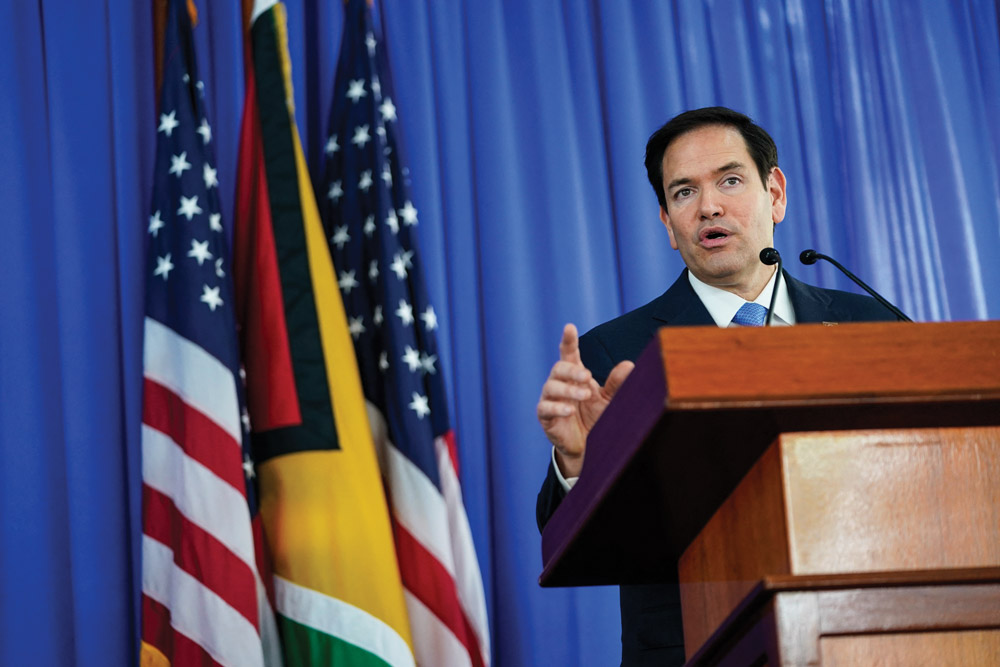
“It might be more than 300 at this point,” Secretary of State Marco Rubio said in late March, regarding the number of revoked student visas at that point. “We do it every day. Every time I find one of these lunatics, I take away their visas.”
According to an analysis from Inside Higher Ed, the administration had revoked visas from more than 1,800 students across more than 280 schools by late April. The stories of several students have made national news. Video of Tufts University doctoral student Rümeysa Öztürk’s arrest went viral this March; she was seemingly detained for having co-authored a student newspaper op-ed that criticized her school’s response to the war in Gaza. A federal judge ordered her release after she spent six weeks in a Louisiana detention center, and she returned to Boston in May.
The visas of one student and two recent alumni of UVA, which currently hosts over 2,500 international students, were revoked in early April.
Such visa terminations are likely to influence not just potential international students, but teachers as well. “Talented young scholars in other countries who might have wanted to teach here no longer will want to,” Milkis said. “So I think that this damage could be an enduring one.”
On April 25, the Trump administration, facing dozens of lawsuits over its actions, abruptly reversed itself and said it would restore legal status to impacted students. But according to The New York Times, a Justice Department lawyer told a federal judge at the time that the administration was developing a new system for reviewing and terminating international student visas.
The actions to restrict international student enrollment continued in mid-June when, after a pause in appointments for new student visa applications, the State Department resumed the process but required applicants to set their social media profiles to “public” to allow the government to conduct “a comprehensive and thorough vetting.” In the weeks leading up to this policy change, Rubio had issued a statement saying his department would work with the Department of Homeland Security to “aggressively revoke visas for Chinese students,” as well as an executive order partially or fully restricting entry to the U.S. for citizens of 19 other countries.
Although the legality of many of these issues is being challenged in the courts (including the previously mentioned ban on all international students at Harvard), Sullivan said they could nevertheless dissuade international students from studying in the U.S.
“Most of your international students are advanced graduate students, and they’re in places like the medical school, the College of Engineering and so on,” she said. “And they’re doing cutting-edge research because they’re among the best minds in the world.”
Sullivan noted that graduate students can’t easily transfer schools like undergraduates can. “If you leave that professor and go to another school, you’ve got to start all over again. And of course no one’s going to want to do that. So I think this could have a really chilling effect on the willingness of international students to go to any [U.S.] university, and not just Harvard.”