Game Changer
Behind Tony Bennett’s surprise retirement and what’s next for Virginia men’s basketball
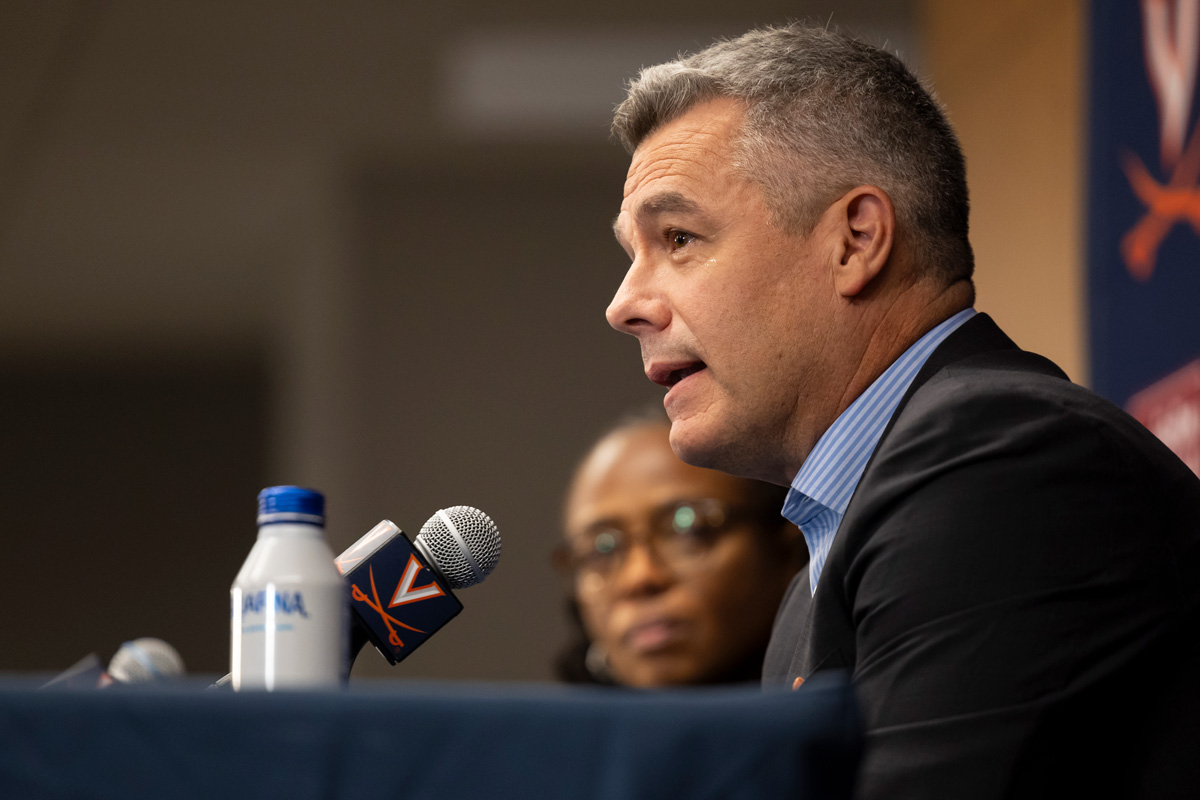
In the end, Tony Bennett retired the way he coached—following his own rules. In mid-October, Virginia’s men’s basketball coach was making the rounds at the 2024 ACC Tipoff in Charlotte, North Carolina, talking to media members about the upcoming season. Afterward, he returned to Grounds and put his team through its paces, showing no indication that he was less than fully committed.
“He was into it,” said former Cavalier player and coach Jeff Jones (Col class of ’82), who was at practice, watching. “Really intense and focused.”
But the following week, Bennett announced his retirement, an abrupt departure that prompted stunned reactions and tributes from college coaches, administrators, commentators, fans and former players. Still in his prime at 55, Bennett declared that he was no longer the right person to lead Virginia in the rapidly changing, chaotic landscape of big-time college sports.
“I’m a square peg in a round hole,” he said. “That’s what it is. Maybe that’s the hard part to admit, but it’s OK because, when you tell the truth, there’s freedom in that.”
But how did Bennett arrive at his decision? And what does the future hold for Cavalier men’s basketball?
A new landscape
Bennett, very much a traditionalist, has made no secret of the fact that he is not a fan of recent changes that have moved major college sports toward a professional model, with loosely regulated payments to players, the lifting of restrictions on player transfers and the increasing influence of agents, among other changes.
“We’ve been talking about the landscape and the difficulties and the challenges for years,” UVA Director of Athletics Carla Williams said.
The disruption began in 2021, when the U.S. Supreme Court found that the NCAA was subject to antitrust laws. The decision opened the way for “name, image and likeness” (NIL) payments to players, ostensibly for things such as brand endorsements, appearances, charity work and social media posts.
Payment for performance was prohibited. But booster-led NIL collectives have paid de facto salaries and signing bonuses to star players and recruits, creating bidding wars for top talent at some schools.
The lifting of restrictions on player transfers in response to another antitrust suit has resulted in virtual free agency.
“Quite honestly, you just don’t know in college basketball what rosters are, what teams have,” Bennett said at his retirement press conference.
Before the changes, players who transferred were required to sit out a season, which limited their numbers. Last season, a record 1,089 Division I men’s basketball players entered the NCAA transfer portal, according to the website On3.com. Virginia added five transfers for this season, after a frantic two-month process that begins immediately after the season and often involves negotiations with player agents, a task Bennett said he had little stomach or talent for and left to assistant coaches.
Attempts at restoring order are underway. In May, the NCAA and its major conferences reached a settlement that will allow schools to share up to 22 percent of their athletic department revenue with players. The deal, which has received preliminary approval from a judge, also seeks to rein in the influence of boosters by subjecting third-party NIL deals to NCAA approval.
Even if approved, however, the settlement is not expected to be the final word on the new model of college athletics.
In these uncertain times, Bennett was not willing to wait for the courts, the NCAA, or possibly the U.S. Congress—which the NCAA has asked for a shield from further antitrust suits—to sort things out.
“The game and college athletics is not in a healthy spot,” he said.
In his announcement, Bennett stressed that he is not against payments to athletes, and he said collective bargaining with players is the only way for the NCAA to impose enforceable salary and transfer restrictions and limit the influence of agents.
But the NCAA has argued in court against granting athletes employee status—key to collective bargaining.
Bennett had been on record as taking a wait-and-see approach to the new environment. He said before the 2023-24 season that if he “can be successful in the right way” he would continue to coach.
At his press conference, he said he had considered stepping down after last season but got swept up in recruiting players in the transfer portal. He signed a contract extension in June, and although he wasn’t sure he’d complete the full six years on his deal, he said he was “excited” and began preparing for the upcoming season.
Still, his discomfort with the state of college athletics lingered. At the ACC Tipoff a week before his announcement, ESPN reporter Jeff Borzello asked Bennett why people thought he could be “the next Jay Wright and retire out of nowhere.” It was a reference to the highly successful Villanova University coach who two years ago retired unexpectedly at age 60, citing the looming changes as one reason.
“I’ve got to call Jay Wright and see what he says, right?” Bennett responded, jokingly. “I always have said, when you’re doing this, you’re in this profession, whether you agree how it’s going or not, you have to be true to yourself and really look at it and say, ‘Who am I? Can I operate how I want, and can it be successful enough?’”
Bennett said at the press conference that he’s spoken to Wright “over the years.” Before making his decision, though, he talked to his father, Dick Bennett. The elder Bennett retired as the University of Wisconsin head men’s basketball coach in November 2000 at age 57, three games into the season, saying he was burned out.
His father told him “you have to do what’s in your heart,” Bennett said.
Bennett also received advice from his wife, Laurel. It was during a fall break trip with her that he realized it would be unfair to his team to continue to coach if he was not fully committed, he said. He called Williams, who asked him to sleep on it. But his mind was made up.
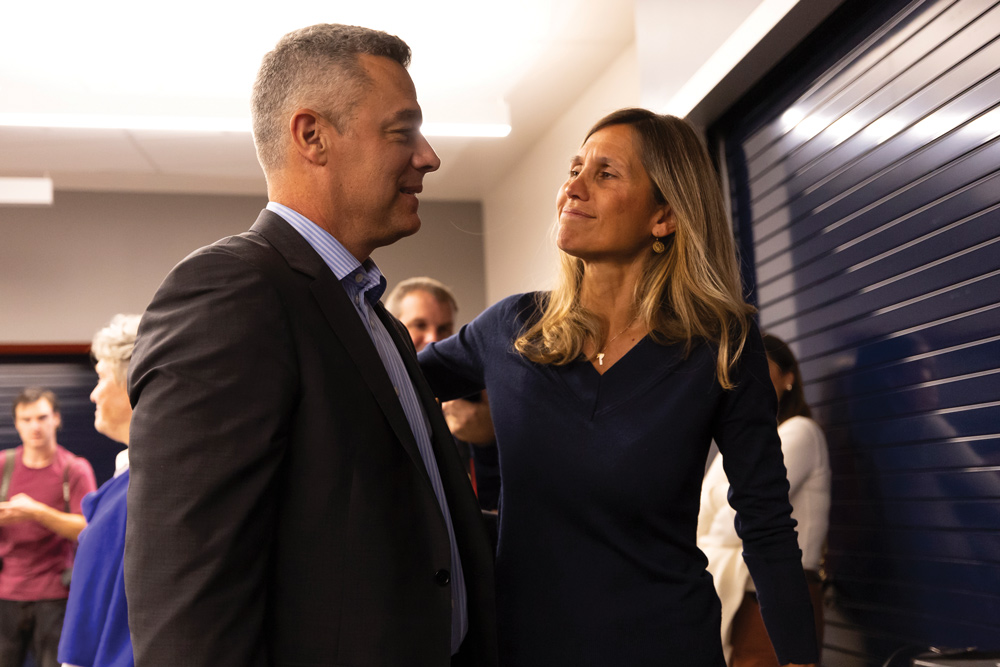
Bennett told his team the next day.
“I was definitely really shocked,” said guard Isaac McKneely (Col class of ’26), the team’s top returning player. “We were just about to have practice, and he broke the news to us.
“I understand his decision. He couldn’t provide his best for us. He’s just doing what’s best. I trust Coach Bennett. I trust his decision-making. I’m thankful I got to play for him for the two years that I did.”
Bennett said he gave everything he could over his 15 years at Virginia.
“I am at peace,” he said. “When you know in your heart it’s time, it’s time.”
Bennett’s legacy
Bennett’s numbers at Virginia speak for themselves. He coached 500 games, the most in program history, and won 364, also a record. He guided the Cavaliers to the 2019 NCAA championship, two ACC Tournament titles, six ACC regular-season championships and 10 NCAA tournament appearances. He was named ACC coach of the year four times.
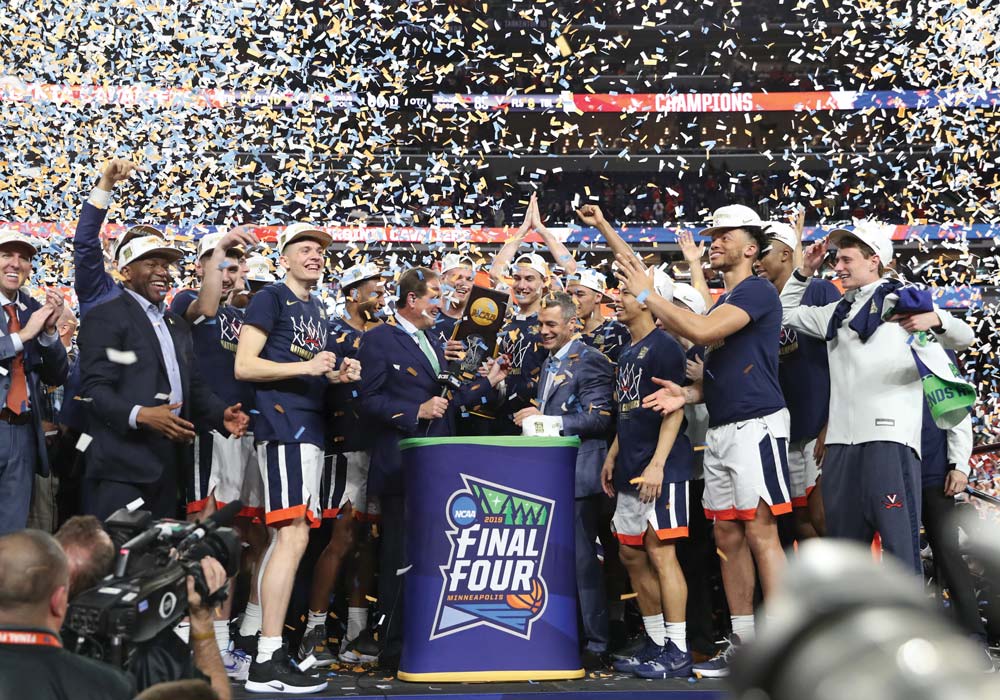
“He elevated the UVA men’s basketball program back to national prominence,” Williams said.
Yet it was the way he coached and built his program that set Bennett apart. He talked often of leading Virginia according to his five pillars of humility, passion, unity, servanthood and thankfulness.
Bennett was humble in victory and gracious in defeat, most notably when No. 1 seed UVA was upset by No. 16 University of Maryland, Baltimore County, in the 2018 NCAA tournament, a historic, gut-wrenching loss. Bennett was widely praised for handling it with class.
Unlike some of his rivals, Bennett recruited fewer top-ranked “can’t-miss” prospects who might stay in college just a year or two and instead brought in less-heralded players who stuck around and developed into stars.
“I wanted to see if I could build a program in our unique way to compete against the Blue Bloods,” he said at his press conference. “I was so intrigued and excited about being at a school that had academic excellence and the degree mattered and it was important.”
Bennett’s against-the-grain approach extended to his team’s famously deliberate and defensive-oriented style of play, a contrast to the faster pace favored by many others that is generally considered
more entertaining.
Winning validated his style of play and brought attention to his personal values and the way he carried himself. Across college athletics, Bennett has widely been regarded as someone who did things the right way. He has also been, given the visibility of men’s basketball, as recognizable a symbol of UVA as any one individual.
“Bennett was the myth that the NCAA tries to present to the public, except he was real,” bestselling author and Washington Post columnist John Feinstein wrote when Bennett retired.
“The college game has lost a giant,” said Indiana Pacers coach Rick Carlisle (Col class of ’84), who was among the many who came to the press conference to salute Bennett. “In the way he has done it and what he stands for and the integrity he has personally and as a coach.”
Carlisle said he believes Bennett’s remarks about the state of college athletics will resonate. Williams said his departure is a sad commentary on where things stand.
“When people like Tony Bennett exit men’s basketball, exit our industry, for something that has nothing to do with coaching or teaching or being a role model, then shame on all of us,” she said.
Amid the praise, there was criticism of the timing of Bennett’s departure just three weeks before the start of the season. Sports Illustrated columnist Pat Forde, who has been critical of Virginia’s style of play, wrote a column theorizing that Bennett’s move may have been calculated to ensure that Williams did not have time to do anything but promote his preferred successor, Ron Sanchez, and that players would not have time to transfer. (In late October guard Jalen Warley (Col class of ’26) announced he would transfer.)
Inside the dining room at John Paul Jones Arena, however, where the press conference was held, several supporters said Bennett was simply being true to himself, a privilege he was entitled to.
“He’s earned the right to take some time and exhale and figure out what he wants to do next, if anything,” Carlisle said.
Virginia’s future
While Bennett was figuring out what he might do next—he hinted at possibly taking a part-time advisory role of some kind, although at publication time that was still to be determined—Sanchez was hastily elevated from associate head coach to interim head coach.
The 51-year-old Sanchez, who was born in the Dominican Republic and grew up in the Bronx, is as steeped in Bennett’s system as anyone. He coached with and under Bennett at Washington State University and for nine years at UVA before leaving to serve as head coach at the University of North Carolina, Charlotte. He compiled a record of 72-78 there in five years but led the 49ers to the school’s first postseason title in his final season.
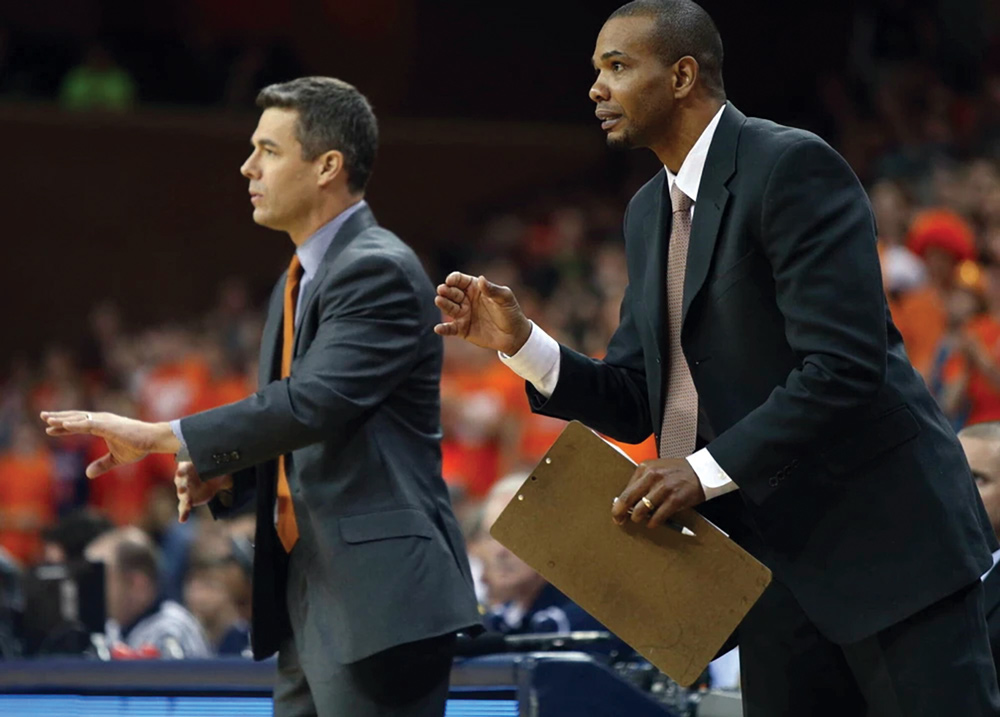
Sanchez returned to UVA in 2023 as associate head coach, the same title he held before leaving. He said he didn’t expect to make many changes.
“It would be a mistake to come in here and think I could do things completely differently and try to have the same results,” he said at a press conference five days after taking the mantle.
“The leadership may have changed, but the program and the culture here will not.”
Sanchez emphasized that he’d been in on the ground floor of something that took years to build. He said his first priority when becoming interim head coach was to check on his staff members and the team’s players in the aftermath of an emotional couple of days.
“I wanted to tell them they are still loved,” he said of the players. “Tony’s departure doesn’t remove that level of appreciation for them as student-athletes here.”
Forward TJ Power (Col class of ’27) transferred from Duke this season largely to play for Bennett, he said. Bennett had recruited him coming out of high school and again when Power decided to transfer.
“It’s definitely been a whirlwind of emotions,” Power said 10 days after Bennett’s announcement and roughly a week before the start of the season.
Although the timing of Bennett’s retirement made it difficult, the team had managed to move on fairly quickly, he said.
“And Coach Sanchez has helped us with that so much. He knows Coach Bennett better than anyone and he knows what needs to continue here and our team has embraced him really well.”
Sanchez said Bennett was more than a colleague; he was his closest friend. Still, he said he was also surprised by Bennett’s decision to walk away.
“This was not expected, but with every challenge comes an opportunity,” he said.
Williams said she will conduct a national search for a head coach after the season, so Sanchez will have at least one year in charge. But he said his interim status won’t affect the way he coaches.
“The title doesn’t mean anything,” he said. “I’m here to serve this institution for however long it is.”
Kyle Guy (Col class of ’20), who was one of the heroes of the 2019 national championship team and recently returned as a special assistant, said Bennett’s presence will remain.
“He set a standard here that we will strive to meet every single day,” he said.