Ding! Ding! Ding!
Experts agree tech can be distracting and worse. UVA is experimenting with ways to help students disconnect.
Editor’s note: This is a longform story. Click here for an abridged version.
With his smartphone and laptop stowed in his backpack, Porter Vaughan (Col class of ’27) felt more present and engaged during English Writing and Rhetoric 1510: Writing and Critical Inquiry than in his other classes last semester.
“I was more invested in what my classmates were saying and what the professor was saying,” he says. “I enjoyed not having the distraction.”
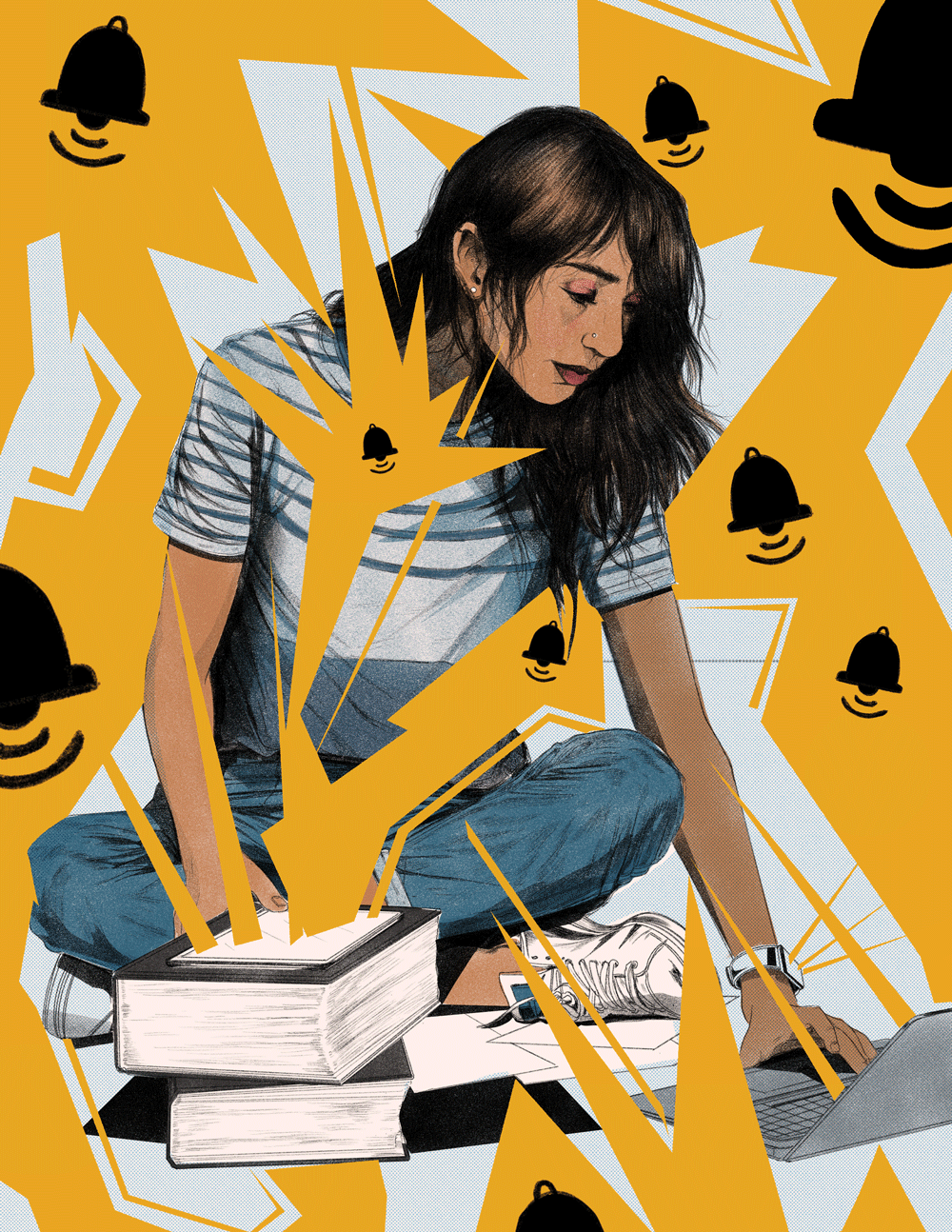
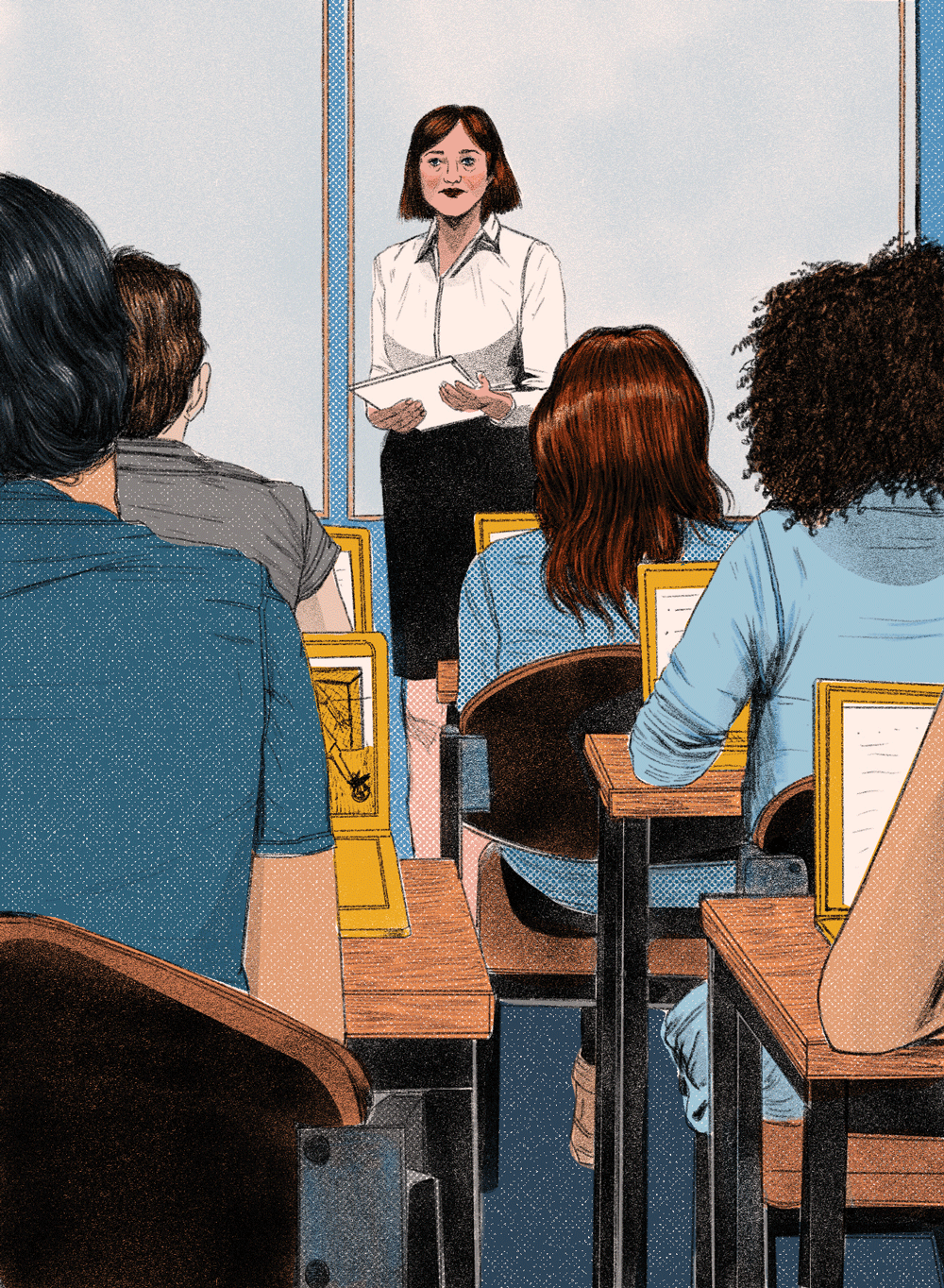
The 18-student class taught by associate professor John T. Casteen IV (Col class of ’93) prohibited the use of laptops and phones during class. Bernadette Montfort (Col class of ’27) says it was her favorite class of her first year in college and a far different experience from the large lecture classes she took, in which students typing notes on their laptops sometimes wandered—virtually, at least—from the room.“There were always a lot of people shopping and watching random videos,” she says. “A lot of people like to do the New York Times Wordle. You’d see them screen-switching back and forth.”
Montfort sometimes falls prey to distractions herself, she says. She’ll scroll social media while studying, for example. And when she gets together with friends to study, they’ll often spend breaks looking at their phones rather than talking.
“I do get sucked in easily,” she says.
It’s a common lament among students who’ve come of age in a hyper-connected world with technology engineered to be addictive. By 2023, 46 percent of teens reported being online “almost all the time,” writes Jonathan Haidt, a social psychologist and former UVA professor now at New York University. In a 2022 Pew Research Center Report, 36 percent of teens said they spent “too much time” on social media.
Some argue that that constant connectedness has negative effects both cognitively and emotionally. While some students are trying to limit their personal use of technology, some administrators and professors at UVA are looking at how to mitigate the issues in other ways.
Haidt, author of the bestselling book The Anxious Generation: How the Rewiring of Childhood Is Causing an Epidemic of Mental Illness, is one prominent voice sounding a warning about technology and mental health. He cites alarming increases in anxiety (up 134 percent) and depression (up 106 percent) among U.S. undergraduates since 2010, around the time adolescents traded flip phones for smartphones. To him, there’s a clear causation between social media use enabled by smartphones and bad mental health outcomes. He points to 13 true experiments—“the gold standard for establishing causality”—that found a significant causal effect.
Haidt, who has been called a “digital absolutist,” has called for a ban on smartphones in schools. Other academics are not as convinced of the need, nor of the causal link between social media and declining mental health among teens. Still, few dispute that there is a correlation.
There appears to be general agreement that “spending time away from technology and social media has psychological and cognitive benefits,” Vice Provost for Academic Affairs Brie Gertler wrote in an email.
Indeed, putting down phones or closing computer screens makes it easier to concentrate, a half-dozen students interviewed by Virginia Magazine said. Unplugging during class leads to more engagement and participation, as well as a better grasp of material, they said.
Conversely, scrolling social media too long can cause feelings of anxiety, inadequacy and loneliness.
“The more time I spend on my phone, the worse I feel,” says Max Manoff (Col class of ’27), whose weakness is Instagram sports videos.
Mai Hukuoka (Col class of ’27) found her first-year roommate through Instagram. She’s also active on Snapchat and TikTok, although she finds that spending too much time on such platforms “kind of drains your energy,” she says.
Stepping away is hard, though. No one wants to feel they might be missing out.
“Everyone knows they are on their phone and social media way too much,” Hukuoka says. “We’re all aware of it, but sometimes it’s something you can’t escape.”
Citing evidence that adolescents who spend more than three hours a day on social media double their risk of anxiety and depression symptoms, U.S. Surgeon General Vivek Murthy has called on Congress to require a tobacco-style warning for users of social media. As of the summer of 2023, the average adolescent spent 4.8 hours per day on such platforms, he wrote.
“The mental health crisis among young people is an emergency—and social media has emerged as an important contributor,” Murthy wrote in a June op-ed in The New York Times.
Nicole Ruzek, chief mental health officer at UVA Student Health and Wellness, says her office does not track how many students report feeling overwhelmed by or addicted to phones and social media. But she’s aware that many feel it’s a problem.
“Anecdotally, I’ve heard a number of students talk about needing to take a vacation from social media,” she says. “Frequently, they’ll uninstall the apps from their phones in an attempt to get it under control.”
Ruzek says one trend she’s following is a jump in students reporting social anxiety, or feeling that they have trouble making friends, having a conversation or generally fitting in. Social anxiety has begun outpacing general anxiety as a diagnosis that “is always at the top, in terms of numbers,” she says.
The 2022 annual report of the Center for Collegiate Mental Health at Penn State confirms that trend. It highlights the fact that over a 12-year period, the number of students seeking services for social anxiety at college counseling centers nationwide increased more than students seeking services for any other area of distress.
Isolation during the pandemic and increased usage of phones and social media are possible contributors. In general, though, figuring out exactly why mental health concerns are on the rise is a challenge. Ruzek believes there are multiple factors beyond the effects of technology.
“I think there is definitely a clear correlation between the rise in mental health concerns and technology advancing and becoming more available,” she says. “I think there’s still some question about causation. Is this the thing that’s causing the problem?
“I think it’s complicated. I don’t know that we can only point to technology as the cause of young people’s mental health concerns. But I definitely think it’s one thing to look into more deeply.”
In her experience, college students—digital natives who have grown up with smartphones and social media—are well-informed and savvy when it comes to recognizing when using them becomes a problem.
“I think there’s a lot of awareness there,” Ruzek says.
As for technology’s effects on learning, Michael Palmer, director of UVA’s Center for Teaching Excellence, says most students are also aware of the need to unplug from social media and other distractions during class. He believes the biggest abuses take place among younger students in larger classes and fall off as students advance in their academic careers.
“Compared to other universities, I don’t know if UVA is any different,” Palmer says.
Palmer’s work sometimes involves observing classes to provide feedback to faculty. From his perch in the back of the room, he can see what students are doing on their laptops.
Most are taking notes, he says. “Then you’ll get the occasional student shopping or watching a soccer game or stuff like that, but I don’t know if that’s as prevalent as people are led to believe.”
Minimizing distraction during class is only half the battle. The biggest impact of smartphones and other devices on learning is their effect on memory, Palmer says.
Memory begins with sensory experience—smell, touch, taste, sight, sound. The vast majority of short-term memories are immediately forgotten. Otherwise our brains would be overwhelmed.
When something catches our attention, our brain begins to process it. The goal in learning is to get it from working memory to long-term memory through a process called consolidation.
It typically takes hours, or longer, Palmer says. Cellphones can interrupt the process by not giving the brain time to rest and do its work, Palmer says.
“So when students immediately get out of class and they’re texting, they’re texting while they’re doing homework, or they’re not sleeping because they are TikTokking all night, it has a detrimental effect on long-term memory.”
Still, Palmer is not a proponent of banning phones and other devices in classrooms.
“The world we live in has those devices, and we need to learn how to use them responsibly, while recognizing the effects they have on ourselves and our relationships and certainly on learning.”
If not a ban, how about a break? UVA offered students a hiatus over the summer, in the form of “tech sabbatical” courses requiring students to put away their phones and laptops as part of their coursework inside the classroom and to commit to screen-free hours outside of it. The idea came from President James E. Ryan (Law class of ’92), who was inspired by an article in The New York Times on the success of such classes at other universities.
In the request for faculty proposals for courses, the provost’s office outlined the stakes. Many students turn to their phones to “fill any spare moment,” the request stated. It cited the “far-reaching cognitive and emotional effects, such as diminishing the ability to sustain focused attention, interfering with relationships, and impairing sleep.”
“The world we live in has those devices, and we need to learn how to use them responsibly, while recognizing the effects they have on … learning.”
Offering the courses as a pilot program during the short-format summer session provided an opportunity for students to develop “a more thoughtful relationship to their devices,” the proposal stated. UVA expects to offer additional tech-sabbatical courses in the upcoming academic year.
Four faculty members developed tech-free summer courses. Adema Ribic, an assistant professor of psychology, was scheduled to teach Neural Mechanisms of Behavior, a course focused on understanding high-level concepts in behavioral neuroscience.
Ribic was hoping the course would give students a deeper, hands-on understanding of the material. She also viewed it as something of a professional challenge.
“I wanted to see if I could run a science course without technology,” she says.
Instead of using computers, students were to conduct old-school experiments using analog props: “Glass prisms for discussing brain plasticity, stopwatches for discussing myelination, yarn for understanding sound localization,” per the course description.
Ribic says she’s found that many students are overly reliant on technology and trust it blindly. Students in her larger classes can also be distracted, she says. Among a class of 150 she taught recently, there were about 10 who spent the time playing video games.
“It’s their time,” Ribic says. “I can’t do much but simply teach them what I know.”
She’s also noticed that students are less likely to ask questions than they once were. She’s hoping that conducting experiments by hand in a less formal atmosphere over the summer will encourage them to be more thoughtful and engaged.
Such experiments are how neuroscience developed and how she learned, not so long ago, as an undergrad in the early 2000s.
“I’m from Bosnia,” she says. “It was right after the war, and we had nothing.”
In her tech sabbatical course, Studies in Modern and Contemporary Lit, Assistant Professor of English Adrienne Ghaly sought to address a problem seen in her field: a lack of reading stamina among students. It’s a concern among academics like her, whose primary genre is the novel.
“For many students, increasingly, reading very long stretches of text at a time is challenging,” Ghaly says.
Blame the constant pings and notifications that come with reading in a digital format such as a laptop or phone. Given that students must be online so much to complete their work, it’s unfair to fault them for reading distractedly, Ghaly says.
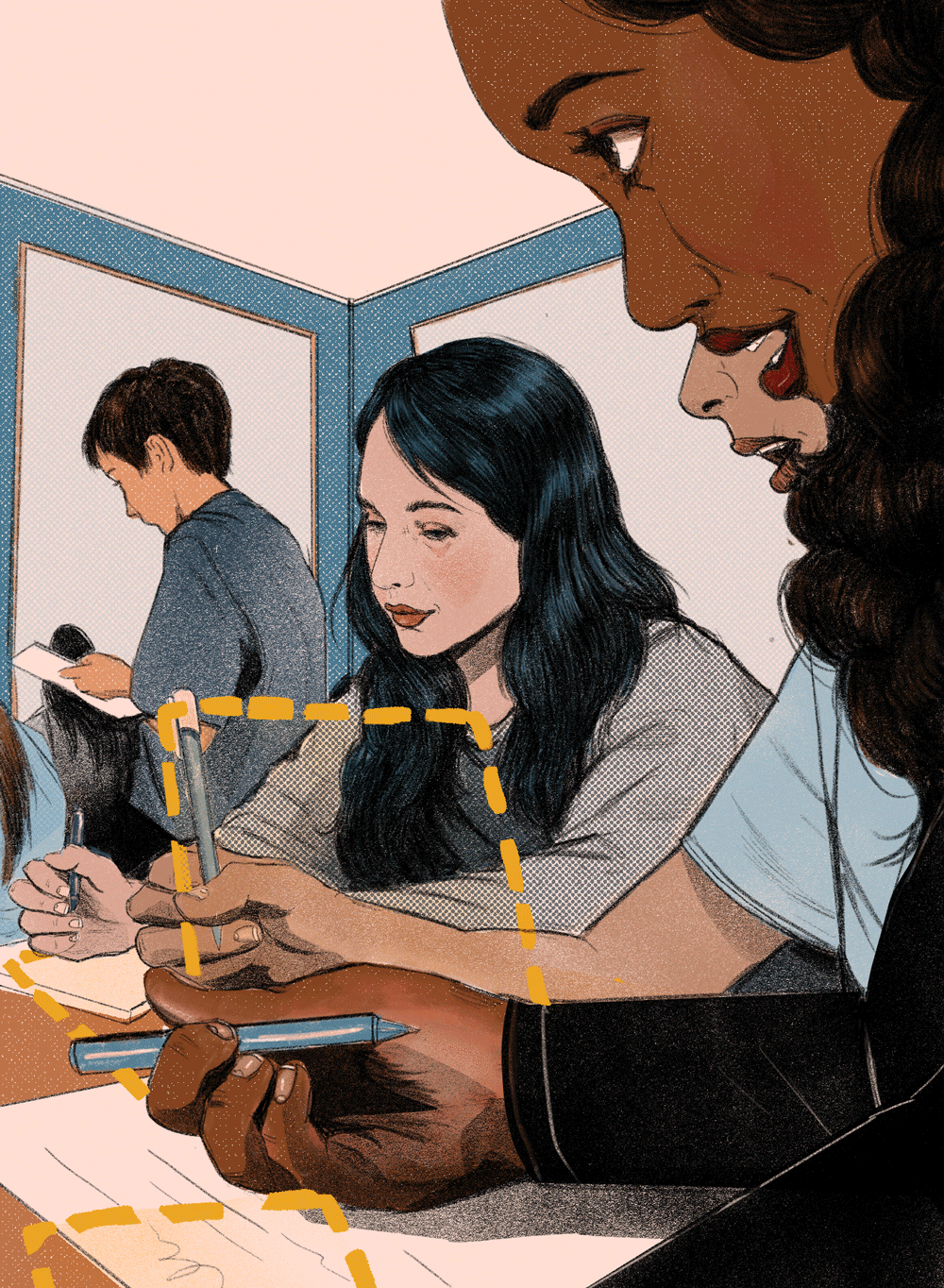
One of her aims in developing the course, which focused on novels concerned with climate and humanitarian crises, was for students to “retrain the cognitive pathways” that encourage immersive reading. Students read physical novels and texts and wrote reflections, in longhand, on not just what they’d read but how they’d read—whether for small details, for big ideas, for argument, or for something else.
In one class early in the session, students decamped to the library to find an ideal space for reading. They reported back on their reading endurance, or how long they could go without taking a break. Some said they could read for the entire 20 minutes of the exercise. Others could go just 90 seconds, Ghaly says.
Liv Jean-Louise Galbreath (Col class of ’26), who took Ghaly’s course, says she found it helpful in thinking about her own reading stamina and attention.
“I’d never focused on how I was reading, or how long,” she says.
For Casteen, developing his course, The Contemporary Essay, for the summer tech sabbatical is a continuation of his practice of keeping devices out of his classrooms.
Casteen is not anti-tech, he says. But he discovered while teaching during the Semester at Sea program, when an internet connection was unreliable, that unplugging elevated the experience.
“What I noticed is that students were paying more attention to one another. The class discussions got better. There were fewer conversations where they would ask me a question and I would answer it. They would ask another student a question about something that student had said. So a lot of the learning became more lateral, which is what anybody wants out of a seminar.”
Casteen recently finished a term as director of studies at UVA’s Brown Residential College and says that in his five years there on Monroe Hill he’s witnessed a decline in social interaction, even among students who’ve gone out of their way to be part of a close-knit living and learning community.
“Students are pulled strongly enough toward screens that it is in my experience, in five years here, always swimming against the current to get them to attend events and seek out the experiences that have historically made college, college,” he says.
“What I noticed is that students were paying more attention to one another. The class discussions got better.”
Casteen’s job at Brown involved teaching all the college’s first-year students. He says “100 percent” of them recognize the ways their phones are addictive and unhealthy and holding them back.
The tech sabbatical courses are intended to show students other ways to experience college, he says.
“It’s meant to offer something they didn’t know college could give them, which is: You can decide to disengage.”
When students realize this, when they’ve unplugged and taken a hike; or gone to a play, concert, or lecture; or simply walked Grounds with Casteen as he points out, for instance, what a hawk looks like, or a walnut tree, it can be a revelation for them.
“You know, they get it, they feel it. It is as if they have been underwater, and they are surfacing, and breathing.”