Crazy Fast
Coach Todd DeSorbo isn’t just transforming UVA swimming. He’s changing the sport—which is totally insane, and exactly how he likes it.
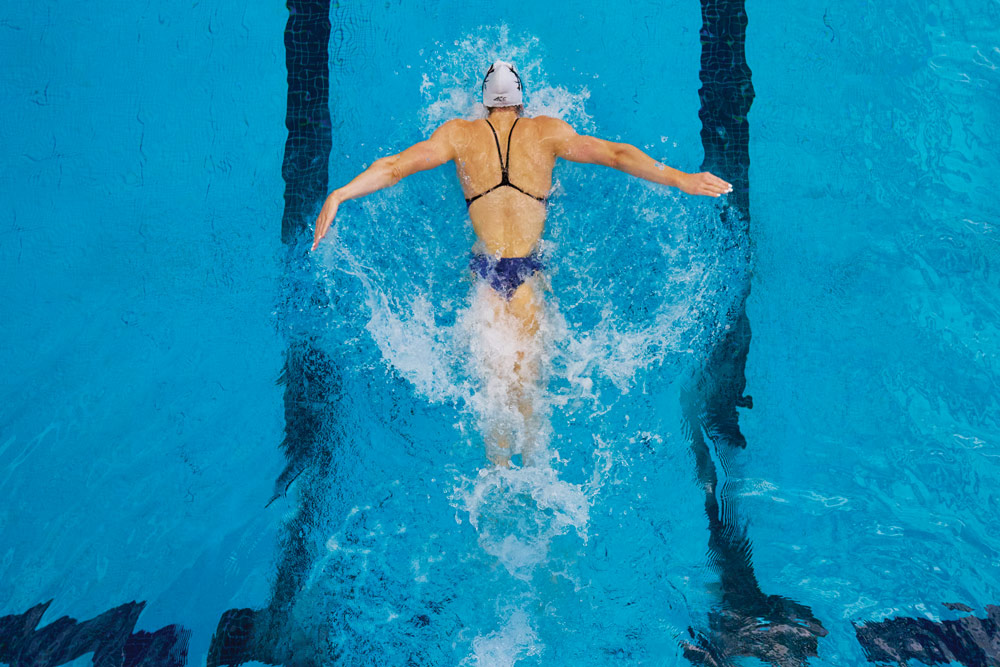
Adam Ewing
It would have made perfect sense for Kate Douglass (Col class of ’23, Grad class of ’28) to swim for Stanford University. The insider websites had her as either the No. 1 or No. 2 girls recruit in the country her junior year in high school, and the Stanford women were once again the reigning national champions. More to the point, Stanford wanted her.
But Douglass’ parents had always had a soft spot for the University of Virginia, though neither had gone there. It, too, offered strong academics in a beautiful setting. And UVA had just hired this new swimming coach, Todd DeSorbo, from North Carolina State University, where he had generated buzz as a sprint assistant. He was coming at Douglass at top speed. It’s his only setting.
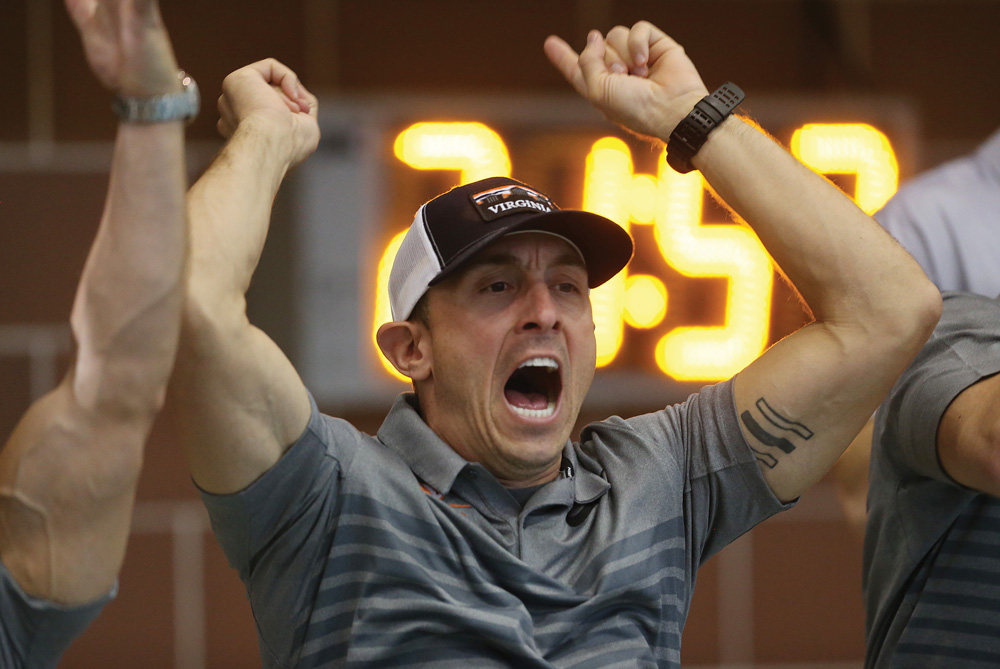
“He had a lot of energy when recruiting us,” says Douglass, a graduate student from Pelham, New York, who since going pro continues to train with the UVA team. Instagram played a big part in the program’s recruitment messaging, and it was boisterous and unrelenting. “It was definitely a little scary, because I’m kind of a very low-key, quiet, more laid-back person,” she says. “I was like, ‘Wow, they’re really just like loud, you know, and a lot of hype.’”
At that point, the 2017-2018 academic year, it was hype alone. The Cavaliers were no swimming power. They’d finished 12th in the 2017 NCAA women’s swimming championships and had never risen higher than fifth in school history. They competed in a conference, the ACC, that had the hope of a swimming title but never the hardware. Plus, UVA was known for its distance swimming, something Douglass did not do.
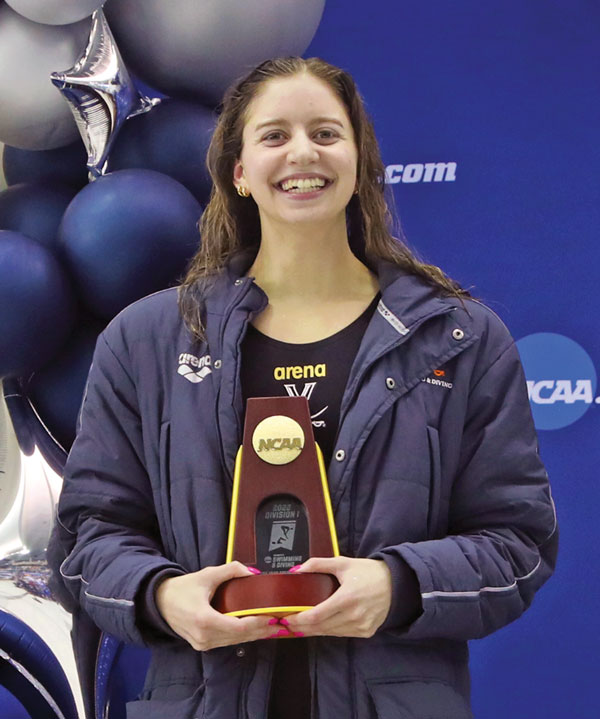
Then Douglass paid a visit, and seeing was believing. In DeSorbo’s office, she saw just how much the coach believed, both in the program and in her. She listened as DeSorbo, in his comfortably confident way, told her the plan: The UVA women were going to win the NCAA swimming title while Douglass was in college. He was going to put UVA swimmers in the 2020 Olympic Games, and he saw her as one of them. He would make her the fastest 50-yard freestyler in the country and, in a swimming world contradiction, he would also make her the fastest in the 200-yard individual medley.
It all came to pass, even sooner than DeSorbo predicted. UVA won its first women’s NCAA title during Douglass’ second year. (COVID canceled the 2020 NCAAs or it might have happened sooner.) Douglass did go to the 2020 Tokyo Olympics (held in 2021), and she medaled, taking bronze in the 200 IM. She did in fact break the American records in both the 50 free and the 200 IM.
“Damn, that’s what we said we would do,” she says, as if still trying to believe. “All these crazy things that he said to me, they all came true.”
Time over distance
Crazy is the word for UVA Swimming & Diving in the DeSorbo era, but it’s crazy like a fox. The pandemonium comes with a plan, and that plan is all about speed—all athletes going all-out all the time, swimming not just fast, but crazy fast.
That’s an upending of convention. Elite-level swimming has traditionally and famously been a grind and a long slog. Coaches pile ungodly amounts of yardage on their swimmers throughout the winter season. They build up athletes’ endurance, break down their muscles, tire them, make them ache. Then, at season’s end, in time for major competition, they scale back—taper, it’s called—so that, once rested and recovered, they’re fit to swim their fastest.
“All these crazy things that he said to me, they all came true,” says Kate Douglass, as amazed as anyone.
DeSorbo rejects that. His mantras: Don’t dull the knife. Protect their speed. He wants his swimmers ready, nimble, on their game year-round. He reduces the yardage and doesn’t track it, at least not closely. It’s not listed on the workouts, though his swimmers are free to count up the laps in their heads. (We asked; none said they do.) The program focuses on technique, strength and agility. It’s a regimen that matches the temperament of a high-energy coach, as does the distinctively lighthearted culture and the unpretentious management style.
And it’s working. Under DeSorbo and his coaches, the women’s team has won the past five ACC championships. They brought UVA (and the ACC) its first national championship in 2021 and haven’t stopped winning since—four national titles and counting, tying early 1990s men’s soccer for the most consecutive UVA national titles. Twenty-six Cavaliers have qualified for the U.S. Olympic Team Trials in June, as have two swimming alumni and several verbally committed recruits. DeSorbo himself is headed to Paris as Team USA’s women’s head coach.
His approach has transformed a pretty good program into something extraordinary, and the sport is taking notice. Says Coleman Hodges, host and production manager of the “SwimSwam” podcast, DeSorbo “has broken the mold in a lot of ways, and I think that is why people have been attracted to his program and have had such success coming out of it.”
That success has largely surrounded the women’s program, which was further along than the men’s when DeSorbo and his coaches arrived. Over their seven years, they have attracted some strong recruits, but the men’s program has yet to establish the momentum needed to contend. DeSorbo, however, has a plan. It’s characteristically audacious. And, also characteristically, it seems on the verge of happening.
Welcome to crazy
Walk onto the pool deck for a DeSorbo practice, and you see and hear the crazy. The music, courtesy of a new sound system and SiriusXM, pulses at around 90 decibels. I share that data point with the numbers-obsessed coach.
“Oh, nice. Is that loud?” he asks. (In fact, yes. It falls somewhere between leaf blower and motorcycle, according to the audiophiles at the Centers for Disease Control and Prevention.) He says, “I like things to be a bit chaotic. I like the loud music. It gets me in a good mood.”
The swimmers say the same, though not everyone on the day someone put on country.
The Aquatic & Fitness Center, the UVA swimming venue beside Scott Stadium, has one giant lap pool, which a movable bulkhead divides into the main competition pool at the deep end and the warmup pool at the shallow end. Between them, DeSorbo and his assistants run six different workouts at any given practice. They move the bulkhead throughout the season to give the swimmers roughly equal time doing their events in 25-yard lengths, the American standard, and in 50 meters, for international competition.
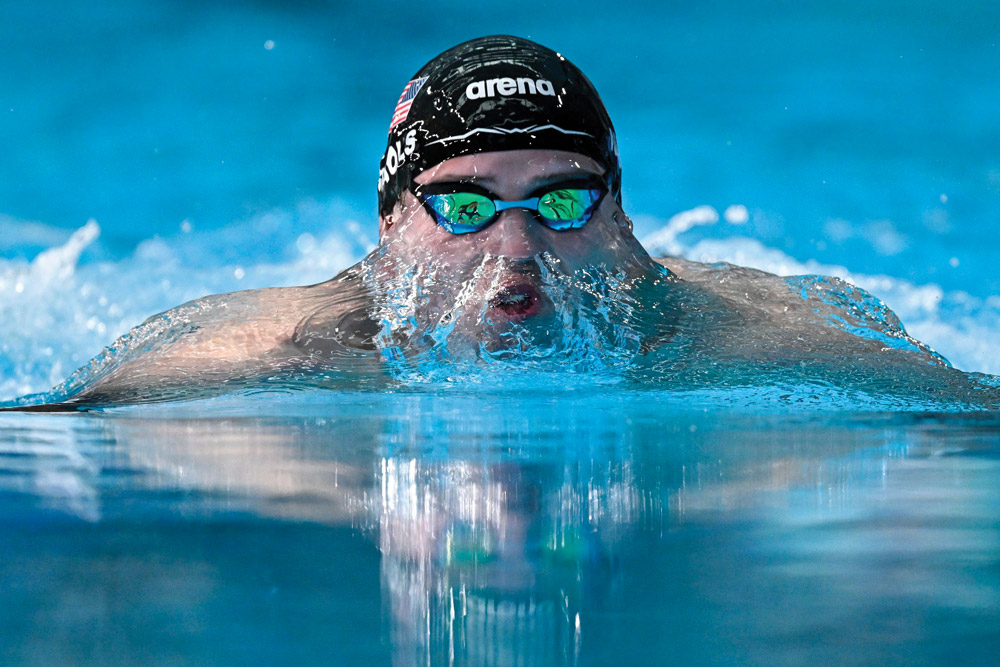
The women’s and men’s teams work out together. Douglass says, “We love training with the boys, and I think the boys enjoy training with us because we kick their asses.” Noah Nichols (Col class of ’24), a fourth-year star on the men’s team, doesn’t disagree. “If you’re next to Kate Douglass on a 200 breaststroke set, you are going to get challenged greatly, because I swear that woman does not get tired at all.”
DeSorbo works with the sprinters, using all manner of devices to build bursts of power and agility. Most prominent is the Power Rack, a 5-foot-9 guillotine-like metal frame, placed at the head of a lane, holding a stack of 15 metal bars, 10 pounds each. A rubber cord and cable connect a belt fastened around the swimmer’s waist to a pulley on the rack. A giant pin lets player or coach set the weight level, from 10 pounds to 150. On cue, the swimmer pushes off the wall with maximum force, kicking and windmilling with everything they’ve got, until the weights hit the top of the rack and the swimmer is stopped dead in the water. A rubber extension on the cable mitigates the abrupt yank on the belt, roughly 10.5 yards down the lane. The goal is to max out the rack in under six seconds. Some of the men can pull 150 pounds. I saw one swim hard enough to bust the cord connection and cause the weights to crash to the bottom of the rack.
Over the music, the splashing, and the well-masticated wad of gum in his cheek, DeSorbo shouts out times and encouragement, bending down to increase weights as he works his way up and down the deck. It’s grueling, bordering on medieval, and yet in the lanes the athletes are laughing and smiling. The sprinters do this about twice a week, the distance swimmers less often.
It’s the DeSorbo method on full display, the well-anchored chaos, the constant readouts of data, the sense of fun, and the coach’s trust to let his assistants develop and manage the other five workouts taking place in the pools.
It showcases the rarefied talent DeSorbo & Co. have recruited to the waters of the AFC. Associate head coach Blaire Bachman Anderson, working with her own group in the competition pool, points to the swimmers arrayed in the lanes before her—Aimee Canny (Col class of ’26), who just qualified for the South African Olympic squad and Team USA alumnae Douglass and Alex Walsh (Col class of ’24). Anderson has played a central role in developing each of them, and she marvels at the opportunity.
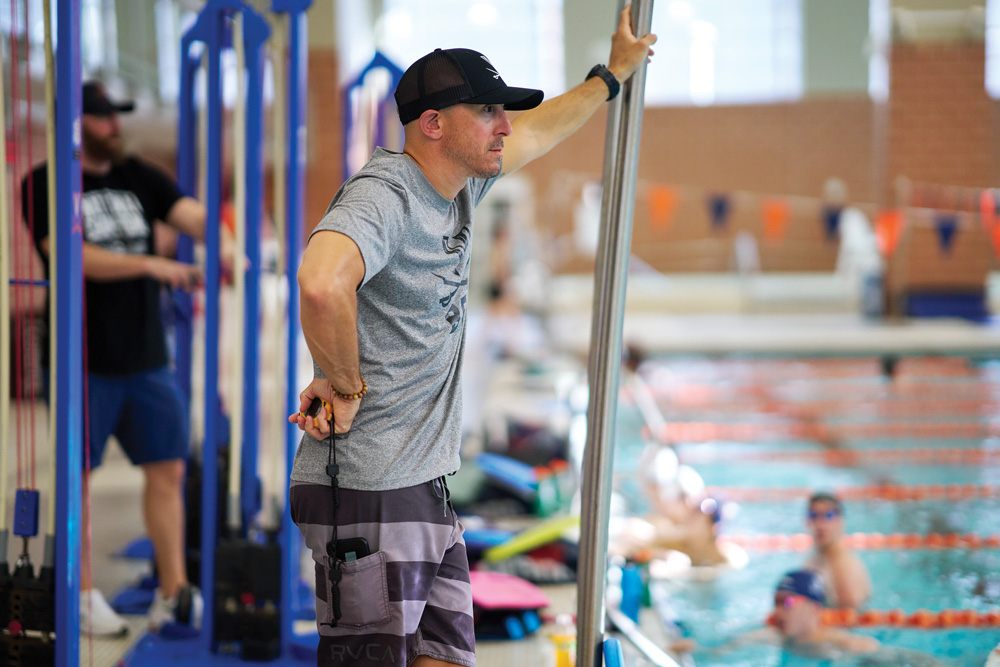
On Power Rack day, you also see the no-frills sensibility that comes with coaching a nonrevenue sport. Once the metal contraptions go back into the equipment room, DeSorbo grabs a hose to power-wash the pool deck. Never mind the four NCAA championship trophies crowding his cinderblock office in the basement: When it’s time to convert the pool from short course to long, he’s bending down to help his assistants take up the lane lines. Then he’s putting his back into the full-body chore of pushing the bulkhead through the water into position.
He wouldn’t have it any other way. “If the kids see me doing that, then they’re like, ‘Well, I need to do something too,’” says DeSorbo, whose reported 2023 base salary of $145,600 falls just shy of a football or basketball strength and conditioning coach.
No, dude, Deloitte
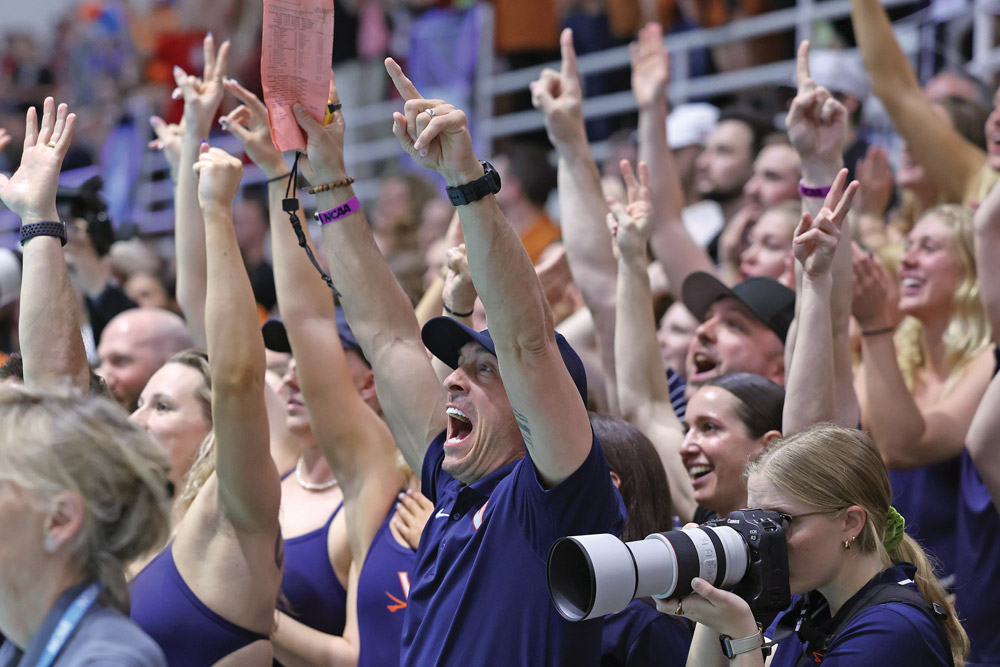
DeSorbo, 46, is fit without being muscle-bound, 5-foot-10 with a swimmer’s broad shoulders. A denizen of the pool deck, he wears cotton and microfiber UVA logo gear and waterproof shoes. He’s always in a hat, covering his closely shaved head, the ears supporting it the best way to spot him from a distance in the stands. He has a tattoo on his inner upper arm, another on his left quad, wears a black Garmin sports watch on one wrist, usually a beaded bracelet on the other.
“People look at Todd and they’re like, ‘OK, like what did you do before this? Were you like a surf instructor? Were you selling mai tais at the beach?’” says associate head coach Tyler Fenwick. “‘No,’” Fenwick says, voicing his boss’s answer. “‘I was a CPA at Deloitte.’”
The professional license came on top of bachelor’s and master’s degrees in accounting from the University of North Carolina, Wilmington, where DeSorbo transferred his senior year from the University of Kentucky swim team. At UNCW, he won conference titles in the 200 backstroke and 200 and 400 IM. At Deloitte his main event was long-distance fly, traveling the country as a tax consultant. Based in Raleigh, he got the firm’s blessing to move to Wilmington to accommodate his wife Lauren’s pursuit of her graduate degree. She was a UNCW diver.
DeSorbo kept up with his swimming at the local YMCA, practicing by himself but quickly catching the attention of a group of triathletes. They asked if he’d coach them one morning a week.
He became a sensation. Soon the Y master’s team, adult swimmers, talked him into coaching their group two mornings a week. When the Y lost the coach of its competitive age-group swim program, the Cape Fear Aquatic Club, essentially high school seniors down to those age 8 and under, the Y management knew whom to ask. DeSorbo started coaching the kids six days a week, sometimes twice a day. He likely dropped the adult groups, he says; it’s something of a blur. And he continued billing upward of 60 hours a week as a Big Four tax consultant.
He says, “I didn’t dislike the Deloitte work. I just—I didn’t wake up every morning like, ‘Can’t wait to go to work.’”
Even with the aid of an assistant coach, it was an unsustainable arrangement. DeSorbo in his late 20s managed to pull it off. But it took a direct question from his UNCW swim coach, Dave Allen, a friend and mentor, to crystallize DeSorbo’s thoughts: What do you really want to do? His answer: Coach swimming at the college level.
“People look at Todd and they’re like, ‘OK, like what did you do before this? Were you like a surf instructor? Were you selling mai tais at the beach?’”
It would take to the end of the season of age-group swimming, and tax accounting, for a position to open on the UNCW staff. When the team’s sprint coach retired, Allen offered DeSorbo the job and with it two instructional videos and a book on sprinting. DeSorbo, like the trained consultant he was, took a much deeper dive. He read everything he could get his hands on, studied the methods of the leading sprint coaches in the country. He was a blank slate, open to anything. “Whatever success I’ve had as a sprint coach, I attribute a lot of it to the fact that I wasn’t a sprinter,” he says. “I didn’t have a preconceived notion of what sprinters should be doing.”
After five years with the Wilmington team, DeSorbo stepped up to N.C. State, where he took over the sprint program. During his six years there, he coached three swimmers to the 2016 Rio Olympics, including gold medalist Ryan Held. He helped the Wolfpack end UVA’s six-year streak of ACC men’s swimming championships in 2014 and, three years later, ended the UVA women’s nine-year ACC run.
The Cavaliers’ misfortunes coincided with leadership turnover. After 35 years, and a record 27 ACC championship titles, head coach Mark Bernardino (Com class of ’74, Educ class of ’78) left in 2013. UVA brought in University of Houston women’s coach Augie Busch to replace him. After four years of both progress and setbacks, Busch in 2017 left for the University of Arizona, his alma mater, where his father had been a longtime coach, taking his top assistants with him.
Forming the rock band
Busch’s departure created the perfect opening for DeSorbo. There was just one catch: He wasn’t interested. He too had put in for the University of Arizona job, gone through the interview process, and he was drained. Lauren DeSorbo, who he says never relished the prospect of a move out West, was incredulous.
“I just don’t want to go through it again right now. I’m done, and I also never wanted to be the kind of coach who would apply for everything,” DeSorbo remembers telling her. “And I was happy at N.C. State.”
For a man known for uncanny timing and the ability to see into the future, it was a rare lapse. Over vacation with his wife’s family, she and they set him straight. “They wore me down,” he insists.
As a coach, DeSorbo likes to keep his swimmers loose going into competitive situations. “He makes it feel like if you fail, it’s OK,” says “SwimSwam” commentator Hodges. “It’s not that it doesn’t matter, but that there’s not a lot of pressure.” That’s how DeSorbo approached the Virginia interviews, loose and alert.
Before he had worked out his deal with UVA, he started assembling his coaching staff. Anderson, an Indiana University coach at the time, spotted DeSorbo on the deck of the U.S. Open Swimming Championships on Long Island and texted him. Like the rest of the swimming world, she knew he was a lock for the Virginia job. They set up a call days after the meet, when DeSorbo’s news had become official.
Here’s what a formal job interview with Todd DeSorbo sounds like: “I’ll be honest. I just want to shoot the sh-- with you for 20 minutes,” she remembers him saying. “He was like, ‘Just talk,’ like we’re just hanging out,” she says.
Not relying on the interview process to assess someone’s technical ability, he was more concerned with group dynamics. “The coaching, that can be figured out if necessary. To me it’s about chemistry, and like, dude, can we just get along, and are we going to enjoy being around each other?” DeSorbo explains.
Over the ensuing week or so, they continued the conversation and continued texting. He offered Anderson the job, asking her whether she needed to see Charlottesville first. She knew to say no. She packed up her life and drove into Charlottesville 72 hours later.
The hiring of Fenwick, then on the University of Tennessee staff, followed roughly the same script. DeSorbo already knew Fenwick’s talent as a distance coach, a strength of the Virginia program that DeSorbo wanted to make sure to preserve. Fenwick knew of DeSorbo from watching him on the competitive circuit, knew that “Todd was high energy and his kids just swam like their hair was on fire,” he says.
Fenwick accepted the job while in California, about to take a group of swimmers to compete in the World University Games in Taipei. With apologies, he sent the athletes on their way, paid someone to pack up his things in Knoxville, and beelined it home and thence to Charlottesville.
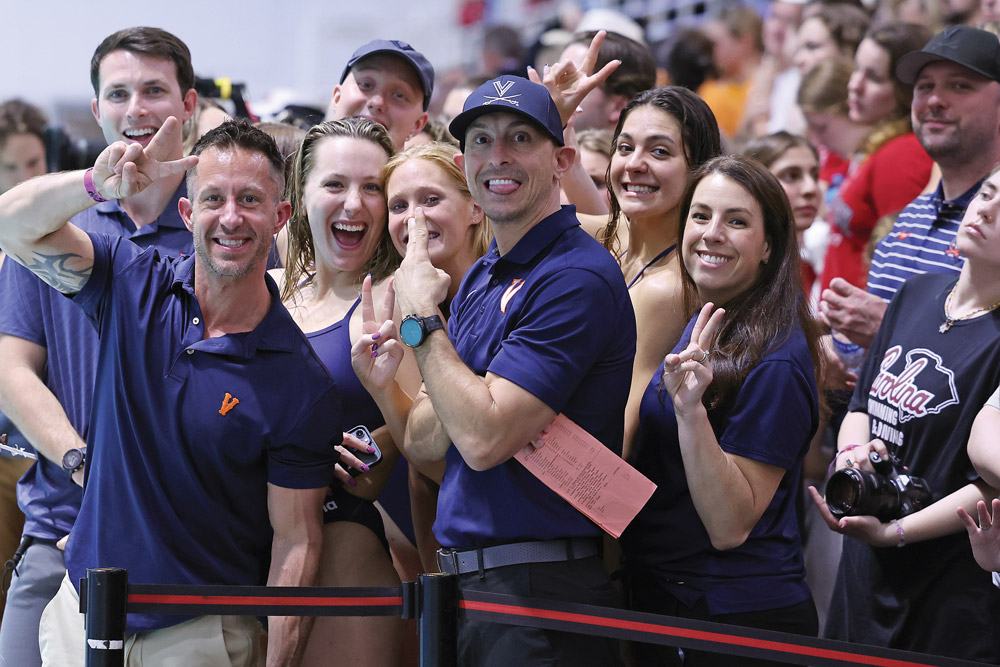
In the early days, fall of 2017, with his family still in North Carolina, DeSorbo lived in a rental house on Price Avenue, a half-mile from the AFC. Most every evening after practice the coaches convened there to reimagine the Virginia swimming program. Anderson describes it as a think tank. “We would flesh out what training groups would look like, what recruiting would look like,” she says.
It was as much about coming together as coming up with strategy. There was a lot of pizza. Fenwick sometimes spent the night on the couch. The core group has coached together for seven years. (Anderson is leaving to step up to director of the Texas A&M program.)
Nichols, who like all the swimmers rotates among all the coaches, marvels at the mind meld. “I don’t get any mixed signals at all from anybody. It’s like they all went to the same school,” he says. “You’re going to get the same exact answer, which is so bizarre.”
Following through on the intuitive way he hired them, DeSorbo leaves his coaches to their responsibilities. “Todd basically said, ‘Here are the keys. Make them fast, and you’re good,’” Anderson says.
But there’s an or-else. Fenwick remembers DeSorbo telling the group: “I want high energy. I want engagement. … If your kids don’t swim fast, I’ll find somebody who will make them go fast.” Says Fenwick, “He told us that one time. I’ll never forget that line.”
‘You win with stars’
DeSorbo didn’t set just the tempo; he also set a tone. His message at his first team meeting was similar to what Douglass and other recruits would soon hear. UVA would during their time win its first NCAA title. He would put swimmers in the Olympics. In fact, he said, there were future Olympians in their midst at that moment.
“Here comes in Todd, somebody that they’ve known for like a hot second,” making that kind of statement, Anderson says. “That’s confidence that can’t be made up. Like, he just walked in there and just said that.”
DeSorbo says, “I definitely made a pretty bold statement, but I believed it.” Once he started focusing on the UVA post, he knew the potential. Virginia’s institutional prestige positioned it to be the next University of California, Berkeley, an elite public university that competed at the highest levels of swimming.
He says he didn’t necessarily have any individual in mind as a UVA Olympian, and yet there in the audience was newly arrived first-year Paige Madden (Educ class of ’21), whom his predecessor had recruited. Four years later in Tokyo, she would help the USA to silver in the 800-meter free relay.
Virginia had a consistently strong program before the coaches arrived, but it had never broken through to the top echelons. The remedy was patently obvious, and nothing that hasn’t occurred to every other winning or wannabe swimming program in the country. It all comes down to recruiting. High school swimming has become so highly refined that college coaching focuses on advanced-level adjustments. It’s not like Boys in the Boat, where a coach can mold Olympians from scratch. Says Fenwick, “The thing about swimming is you win with stars.”
The new coaches were months behind other schools in recruiting the fall of 2018’s incoming class, though they did make several good pickups. They immediately got to work recruiting for fall of 2019. They rooted their pitch in their unshakable certitude that they were going to take Virginia swimming to a national title and its swimmers to the Olympics. Sure, you can go to Stanford, with its 11 NCAA women’s titles, to Texas with its seven or to Cal with its four. Or you can come to UVA and make history.
It was compelling, and it needed to be. “We had nothing to show for anything,” DeSorbo says. “We hadn’t done anything at that point—we just got here—other than our personalities. Like, that’s what we had to show.”
Margaret “Ella” Nelson (Educ class of ’23, Com class of ’24), the No. 8 recruit in the country, came through for an unofficial recruiting visit with her parents just weeks after the new coaches had arrived. Anderson, who’d assured DeSorbo that she didn’t need to see Charlottesville before relocating, led them on a tour of Grounds.
In circles. It was September and it was hot, and she walked them a mile out of their way in search of the Lawn. She got them no closer than the ed school.
It didn’t matter. It became a joke, and proof positive of just how new and eager Virginia’s coaching staff was. Nelson, who was also considering Texas and Cal, clearly saw the spark. “When I would talk to all the coaches, they just had this excitement and confidence in what they could do with the team. You couldn’t help but believe them,” she says. “There was no way I was not going to be part of this process.”
The coaches courted Nelson together with Douglass and Maddie Donohoe (Col class of ’23, Educ class of ’28), a distance swimmer from Annandale, Virginia, the 11th-ranked national recruit. The three knew one another from USA Swimming’s National Junior Team, and they kept in close touch during the recruiting process. As they committed one by one, Virginia swimming climbed three steps higher toward its aspirations.
The recruiting started gaining momentum. Nelson’s commitment gave UVA a better line on Alex Walsh, the No. 2 ranked women’s recruit for the class of 2020. They were close friends, Walsh a year behind Nelson at Harpeth Hall girls school and a teammate on the nationally prominent Nashville Aquatic Club.
Walsh has gone on to become one of the stars of the program. When Douglass fulfilled DeSorbo’s prediction by winning that 200 IM bronze medal in Tokyo in 2021, standing on the podium one step above her was Walsh, who took silver.
For the incoming class the following year in 2021, UVA signed the No. 1 girls recruit in the country, Gretchen Walsh (Com class of ’25), Alex’s younger sister by 18 months and, of course, another friend of Nelson’s from Harpeth Hall and the NAC age-group team. Gretchen was determined not to follow her sister in lockstep. Both Walshes enjoy telling the story of Gretchen’s drawing up a pros-and-cons list about UVA, with Alex’s name being the only entry on the debit side of the ledger.
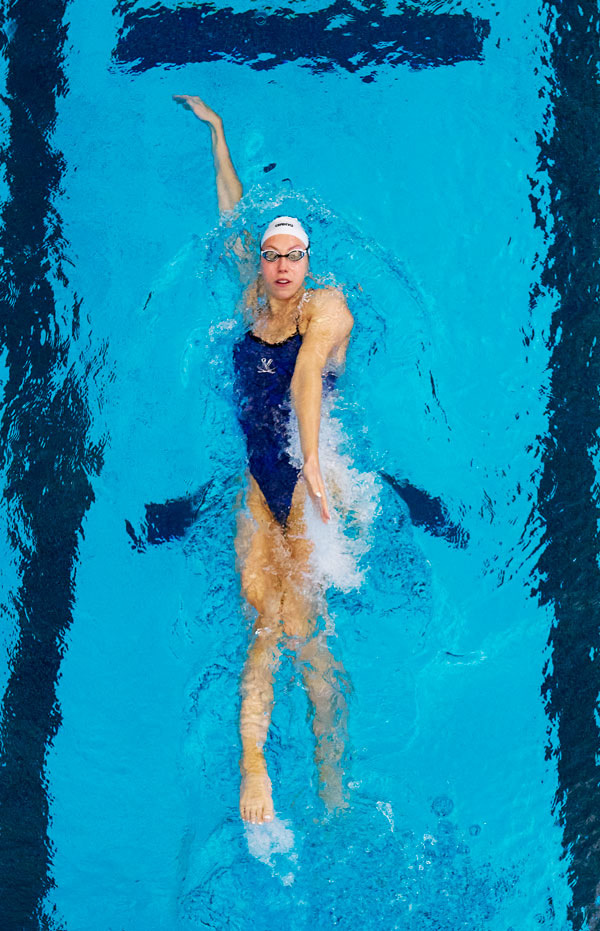
“I honestly wanted to prove people wrong, but I couldn’t deny that this was where I was supposed to be at the end of the day,” Gretchen Walsh says.
The Walsh sisters dominated the UVA women’s 2024 win of the national title. Gretchen bested her previous NCAA records in each of her individual events. Alex similarly won each of her individual events by swimming personal bests. Both powered UVA’s victories in four relays, including setting a new record for the 400-yard medley.
Those NCAA and personal bests underscore the crucial companion element of UVA’s recruiting success. It’s not just that the coaches can create the excitement to attract elite talent to Charlottesville. It’s that, once they get here, the athletes get better, and then better still.
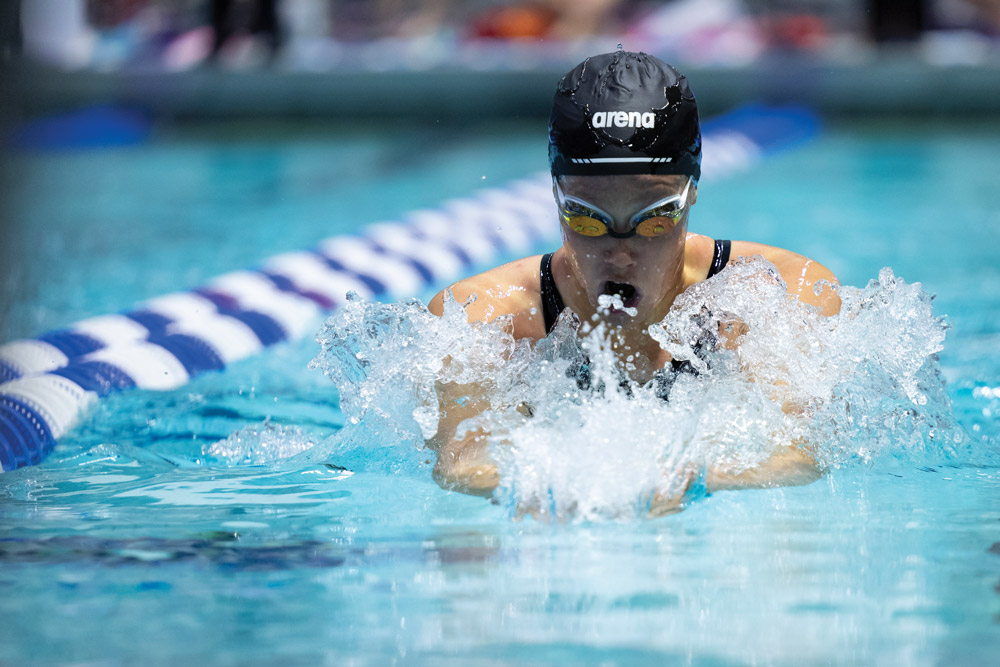
Gretchen Walsh, as a prime example, has reduced her times in key events each of her three years at UVA. Between this year’s ACC championships in February and the NCAAs in March, she set four successive records in the 50 freestyle. “I’ve honestly improved so much here, more than I could have ever dreamed of,” she says.
Moonshot
So what about the men? The UVA coaches have set out to moonshot the program the same way they did with the women in 2019, when Maddie Donohoe, Ella Nelson and Kate Douglass came to Virginia as a package deal. This time, for the fall of 2025 incoming men’s class, they’ve targeted a group they’ve dubbed the Savage 7.
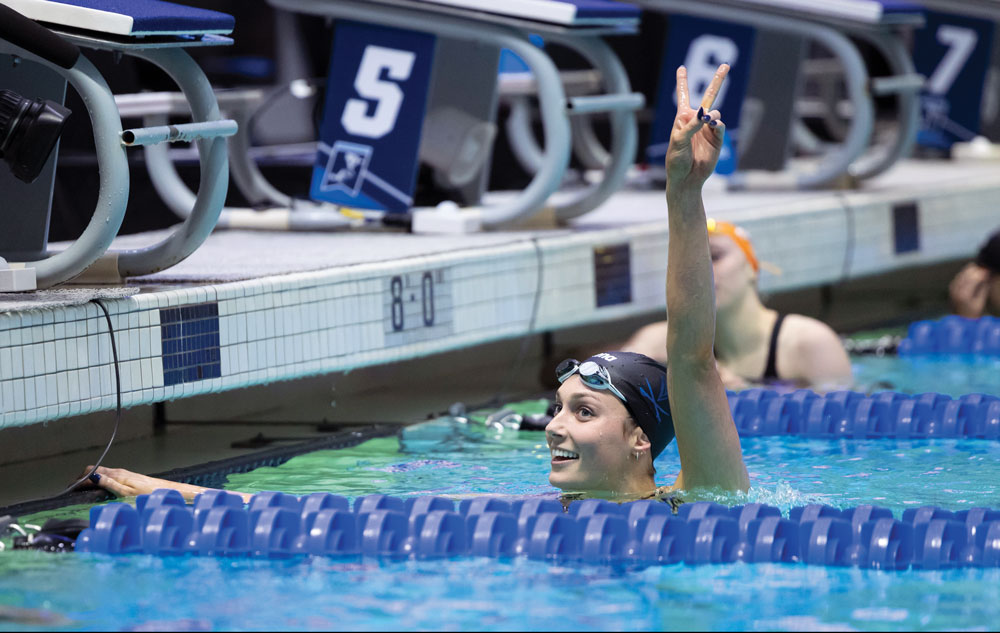
At the center of the plan has been attracting the No. 1 boys recruit in the country, Albemarle County resident Thomas Heilman, who’s already turning in NCAA-level times. His brother, second-year Matthew Heilman (Col class of ’26), swims for UVA, where their mother, Carrie Heilman, teaches in the School of Commerce.
Thomas Heilman has been a key link to the No. 2 recruit, his friend on the national scene Maximus Williamson who, like Heilman, is considered a once-in-a-generation talent. Among other feats, Williamson broke Michael Phelps’ 20-year high school record for the age 15-16 400 IM, beating it by four seconds.
It has been a steady courtship of both of them. As part of it, DeSorbo and Fenwick made a pilgrimage to the Williamson home outside of Dallas in October, hoping to get a verbal commitment. Instead, they got an earful from Williamson’s mother, Jenny, about the visit her son had just taken to Arizona State University, where Bob Bowman, Michael Phelps’ legendary coach, ran the program.
“She’s talking about Arizona State and how great it was, for like an hour straight,” Fenwick says. “Todd’s not happy.”
DeSorbo said they needed to get down to business. Jenny Williamson called in Maximus to join them at the kitchen table. As they got underway, his phone rang.
It was Thomas Heilman FaceTiming him, asking if DeSorbo was there. Williamson turned his screen around to the coach, where he saw Thomas Heilman say: “Todd, you’re looking at your two newest commits.”
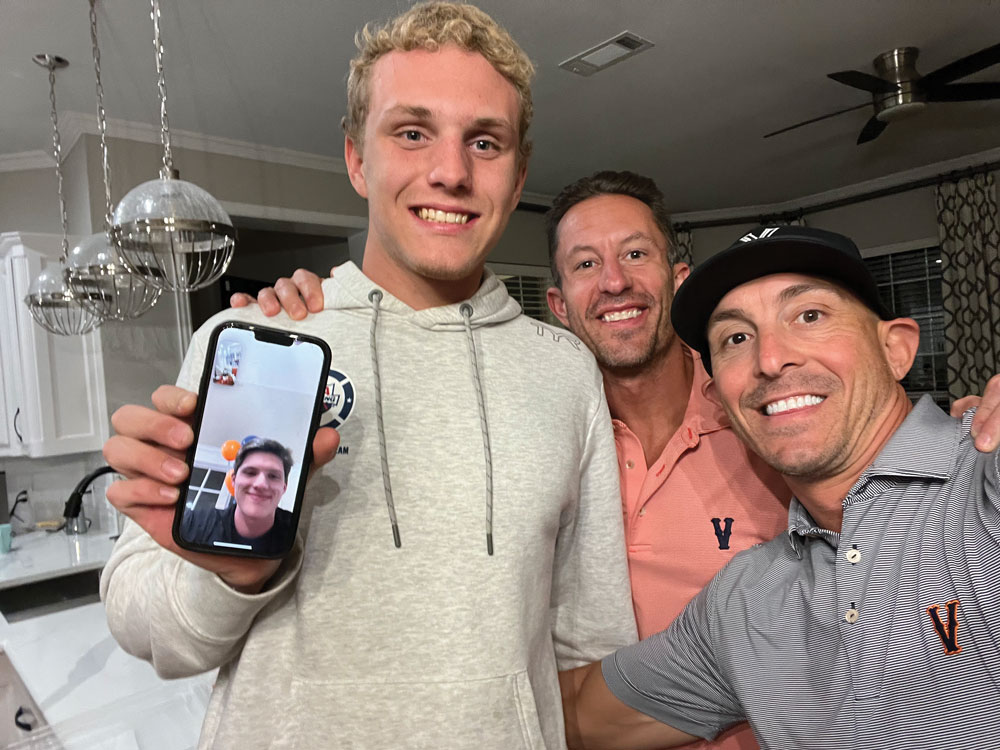
Says Fenwick, “It took us like a second, and then we’re like, ‘Oh my God,’ like everything just changed.” At which point, Jenny Williamson, who’d been working them hard all afternoon and evening, brought out a plate of homemade cookies. They were in the shape of the University of Virginia block-V, with orange-and-blue icing on top.
The next Saturday Heilman and Williamson made their verbal commitments to UVA in unison with No. 8 recruit Thomas Mercer, No. 12 Josh Howat, and a fifth Savage, Grant Murphy. The boys came up with the idea of making their announcements together to make a maximum impact. Jaws dropped. SwimSwam said simply: “Here. We. Go.”
DeSorbo’s plan seemed to be coming together, just as he said it would.