Competing Narratives
Alumni groups battle leading up to, and in wake of, Ryan’s resignation
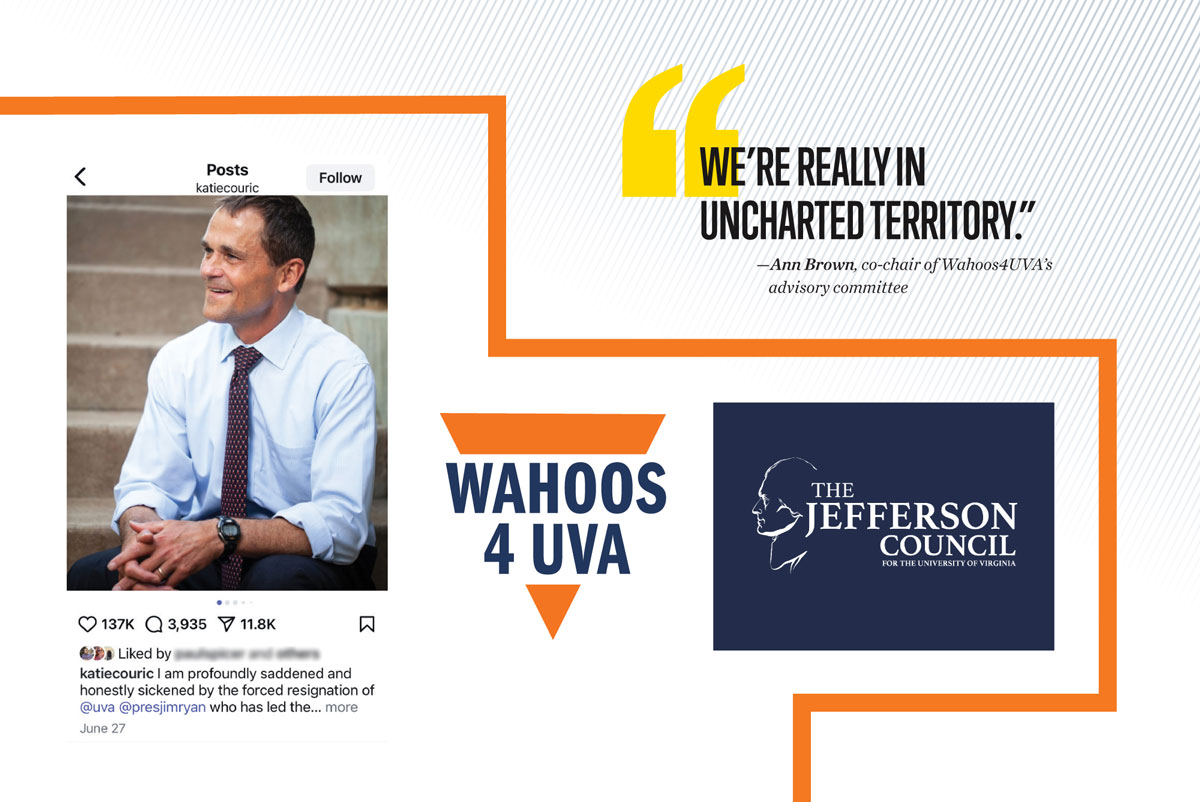
They all walked the same Grounds and wore the honors of Honor. But this spring and summer, groups of UVA alumni also were on diametrically opposed sides of countless news cycles that swirled around the resignation of President Jim Ryan (Law class of ’92).
On one side were a group of alumni called the Jefferson Council and lawyers with the U.S. Department of Justice’s Civil Rights Division, concerned that UVA hadn’t fully complied with a Board of Visitors resolution to dissolve its Division of Diversity, Equity, Inclusion, and Community Partnerships. This spring, Harmeet Dhillon (Law class of ’93), assistant attorney general for the Civil Rights Division, and Gregory Brown (Col class of ’89), a deputy assistant attorney general, began sending letters of increasing urgency about the issue to university leaders, also demanding information about allegations of discrimination and antisemitism.
On the other side was an upstart group of alumni and faculty members called Wahoos4UVA. It formed in May to sound the alarm as news stories increasingly hinted that Ryan’s job might be in jeopardy. The group, with an advisory committee led by co-chairs Ann Brown (Col class of ’74, Law class of ’77) and Chris Ford (Engr class of ’87), aimed to “set the record straight” on UVA’s success under Ryan. They asked followers to sign onto a letter in support of the president. In less than a month, thousands were following their lead.
In the days and weeks leading up to and after Ryan’s resignation, alumni with sharply contrasting views on UVA’s direction spoke out in news stories, op-eds and social media posts. They offered competing narratives about the university’s leadership and what should happen next.
“We’re really in uncharted territory,” Ann Brown said.
Longstanding concerns
To some, the troubles on Grounds started this spring, but for the alumni behind the Jefferson Council, their dissatisfaction began years ago.
Back when Joel Gardner (Col class of ’70, Law class of ’74) was a student in the 1960s and 1970s, he said, political differences didn’t get in the way of personal relationships. “I can remember that in my fraternity house,” Gardner said. “We used to get into arguments and then laugh and have a beer.”
But decades later, he sensed a different climate as he spoke with students and faculty. In his view, Grounds had become more “politicized.” He said the excessive focus on diversity, equity and inclusion stifled free expression.
Dissatisfaction with UVA’s leadership was bubbling up for others as well after a Lawn resident posted a sign on her door that said “F--- UVA” in the fall of 2020. Some called for the sign to be removed; Ryan declined. Signs were allowed on Lawn room doors, and removing the sign because of its content would “run afoul of the Constitution and our own commitment to protecting free speech,” he wrote.
“We’re really in uncharted territory.”
Ryan’s decision “agitated” some alumni, Gardner said, including the Jefferson Council’s eventual co-founders, Bert Ellis (Col class of ’75, Darden class of ’79), who reportedly brought a razor blade to the Lawn to cut the sign down and confronted the student, and Thomas Neale (Col class of ’74).
According to the Jefferson Council’s 2024 prospectus, the group formed in 2021 to uphold the Jeffersonian legacy, support the Honor Code, protect the dignity of the Academical Village and promote a culture of civil dialogue. Gardner was named president in 2024.
Since its founding, the group has regularly published articles on its website, maintaining a steady drumbeat of criticism of UVA and Ryan. The prospectus said its blog had more than 800 subscribers and a membership of roughly 2,800. In July, Gardner said the group had about 10,000 people, including supporters and others, on its listserv.
Through the years, the council also has coordinated with conservative student groups and brought conservative speakers to Grounds, including former Vice President Mike Pence and Abigail Shrier, author of Irreversible Damage: The Transgender Craze Seducing Our Daughters.
Before Gregory Brown joined the Justice Department, the Jefferson Council also had connected Brown’s Charlottesville law firm with a UVA student with a claim of free speech violation and one with a claim of antisemitism, as reported by The New York Times and The Chronicle of Higher Education. Both cases with UVA were settled out of court. Brown also was scheduled to speak at the council’s fourth annual meeting in April but didn’t attend, The New York Times and The Chronicle of Higher Education reported.
The 2021 election of Virginia Gov. Glenn Youngkin, a Republican, gave the group hope that their concerns would be taken seriously, Gardner said. Under state code, the governor appoints members to the BOV, subject to approval by the General Assembly.
“Once Glenn Youngkin was elected, we knew that there was going to be a board there that wasn’t going to be totally one-sided,” Gardner said. In early July, the BOV was composed entirely of Youngkin-appointed members.
A new group grows
After the March BOV resolution to dissolve UVA’s DEI office, the Jefferson Council’s drumbeat of concerns about Ryan got louder. The group placed ads in the Richmond Times-Dispatch and launched websites that claimed UVA hadn’t ended its DEI programs and characterized Ryan’s leadership as “politicized and feckless.”
Kimberly Acquaviva, a professor in UVA’s School of Nursing, had been watching the Jefferson Council’s activities and had grown increasingly concerned. In her health policy work, she said, she’s committed to fostering viewpoint diversity and fact-based dialogue. But she was dismayed by what she considered to be misinformation in the Jefferson Council’s newspaper ads in Virginia’s capital.
“I felt a real sense of frustration, because over the last six to eight months, I’ve seen multiple attacks on UVA … by a group that is not directly affiliated with UVA but has some clear partisan affiliations if you look at who their speakers have been,” she said.
In May, Acquaviva and assistant nursing professor Ashley Apple (Nurs class of ’18, class of ’20) founded Wahoos4UVA. Ann Brown first learned about the group in a late-May Chronicle of Higher Education article about the Jefferson Council’s demands for Ryan’s firing. She quickly reached out.
Worries about the impact of the Trump administration on UVA had been weighing on both Brown’s and Ford’s minds. But—naively, perhaps, Brown said—a “frontal assault” on Ryan was unexpected. No leader is perfect, Brown and Ford agreed. But they could quickly tick off Ryan’s big successes, starting with a $6 billion capital campaign that exceeded its original goal by $1 billion.
“His accomplishments are extraordinary,” Brown said. “My reaction was, we’ll be the laughingstock of the country that we’re exiting a president who just completed one of the largest capital campaigns of any public university in America, among many other accomplishments.”
The picture that the Jefferson Council and other critics were painting of Ryan and UVA didn’t mesh with their own experiences on Grounds. Ford pointed out that critics’ attacks often related to events out of UVA leadership’s control.
“The question is whether the leadership in charge at that time handles those events with thoughtfulness, effectiveness and with an eye toward what is best for the institution,” he said. “And we see—at least in our viewpoint, and I would argue the vast majority of the alumni—nothing but positive results coming out of this administration.”
What’s more, Wahoos4UVA’s leaders said, building a more diverse, equitable and inclusive university community has been a key goal of UVA presidents long before Ryan. John T. Casteen III (Col class of ’65, Grad class of ’66, class of ’70) established UVA’s original Office of Diversity and Equity, prompted by a series of racial incidents on Grounds in late 2002 and early 2003.
Decades earlier, when UVA’s student body was composed mostly of white men, Brown was part of the first coeducational undergraduate class enrolled at UVA. “My own class had twice as many Black students as any prior undergraduate class,” she said. “Those kinds of advances and inclusion and welcome and support for groups that had been missing or terribly underrepresented on Grounds was a core belief of [former UVA President] Edgar Shannon.”
That history makes this moment a true test of UVA’s governance and longstanding commitments to nurturing a more diverse community, Brown said.
“There’s an enormous obligation on the BOV to really step up and, in both word and action, demonstrate their commitment to our ongoing academic excellence, to our openness as an institution, to different points of view, to the diverse nature of our student body and our faculty, and to the principles that have animated our university to an increasing extent over the last five decades of its 200-year existence,” she said.
As Wahoos4UVA’s leaders began to build their own platform, the idea for an open letter emerged. Between late May and early July, more than 15,000 people had signed the letter supporting Ryan and Wahoos4UVA’s mission. After Ryan’s resignation, the group messaged its growing list of followers with a link to a letter that they could send directly to the BOV. Within days, some 1,400 people had clicked send.
Free speech—or not
Wahoos4UVA’s evidence of a thriving university is great, in their view: In addition to the successful capital campaign, it includes the launch of the popular new School of Data Science and retention rates for first-year students that match or exceed peer schools.
Wahoos4UVA also highlighted that UVA ranked No. 1 in the Foundation for Individual Rights and Expression’s 2025 College Free Speech Rankings, moving up from No. 6 the previous year. Harvard, at No. 251, was last and received the lowest possible score of 0.00. UVA earned a 73.41. Results of a student survey make up a large majority of the score, according to FIRE.
Gardner discounts UVA’s top score. “It was a low bar because there’s a lot of other universities that were pretty bad,” he said.
The survey results aren’t all positive. Students at UVA, for example, are more likely to say it is acceptable to shout down a speaker than on other campuses. Still, while some universities earned penalties in recent years for deplatforming speakers, UVA’s Ryan administration earned bonuses, including when it allowed Pence to speak even after some students called on UVA to cancel the event.
Looking ahead
On June 27, most alumni found out about Ryan’s resignation via a news notification. In a statement, Ryan wrote that his resignation came with a heavy heart, but he aimed to protect UVA from further harm from the federal government.
Again alumni were back in the spotlight. That evening, the DOJ’s Dhillon, who was a year behind Ryan at UVA’s law school, went on CNN’s The Lead With Jake Tapper to explain her point of view.
“Jim Ryan has built his entire career on what was the academic vogue, which is DEI. Now it isn’t,” she said. “And so I think that it is time for new leadership that’s willing to comply with federal law. I think that’s the best thing for UVA. I love UVA. I proudly have my law review and my degree on my wall in my office in the Department of Justice.”
The Jefferson Council touted her interview on social media, and ahead of the July 4 weekend, Gardner sent a letter to supporters calling Ryan’s resignation a “necessary and welcome step.”
Going forward, Gardner said, “we’re looking for someone to move the university back to the center, to depoliticize the university, to pursue true intellectual diversity, to create that level playing field for the free exchange of ideas, and someone who will judge students, faculty and administrators based on merit, achievement and character, and not other factors.”
On the other side, prominent ’Hoos quickly spoke up in Ryan’s defense. “Jim is a tremendous leader; this is a very sad day for @UVA. The University hasn’t just been a consistently great academic program under his tenure, it’s ranked NUMBER ONE in Free Speech by FIRE,” Reddit co-founder Alexis Ohanian (Com class of ’05) wrote on X.
Journalist Katie Couric (Col class of ’79) posted about her sorrow to her 2 million followers on Instagram and 938,000 followers on Facebook, mentioning Wahoos4UVA, quoting Ann Brown and inferring what UVA founder Thomas Jefferson would think.
“He would no doubt be incensed that the federal government was demanding the resignation of any officer of the University of Virginia—or any other college,” Couric wrote.
In messaging to its followers and on social media, Wahoos4UVA leaders demanded accountability and transparency from the BOV. In a July 8 letter to supporters, Brown and Ford wrote that the BOV had abandoned its fiduciary duty to act in the best interests of UVA, leaving it defenseless against political overreach from the Trump administration.
“Nothing good will come of this,” Brown said. “Almost no matter what happens next, this is going to be a very dark chapter.”