Alternating Coasts Conference
The upshot for UVA as Tobacco Road extends to Dallas and the San Francisco Bay
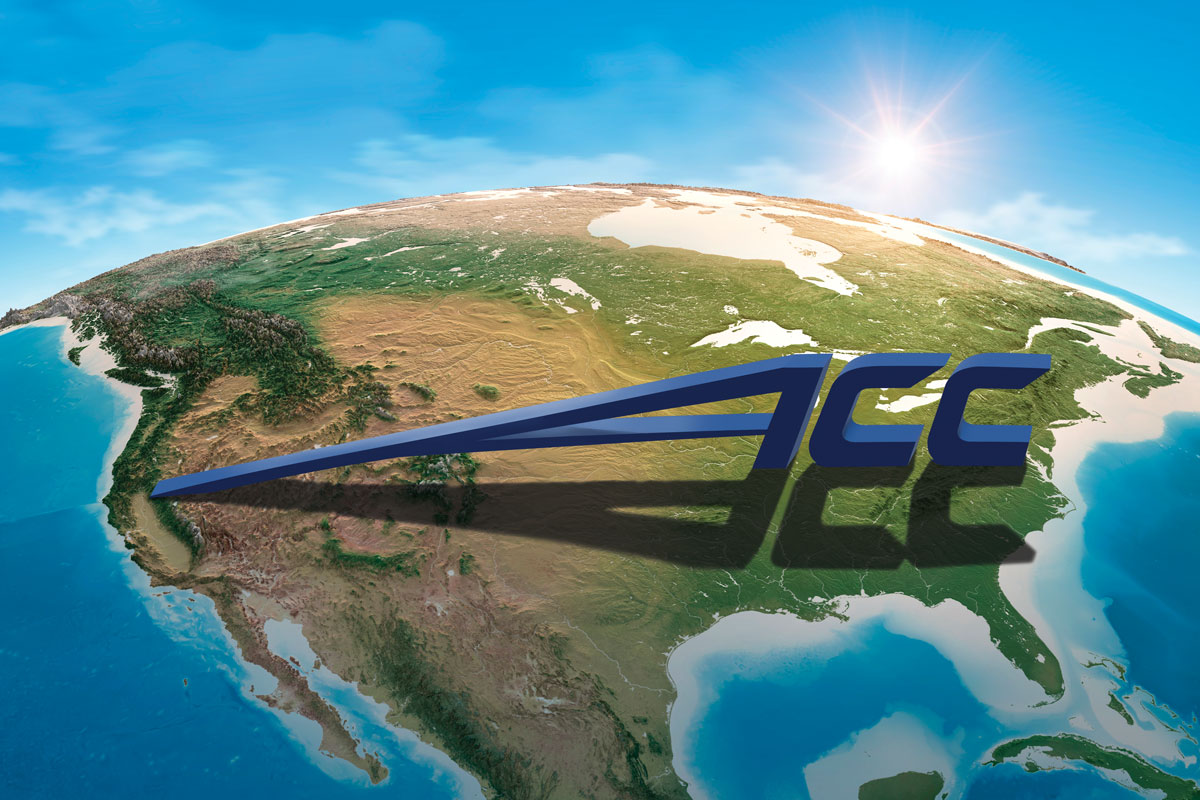
The Atlantic Coast Conference, founded in 1953 by seven regional rivals at the Sedgefield Inn, a 55-room Tudor-style inn on a golf course near Greensboro, North Carolina, is going bicoastal. Cal, Stanford and SMU will join next fall, completing a transcontinental expansion that takes the conference, already stretched by 20 years of realignment, even farther from its roots along North Carolina’s Tobacco Road.
The Big Ten, once confined to the Midwest, will soon sprawl from the mid-Atlantic to Southern California and the Pacific Northwest. The Big 12, rooted in the nation’s breadbasket, will range from Florida to Arizona.
For major conferences these days, bigger is better. Manifest Destiny, of a sort, is part of the mission.
“We’ve gone from regional-based conferences to national, coast-to-coast conferences,” ACC Commissioner Jim Phillips said after conference members voted Sept. 1 to add the three schools.
“Either you get busy, or you get left behind.”
It’s a contest of mergers and acquisitions as conferences chase market share and media revenue. After the latest round of strategic reshuffling, the ACC, home to Virginia athletics for 70 years, will have 17 football members (Notre Dame remains independent in that sport) and 18 total. It will be one of four megaconferences, along with the 18-member Big Ten, the 16-member Big 12 and the 16-member Southeastern Conference.
For members of the super-sized leagues, the pursuit of cash comes with costs: More travel time for student-athletes. The loss of traditional rivalries. The dilution of the regional identity and sectional pride that has long been a big part of the allure of college sports.
Still, there’s no going back. As if to emphasize the point, the ACC in September moved its headquarters from Greensboro, a little more than a mile from where the conference was founded, to Charlotte, the more cosmopolitan financial center.
The relocation, after 70 years, “kind of fits together with all the changing times in college sports and all the movement you see now,” Phillips said.
How did we get here?
The money flowing in from one sport is driving the disruption.
“Conference realignment for the past several decades has been driven pretty much solely by the football TV markets,” says Amy Privette Perko, CEO of the Knight Commission on Intercollegiate Athletics, an independent group focused on reform in college athletics. “Because 80 [percent] to 85 percent of conference media contracts are driven by football.”
The ACC kicked off an era of aggressive football-focused maneuvering in 2003, when it convinced three members of the Big East—Miami, Virginia Tech and Boston College—to jump leagues. The additions, which were completed in 2005, increased the ACC’s membership to 12, the minimum number needed to host a lucrative conference football championship game.
The SEC had shown the way by holding the first conference championship game in 1992. Other conferences with sufficient membership followed suit. The ACC came late to the dance, and the way it went about bolstering its membership—by raiding a rival league—drew criticism.
“They made a bad deal. They didnt look down the road and see the whole field.”
“It’s wrong,” then-Big East commissioner Mike Tranghese said at the time. He called the ACC’s actions “the most disastrous blow to college athletics in my lifetime.”
The ACC effectively finished off the Big East as a football conference when Syracuse and Pittsburgh switched leagues in 2013 and Louisville jumped in 2014. Soon after, the Big East’s basketball-only members split off from the league and got to take its name in the parting. The remaining football members reorganized as the American Athletic Conference. Notre Dame, along the way, switched its basketball affiliation from the Big East to the ACC, staying independent for football.
By then, the ACC had gotten a glimpse of the other side of the new era it helped create. Maryland, a charter member of the conference, left the ACC for the deeper-pocketed Big Ten, tossing aside decades of tradition to shore up a financially ailing athletic department.
“The Maryland move was a stunner,” says Gerald Starsia (Educ class of ’10), an associate professor in the School of Education and Human Development who teaches courses on college athletics administration and leadership. “They pay their exit fee, their penalty, and they are happy to do it because they are making many times more money.”
Maryland swapped the ACC’s $19 million annual payout for the Big Ten’s $37.7 million, a windfall that allowed it to pay off the $31.4 million exit penalty in less than two years.
Feeling vulnerable, the ACC responded by requiring members to sign an agreement granting their media rights and revenue to the conference, even if they should leave. This “Grant of Rights” was amended in 2016, when the ACC signed a 20-year deal with ESPN that remains in effect.
The Grant of Rights helped stabilize the ACC’s membership, but it also locked the league into a long-term media deal that is less lucrative than ones the Big Ten and SEC signed since.
“They made a bad deal,” Starsia says. “They didn’t look down the road and see the whole field.”
Phillips, who was not commissioner when the deal was made, conceded in May that: “I understand times change, and you adjust … so we’re figuring this out.”
Adding three new schools will bring in more TV money. Despite the additions, though, the ACC is projected to remain well behind the Big Ten and SEC in revenue and in what it pays out to members. According to IRS filings, the ACC took in $617 million in the 2021-22 season, compared with $845 million for the Big Ten and $802 million for the SEC. The ACC distributed an average of $39.4 million to its full members, compared with $58 million in the Big Ten and $49.9 million for the SEC.
When newly signed SEC and Big Ten deals kick in next year, the gap is expected to widen.
Media rights revenue does not account for all the money conferences distribute to members. Schools also receive shares from the NCAA men’s basketball tournament and post-season football. But media money is a significant portion of the distributions, which are a significant part of athletic budgets. At UVA, distributions accounted for $42 million of the $161 million the athletics department took in in 2022, according to the Knight-Newhouse College Athletics Database. From 2018 through 2022, they have averaged $34.2 million per year, 29 percent of UVA sports revenue.
The league’s top football brands, Clemson and Florida State, have expressed frustration with the ACC distributions compared with what the Big Ten and SEC pay out and with the way they’re allocated. They joined North Carolina in voting against adding new members, according to reports. The measure passed 12-3, the minimum needed.
The vote highlighted a fissure that bears watching, Starsia says.
“I think Clemson and Florida State would be gone tomorrow if they didn’t have the Grant of Rights,” he added.
No one has found a loophole in the deal, though not for lack of trying. Sports Illustrated reported in May that a group of seven ACC schools—including Virginia—had been meeting with lawyers to examine the document for possible outs. Asked about the report, a UVA Athletics spokesperson said the department had no comment.
Bringing in three new schools was partly a hedge against losing members, Starsia says. The fate of the Pac-12 illustrates the dangers of doing nothing. With the announced departures of 10 schools in the past 14 months—four each to the Big Ten and Big 12 and two to the ACC—as of October, Oregon State University and Washington State University were all that was left of the conference, putting its survival in doubt.
What’s next?
In the short term, the logistics of adding far-flung schools must be worked out for all of the ACC’s 28 sports. Though football drives realignment, thousands of other student-athletes will feel its effects.
In welcoming the new schools, UVA President James E. Ryan (Law class of ’92), chair of the ACC’s board of directors, praised the “tireless” efforts that went into minimizing travel burdens on student-athletes. A UVA Athletics spokesperson said a conference committee is studying the issue, seeking the best approach.
At a September press conference, Phillips previewed how travel would work. The initial burden would fall heaviest on the new West Coast members.
In football, current members would travel to the West Coast every other year. Cal and Stanford would come east three or four times per season. Major college football teams typically charter planes for trips.
In basketball, current members would travel west twice every four years. Stanford and Cal would come east three or four times a season and play at least two games each trip.
“Conference realignment for the past several decades has been driven pretty much solely by the football TV markets.”
In certain sports, such as soccer, field hockey and lacrosse, current members would go west once a year at the most, Phillips said. The West Coast schools would come east more often. Other sports such as track and field and swimming and diving, which compete in invitational events involving schools from multiple conferences, would be less affected. Baseball and softball teams would play series on weekends.
Still, there’s no denying a bigger geographic footprint means more travel. Stanford and UVA are 2,800 miles apart. Perko, of the Knight Commission, says the latest round of realignment should be a tipping point for those who run college athletics. They should examine whether the current conference structure, dictated by football, works for all sports.
“The Knight Commission view is that the structure is outdated,” she says. “There needs to be a more thoughtful approach in providing more flexibility in [conference] affiliations, and championship access for other sports.”
A Knight Commission report released in September projected that, over the next nine years, more than $1 billion in new and uncommitted revenue will flow to major college football teams from the expansion of the College Football Playoff and more lucrative media rights deals. If current practices hold, much of the windfall will go toward football coaches’ salaries, Perko says.
“In my personal view, that’s not a very good reason to grow,” she says. “Just generating more revenue does not produce better student-athlete experiences, or frankly, winning.”
Starsia says the Big Ten and the SEC already constitute a “power two” structure, and the leverage of the ACC and Big 12 will only weaken over time.
“There are going to be two conferences led by massive football machines and then there will be the other two conferences that will be a more balanced kind of league, with Olympic sports, less concentration in football,” he says.
Schools will have to make philosophical choices about which side they want to be on, he says.