A Presidency Abbreviated
Against a backdrop of crises, Ryan had his share of wins and controversies
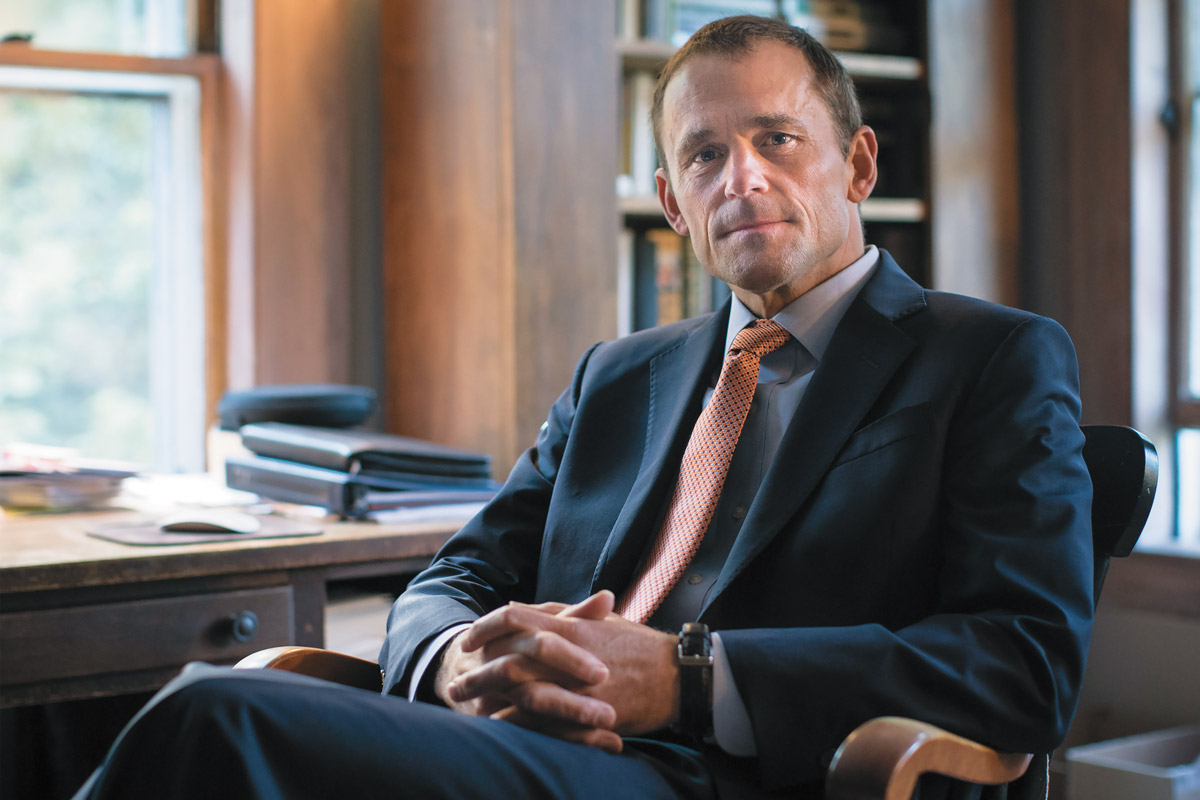
At three weeks shy of seven years, the presidency of Jim Ryan (Law class of ’92) was the second shortest in UVA history. Only Robert O’Neil, who led UVA from 1985 to 1990, had a shorter term.
Length is just one measure of a presidency, however. Ryan’s tenure, which ended with his resignation July 11, was notable not just for what he was able to accomplish in a relatively short time, but for the historically trying conditions under which he operated, said several UVA officials who worked with him closely.
“It was an incredibly consequential seven years,” said Ian Baucom, who served as dean of the College and Graduate School of Arts & Sciences and then as UVA’s provost before becoming president of Middlebury College in July.
Ryan’s presidency was one of sweeping ambition. His “Great and Good” strategic plan, adopted in 2019, called for nothing less than making UVA the best public university by 2030.
Though Ryan left just over halfway through the plan’s 10-year timeline, several of the key initiatives were underway. Its physical imprint can be seen in the emergence of the Emmet-Ivy corridor, which is home to the new School of Data Science and the future site of a hotel and conference center and the Karsh Institute of Democracy, both now under construction. UVA also built the Contemplative Commons and the Hardie Football Operations Center and completed a major overhaul of Shannon Library.
The university raised $6 billion in its “Honor the Future” capital campaign, launched biotechnology and democracy institutes, saw annual research awards surpass $500 million, and saw increases in the number of first-generation students and in the graduation rate of Pell Grant recipients. It implemented a $15 minimum wage for employees and launched the Center for Community Partnerships, both toward Ryan’s goal of being a better neighbor to the surrounding region.
“His emotional accessibility and his ability and willingness to feel alongside the community I think was highly unusual and extraordinary and astonishing.”
In addition, Ryan served—including as chair of the ACC’s board of directors—during a time of unprecedented change in college athletics.
“My view is simple,” said John C. Jeffries Jr. (Law class of ’73), a former dean of UVA’s law school who had served on the search committee that recommended Ryan and then as an adviser to him. “I’ve been here 50 years and I think he’s the best president of the university I’ve ever seen.
“I say that with appropriate deference to John Casteen (Col class of ’65, Grad class of ’66, class of ’70), who I also admire, but Jim was able to do pretty much what John did in a lot less time.”
Ryan strove to move UVA forward while also steering it through the aftermath of the deadly white supremacist Unite the Right rally of Aug. 11-12, 2017, guiding the university through a pandemic and the collective trauma of the fatal shooting of three football players in November 2022. He also served during a time when federal officials sought more control over colleges and universities.
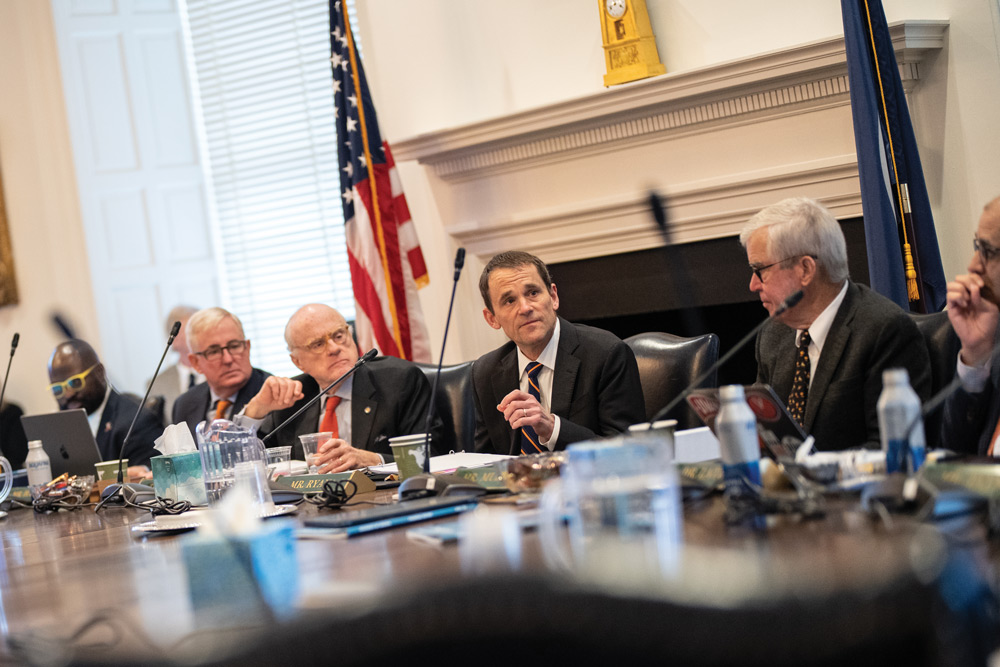
“As president he had to help our community do a lot of healing,” said Risa Goluboff, who served as dean of UVA’s law school from 2016 to 2024 before returning to the faculty, as well as serving as chair of the Deans Working Group that led UVA’s response to the events of August 2017.
Just 10 days into his presidency, on the one-year anniversary of the Unite the Right rally, Ryan gave a speech in which he thanked students who stood up to white supremacists at the statue of Thomas Jefferson near the Rotunda, calling it a “remarkable moment of courage and bravery.”
Ryan also apologized to those injured by the white supremacists for “mistakes we have made.”
Goluboff called it “an incredibly healing moment.”
“His emotional accessibility and his ability and willingness to feel alongside the community I think was highly unusual and extraordinary and astonishing,” she said.
“It was fairly continuous crisis management. What’s amazing is there aren’t that many people who are visionary and forward thinking and able to manage a crisis.”
Ryan threaded that needle with the help of personal qualities that drew widespread praise, particularly his warmth, modesty, humanity, and ability to connect with students and staff.
“You never felt like he lost sight of you as an individual person,” Baucom said. “I think that was core to his leadership style. He was strategic, there was a strategic plan. All of it rested on a series of values, on principles. And I think they emanated from him as a person.”
Matt Weber (Educ class of ’25), a senior Ryan adviser, recalled a whirlwind trip to London in the fall of 2022 that left staff members drained and weary as they waited for a flight home. On the plane, Ryan gave up his business-class seat to a staffer as thanks for their hard work. Ryan sat in the second to last row, Weber wrote in one of a series of posts on LinkedIn remembering moments from Ryan’s presidency.
“When I think about the kind of leader that inspires and sacrifices and gives and shares, and is fun and thoughtful and spontaneous and generous to his staff and the world and trades lie-flat seat 2B for…. seat 55E — I think of Jim Ryan,” Weber wrote.
Ryan led students on “Run with Jim” morning jogs, with several hundred, on average, turning out each week, Weber wrote. Ryan opened Carr’s Hill to students and said yes to requests ranging from wearing moose antlers to posing in a banana costume, he wrote.
“He didn’t seem like this guy you only saw through emails or press releases or videos the university posted,” said Lillian Rojas (Batten class of ’24), who served as student representative on the Board of Visitors. “He was always around, and I feel that most students who went to UVA during his time here would agree.”
Others who worked with Ryan lauded his willingness to listen.
Margaret Grundy Noland (Col class of ’06, Darden class of ’15), who served as his chief of staff, recalled a meeting with student leaders in 2022 shortly after then-student Christopher Darnell Jones Jr. fatally shot football players Devin Chandler (Col class of ’24), Lavel Davis Jr. (Col class of ’24) and D’Sean Perry (Col class of ’23). A first-year student Ryan had taught in a seminar pulled him aside and stressed that students needed clarity on when classes would resume, rather than daily updates, Noland said.
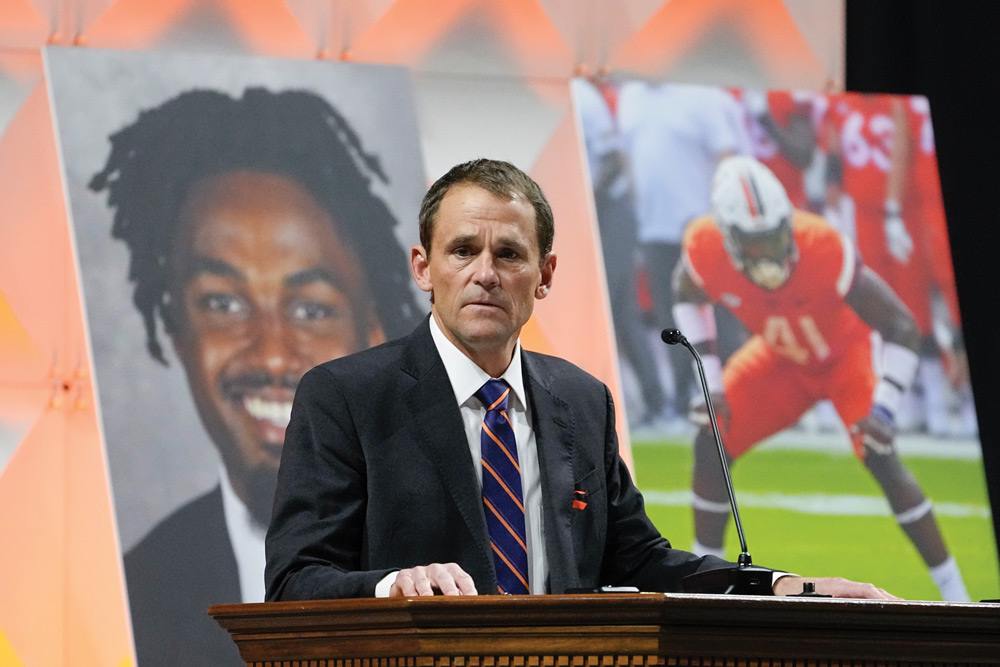
“Jim said, ‘Good point,’” and tasked Baucom with formulating a plan, Noland said.
“It was an example of his commitment to doing the right thing and trying to create conditions where people could thrive,” she said.
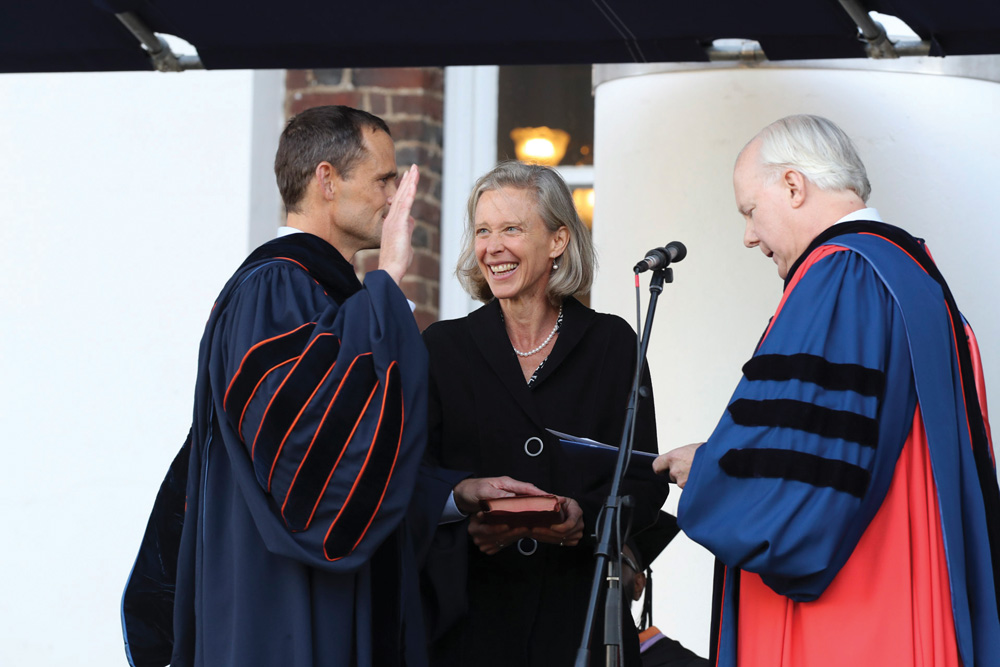
Ryan, 58, professed an abiding love for UVA during his inaugural address, “Faith in the Unfinished Project,” on Oct. 19, 2018. He likened the sense of responsibility he felt toward the university, where he had spent a total of 18 years as a law student and faculty member before returning as president, to the responsibility a parent feels toward a child.
Ryan provided an outline of his vision for UVA in his inaugural speech. Flesh went on the bones in the “Great and Good” plan adopted 10 months later, in August 2019.
At the heart of the plan were new, major efforts by the university in financial aid, student housing, research, faculty and staff recruitment and retention, community engagement, the establishment of a School of Data Science, and a new “Open Grounds” gateway to the university at Emmet-Ivy.
Such big plans required raising an unprecedented amount of money. While still at Harvard, Ryan met with Mark Luellen, UVA’s senior vice president for external relations; Jeffries, who was then senior vice president for advancement; and Peter Grant (Col class of ’78, Darden class of ’86), who would chair the campaign.
Luellen said a consultant suggested that UVA should set a goal no higher than $3 billion. The university did its own analysis and thought it could raise $4.5 billion.
“He said, ‘Let’s go for 5,’” Luellen recalled.
UVA hit that goal 18 months ahead of schedule and ended the campaign June 30 having raised more than $6 billion. Luellen credited Ryan with being “omnipresent” throughout the six-year effort.
Said Jeffries: “That money was raised primarily by him, either personally, in some very large donor categories, but also secondarily in the way he inspired people’s affection and generosity.”
The campaign supported initiatives to endow scholarships and professorships, through the Bicentennial Scholars Fund and the Bicentennial Professors Fund. The former endowed more than 750 new scholarships, the latter nearly 140 new professorships.
Expanding access to the university for all students, regardless of their ability to pay, was one of Ryan’s top priorities. UVA covers tuition, fees, and room and board for in-state undergraduates with family incomes of less than $50,000. It covers tuition and fees for in-state undergraduates with family incomes of less than $100,000.
During Ryan’s tenure, The Princeton Review ranked UVA the No. 1 school for financial aid for four years in a row, from 2021 to 2024. It ranked UVA the No. 2 best value public university in 2025. UVA in 2024 also had the highest Pell Grant recipient graduation rate among public universities ranked in the top five overall by U.S. News & World Report.
Ryan’s presidency also saw a jump in the number of first-generation undergraduate students, from 1,830 or 10.9 percent of total enrollment in 2018 to 3,030 or 16.9 percent in 2024. Ryan himself was a first-generation student.
Ryan was mulling the offer to become UVA’s ninth president when white supremacists marched on the Lawn and in downtown Charlottesville during the Unite the Right rally in August 2017. He decided to take the job not despite the rally, but because of it, he said in a 2020 interview with The Washington Post.
Ryan spoke of the idea of running toward a crisis as first responders do. He could not have anticipated the scale or severity of the crises he would be running toward in his new job.
Ryan had been in office about 19 months when the COVID-19 pandemic brought university life to a halt. Grounds locked down the same day the World Health Organization declared a pandemic. UVA put more than 4,000 classes online in eight days.
The next six months “felt like five years,” Ryan told the Post, as UVA prepared to reopen for the fall 2020 semester. The uncertainty surrounding the virus left no clear road map for action.
“I was in the room when that was a current issue,” Jeffries said. “It’s just hard to describe how many decisions had to be made right now on inadequate information.”
Noland, Ryan’s chief of staff, cited the decision to bring back students in the fall of 2020.
“I’ve been here 50 years and I think he’s the best president of the university I’ve ever seen.”
“Plenty of people were pleased with that decision, but there were many who were not (and believe me, we heard from them!),” Noland wrote in an email.
“Ultimately, Jim and the rest of the leadership team felt it was the right thing to do, especially for our students, who only had one chance to experience their UVA education.”
UVA reopened in a hybrid virtual/in-person capacity, the start date pushed back two weeks to shore up testing, study the lessons of other universities, and add quarantine and isolation space. The 2020-21 year was a juggling act requiring frequent tweaking of regulations around masking, distancing and gathering as case numbers rose and fell.
Ryan acted on the advice of medical experts but had to make the final calls. He said in February 2021 that the challenge was to find a balance between “freedom and trust on the one hand and complete control on the other.”
The next year, the murder of three students on Grounds traumatized the community and left unanswered questions. The shooter also wounded students Michael Hollins Jr. (Col class of ’22, Educ class of ’24) and Marlee Morgan (Com class of ’25).
Baucom said Ryan’s leadership was crucial in pulling the community together.
“The whole community acted in grief and in compassion,” Baucom said. “It was everybody, and Jim was at the heart of it.”
Ryan made the initial announcement of the murders at 4 a.m. Nov. 14. In an update two days later, he appealed to the community to draw strength from its bonds with one another, which he said “are more real and powerful than our perceived differences.”
“Jim was very steady throughout,” Noland said, “as someone who was operating on a lot of different levels, as someone whose heart was broken, and also as a person who needed to just on a very practical level marshal the resources of the university to make sure we were providing the support we needed.”
Days after the shooting, Ryan and then-Rector Whittington W. Clement (Col class of ’70, Law class of ’74) asked Virginia Attorney General Jason S. Miyares to appoint special counsel to review what happened before and after the shooting. Two law firms completed reports in October 2023, and UVA initially said they could be released the following month. The university then announced that it would delay the release, first citing attorney-client privilege and then concerns about the impact it could have on the criminal trial.
Though Jones pleaded guilty in November 2024, UVA did not release the heavily redacted report until March 2025. Through an attorney, the families of Perry and Hollins said the long wait for the report caused additional pain and suffering. Ryan acknowledged that the report, the unredacted portions of which shed little light on the events that led up to the shooting, could not provide adequate closure.
“Although I hope this update brings a measure of solace, I know that this information will not provide answers to all of your questions, nor does it answer all of mine,” he said in a statement accompanying the reports.
Ryan also faced criticism for his handling of two other high-profile controversies: a letter anonymously signed by more than 100 UVA Health faculty members expressing no confidence in CEO Craig Kent and medical school Dean Melina Kibbe, and the university’s forceful removal in May 2024 of students engaged in a pro-Palestinian protest.
The letter, sent in September 2024, accused Kent and Kibbe of encouraging doctors to overbill patients and of creating a culture of fear and intimidation. Ryan said it offered many accusations and few details and “unfairly—and I trust unwittingly—cast a shadow over the great work of the entire health system and medical school.”
After Kent’s resignation in the wake of an independent investigation of the allegations, Ryan apologized for his initial response, which he said was “intemperate and disrespectful.”
Ryan was also criticized for the forceful way in which UVA cleared student protesters who set up tents near the University Chapel in May 2024 in opposition to the war in Gaza. Police in riot gear used pepper spray to roust and remove about 45 people after nearly four days of peaceful protests. More than 25 protesters were arrested.
Virginia state Sen. Creigh Deeds was among those who questioned the way the encampment was cleared. “People have a right to protest,” he said. “I’m not sure what change provoked this sort of response by the police. Violence is unnecessary.” Faculty members also faulted UVA’s response.
Ryan said at a town hall three days after the incident that he realized he had lost some trust from the community.
“At the same time, I have an obligation as a president to make decisions that I think are in the best interest of the entire community, not one segment of it,” he said.
Ryan weathered those controversies but was ultimately swept out by the rising conservative backlash against diversity, equity and inclusion.
Ryan made diversifying UVA’s student body, faculty and staff a priority in his Great and Good plan. Though he was a proponent of DEI initiatives, he said universities should not shy away from “honest critiques” of them.
In an op-ed published in The Chronicle of Higher Education in May 2023, Ryan defended DEI as promoting equal opportunities, not equal outcomes, and said it was key to “attracting and retaining the most talented people, creating a vibrant campus culture, and promoting a richer and more robust exchange of ideas.” He also conceded that DEI statements and training could run the risk of seeming “coercive.”
How much more diverse by race or gender did UVA’s student body and faculty become during Ryan’s tenure? The picture is mixed.
Among students, those who identify as Asian American made the biggest gains, going from 14.2 percent of the total undergraduate enrollment in the fall of 2018 to 19.7 percent in the fall of 2024, according to UVA’s office of institutional research.
The percentage of Black undergraduate students grew modestly, from 6.7 percent to 7.5 percent. Enrollment of Hispanic students increased from 6.4 percent to 7.8 percent.
Compared with Virginia’s four-year public universities as a whole, however, UVA had both smaller proportions and slower rates of growth of students who were Black or Hispanic, according to data from the Virginia State Council of Higher Education. Statewide, the proportion of Black students grew between 2018 and 2024 by 14.5 percent, compared with 11.8 percent at UVA. For Hispanic students, the proportion grew 28.2 percent statewide, compared with 22.0 percent at UVA. In 2024, Black students made up 16.7 percent of state undergraduate enrollment overall and Hispanic students 10.7 percent.
The proportion of UVA students who identify with more than one race grew from 4.6 percent to 5.8 percent, growing slightly faster than at schools statewide but ending up at the same percentage.
White students fell from 57.2 percent of UVA undergraduate enrollment in the fall of 2018 to 48.8 percent in 2024. While the rate of decrease was higher than the rate statewide—14.8 percent compared with 11.4 percent—the proportion of white students has been consistently higher at UVA than at schools throughout the state, which had 47.4 percent white students in 2024.
UVA had both a higher percentage of Asian American students than the state as a whole in 2024—at 19.7 percent compared with 11.9 percent—as well as a faster rate of growth for the past seven years.
“It was the honor of my life to work beside and learn from you.”
At UVA, Asian Americans also made the largest percentage-point gains—though still small—among total faculty during Ryan’s tenure. The group accounted for 12.8 percent of all faculty in 2024, compared with 10.5 percent in 2018. The percentage of Black faculty rose from 3.9 percent to 4.8 percent. Hispanic faculty went from 2.5 percent to 3.0 percent, and the number of international faculty rose from 4.6 percent to 6 percent.
The percentage of faculty who are white fell from 77.3 percent to 68.7 percent. Women increased from 40.4 percent to 44.4 percent. Female students also made gains, increasing from 54.9 percent of undergraduate enrollment in 2018 to 56.2 percent in 2024.
When announcing his resignation, Ryan said that he had already planned to leave after the 2025-26 academic year. His contract ran through July 31, 2028, which would have given him 10 years in office. That’s a long time in the pressurized environment now faced by university presidents, Jeffries said.
“Being a university president is orders of magnitude more difficult today than was true 20 years ago,” he said. “And that’s not just true at Virginia. That’s true everywhere. You can see it throughout the country. Universities are under attack today.”
Ryan, who through a staff member did not respond to an interview request for this story, plans to join the law school faculty after taking a sabbatical. He said in his farewell address that he will have more to say about the challenges faced by higher education, and UVA, at a later time. He focused instead on thanking the university community.
“It was the honor of my life to work beside and learn from you,” he said.